Get Full Government Meeting Transcripts, Videos, & Alerts Forever!
Get email alerts on the Corrections Operations topic
No spam. Unsubscribe anytime.
Michigan Department of Corrections details operations, prison trends and parole process to House Judiciary Committee
Summary
Kyle Kaminski of the Michigan Department of Corrections briefed the House Judiciary Committee on MDOC operations, staffing challenges, prison population trends and how the state parole process works, including victim notification and parole guidelines.
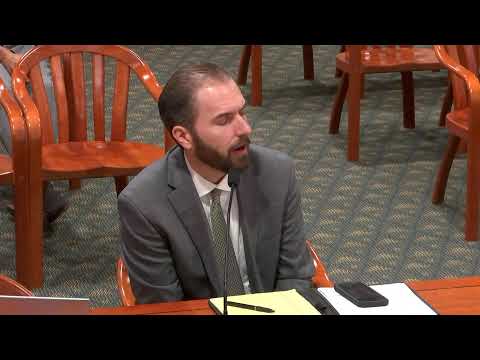
Kyle Kaminski, OS administrator and legislative liaison for the Michigan Department of Corrections, told the Michigan House Judiciary Committee that the department’s “primary focus is public safety” and laid out how the agency pursues that goal through prison operations, community supervision and reentry programming.
Kaminski briefed committee members on the department’s scale and budget, staffing and recruitment trends, recent prison population history, and how the state parole board makes decisions. "We touch every county of the state," he said, noting the MDOC operates 26 prisons and more than 100 field offices. Kaminski said the department has about 11,000 employees, roughly half in direct custody roles, and a total annual budget “slightly over $2,000,000,000.” He said staffing consumes more than 72% of MDOC spending.
The department reported current counts of about 32,000 people incarcerated in state prisons, roughly 32,000 on felony probation and about 9,000 on parole — a daily total the MDOC describes as more than 70,000 Michigan residents under its jurisdiction. Kaminski said state prison population peaked at roughly 51,000 in the mid-2000s and now is about 32,500, a level similar to 1991 that has been relatively stable for the last several years.
Kaminski described long-term trends the committee asked about. Felony dispositions statewide have declined over the past two decades, he said, and only about 20% of felony dispositions now result in a prison sentence. The department’s five-year projection showed stability to a slight decline in the prison population under current sentencing and supervision practices. Kaminski also said the average minimum sentence for people entering prison has risen — from just under 42 months in 2004 to more than 61 months for the most recent intake cohort.
On parole, Kaminski outlined how the Parole Board operates under the corrections code and statutory rules. The state uses parole guidelines to classify cases into low, average or high probability of parole; the guidelines “stratify” cases but do not decide outcomes, he said. The Parole Board is a 10-member panel appointed by the MDOC director; most routine parole decisions are decided by a three-member panel, while life-sentence cases require six votes. Kaminski said the state’s parole approval rate has risen from about 50% historically to roughly 68%, though the absolute number of people paroled each year has fallen because the overall prison population is lower.
Kaminski described victim-notification and victim-engagement procedures: registered victims receive notice when a case is eligible and can submit materials or request an interview; those materials are kept confidential from the person under consideration in most cases. He explained the board considers both aggravating and mitigating factors and may place conditions on parole such as no-contact orders or special programming.
Committee members pressed MDOC on staffing and recruitment. Kaminski said the department has about 875 corrections-officer vacancies against a fully staffed complement of roughly 5,200–5,500 custody positions. He described recent increases in academy class sizes, regional variance in vacancies (notably the Upper Peninsula and Jackson area), and retention challenges for early-career officers. Kaminski said MDOC and its union have negotiated pay changes and compressed step progression: starting pay will be $23.45 per hour as of Oct. 1, and a new top step at 54 months will pay $35.22 an hour (about $73,000 a year before overtime).
On outcomes, Kaminski told the committee Michigan’s three-year recidivism rate has fallen from about 45% to 22.7% over two decades. He said the state has adopted evidence-based supervision and programming in prisons and the community and that other states visit Michigan to study its approach.
Kaminski closed by inviting committee members to visit MDOC facilities, field offices or to observe parole interviews in Lansing.
This briefing was discussion and information only; no formal action or vote followed the presentation.