Get Full Government Meeting Transcripts, Videos, & Alerts Forever!
Get email alerts on the Animal Shelter Funding topic
No spam. Unsubscribe anytime.
Residents press council to increase animal shelter funding, call out breed-specific restrictions
Summary
Multiple volunteers and shelter advocates told the council the county's proposed FY26 budget reduces animal services spending and described staffing, medical-supply and disease-control shortfalls at the county shelter; several speakers linked adoption barriers to the county's breed-specific rules.
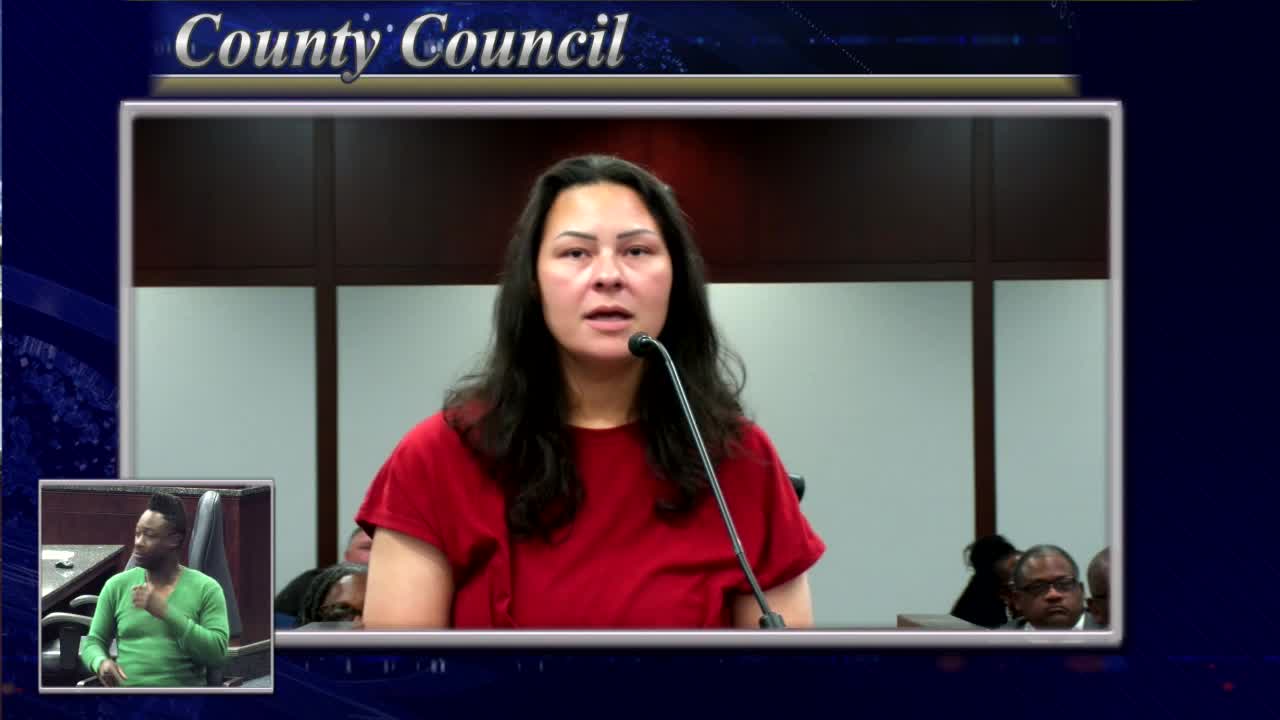
Residents and volunteers told the Prince George's County Council on April 28 that the county animal shelter is underfunded, understaffed and struggling with disease control and high turnover.
At the public hearing on the proposed FY26 operating budget, several speakers described deteriorating conditions and asked the council to restore or increase funding for animal services. Leah Schuler, a District 4 homeowner and volunteer, said inadequate funding has led to shortages of medical supplies, cleaning materials and staffing that affect animal care. “The underfunding has a significant impact on staffing levels and medical needs and supplies provided to the animals residing at the facility,” she said.
Julie Marks, who said she volunteers at the shelter and lives in Greenbelt, told the council the FY26 budget proposal includes “a decrease in expenditures for animal services totaling, minus 6.2%,” which she said reflects reassignment of an associate director position. Marks raised imminent adoption or euthanasia deadlines, saying 40 dogs faced a deadline the next day; she said only two of those 40 were spayed or neutered and that 24 of the 40 were listed as terrier mixes. Marks and other speakers linked the county’s breed-specific restrictions (often described in testimony as a “pit bull” designation or ban) to longer shelter stays and lower adoption rates for animals labeled as terrier or pit-bull mixes.
Volunteer Amy Progoski said the shelter’s physical conditions contribute to illness among animals and deter adopters: she asked the council to publicize new shelter hours and to approve funding for HVAC and drain repairs, pest control and additional fenced play yards. “Poor air quality is dangerous for the animals and of course the staff volunteers and the public,” she said; she also asked that the council approve a full-time veterinarian (a personnel action that Progoski said needs council approval).
Multiple witnesses urged the council to adopt nonlethal programs to address animal overpopulation, including trap-neuter-return, low-cost spay/neuter programs, and to reconsider policies that restrict in-county adoptions for dogs labeled as pit-bull or terrier mixes.
Speakers framed these requests as both humane and fiscal: longer shelter stays and higher illness rates increase operating costs, volunteers said. Council members did not vote during the hearing; the testimony will be included in the FY26 budget record.
Provenance: animal-shelter testimony opens with Leah Schuler (transcript timecode ~00:13:51) and continues through multiple volunteers including Julie Marks and Amy Progoski (transcript timecodes ~00:13:51–01:46:28).