Get Full Government Meeting Transcripts, Videos, & Alerts Forever!
Get email alerts on the Transportation Policy topic
No spam. Unsubscribe anytime.
Minnesota House approves transportation omnibus after fights over greenhouse-gas rule, EV fees and transit cuts
Summary
The Minnesota House passed House File 2438, a transportation omnibus bill that reallocates transportation funds amid a projected state deficit, funds regional projects and postpones full implementation of a greenhouse‑gas/VMT mitigation requirement after intense floor debate and several failed and adopted amendments.
The Minnesota House passed House File 2438, the transportation omnibus bill, on a vote of 85-49 after several hours of debate that featured clashes over a greenhouse‑gas/vehicle‑miles‑traveled mitigation law, electric‑vehicle registration surcharges and funding for Greater Minnesota transit.
Representative Kosnick, the bill's author, said the package “makes our transportation system smarter, safer and more sustainable” and described a mix of reallocations and targeted investments that the majority framed as fiscally responsible amid a large state deficit. Kosnick said the bill holds general‑fund spending steady while reprioritizing other transportation funds to “redirect savings toward road construction, maintenance and common‑sense transportation programs.”
Why it matters: HF 2438 directs funding for roads, bridges and transit and changes how the state will phase in a 2023 law that requires greenhouse‑gas and vehicle‑miles‑traveled (VMT) assessments for large projects. Supporters said the bill protects ready‑to‑build projects and eases pressure on the capital investment (bonding) committee; opponents said it weakens Minnesota’s climate commitments and shifts costs to future taxpayers.
Major provisions and money cited on the floor included a noted appropriation of about $650,000,000 to the Blatnik Bridge, roughly $30,000,000 one‑time for the Corridors of Commerce program, a $50,000,000 resilient pavement program, regional transit capital bonds “over a hundred million dollars” for MET Council transit, and funding for a replacement air‑traffic control tower at Duluth. Kosnick also said the bill includes reallocated funds that reduce pressure on the bonding capacity by “over a hundred million dollars.”
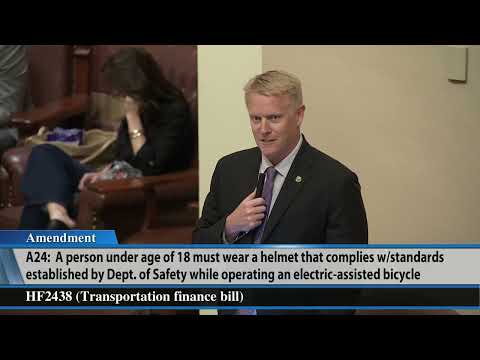
Key floor actions and amendments - A31 (moved by Representative Hansen R.) changed the funding source and reduced an appropriation for the Washington Avenue Bridge project from $15,000,000 to $9,000,000; sponsors said the bridge has been a “magnet” for suicides and the amendment was adopted by voice vote. - A24 (Representative Myers) would have required helmets for riders under 18 on electric bicycles; Myers withdrew the amendment after describing the safety intent but noting disagreement on the floor. - A22 and A26 (both moved by Representative Kraft) sought to remove a multi‑year delay in implementing the 2023 greenhouse‑gas/VMT law. Kraft described the law as grounded in studies of induced demand and framed the amendment as restoring a tool to reduce vehicle miles traveled and emissions; both amendments failed on roll calls that ended tied, 67 ayes and 67 nays, and thus were not adopted. - A38 (Representative Jones) would have restored additional funding to Greater Minnesota transit; the amendment failed on a roll call, 65 ayes to 68 nays.
Debate highlights Proponents of keeping the greenhouse‑gas mitigation law in force immediately said it helps planners avoid projects that induce driving and increases long‑term savings and safety. Representative Kraft argued the law would reduce vehicle miles traveled and cited studies and MnDOT testimony about potential life‑safety and fiscal benefits. Representative Jones and other rural proponents framed transit funding as essential for seniors, workers and rural mobility, arguing cuts would reduce access to jobs, medical appointments and groceries.
Opponents warned the mitigation requirements were not yet ready to implement and could raise project costs. Representative Olson and Representative Kosnick urged a delay to allow technical guidance development, coordination across jurisdictions and clarity about who pays for offsets; Kosnick noted MnDOT estimated mitigation could increase costs by 5–30 percent and stakeholders warned it might be higher for some projects.
Electric‑vehicle fee debate Representative Kraft pressed to reduce a proposed EV registration surcharge — citing current $75 fees and presenting calculations comparing annual gas‑tax contributions — and offered an amendment to set the surcharge at $100 instead of $200; that amendment failed on a roll call (67‑67). Opponents argued EV drivers currently pay higher upfront sales taxes and that user fees should fund road wear.
Votes at a glance - Amendment A31 (Washington Avenue Bridge funding reallocation): adopted (voice vote; mover: Hansen R.). - Amendment A24 (e‑bike helmet mandate, under 18): withdrawn by mover (Myers). - Amendment A22 (remove delay to GHG/VMT law): failed (67 ayes, 67 nays; mover: Kraft). - Amendment A26 (similar GHG/VMT amendment): failed (67 ayes, 67 nays; mover: Kraft). - Amendment A38 (restore Greater Minnesota transit funding): failed (65 ayes, 68 nays; mover: Jones). - Final passage of House File 2438, as amended: passed, 85 ayes, 49 nays.
Process and caveats The House debate repeatedly referenced a projected state deficit and the need to reallocate non‑general‑fund transportation dollars rather than add new general‑fund spending. Sponsors emphasized that many appropriations are to “construction‑ready” projects to relieve bonding pressure. Opponents repeatedly urged caution about implementing mitigation offsets without finalized technical guidance from MnDOT and the technical advisory committee.
The bill text as amended struck and replaced the February 1 implementation date for parts of the 2023 law with a later date noted on the floor (the floor exchange described inserting August 1, 2028 for implementation). Kosnick described that change as intended to allow additional time for stakeholders to finalize mitigation guidance.
The bill passed the House as amended; the clerk recorded the final vote as 85 ayes and 49 nays and the bill’s title was agreed to on the House floor.