Get Full Government Meeting Transcripts, Videos, & Alerts Forever!
Get email alerts on the Code Enforcement topic
No spam. Unsubscribe anytime.
City of Miami code board grants a mix of mitigations and extensions across its calendar; several fines reduced or reset
Summary
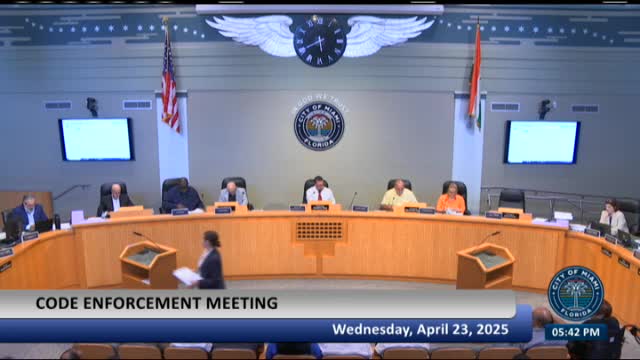
At a lengthy Code Enforcement Board meeting, members approved motions to vacate at least one improperly heard order, granted extensions of time for multiple repair and permitting efforts, and reduced or set mitigation amounts on dozens of older liens and nuisance cases.
The City of Miami Code Enforcement Board spent its calendar hearing dozens of extension and mitigation requests across property cases ranging from nuisance abatement tied to alleged drug activity to requests to reduce long-running fines and to allow time for building permits and unsafe-structure corrections.
The board handled two categories of business: nuisance-abatement matters presented by city staff (including the matter at 1721 NW 55th Street described separately) and a long mitigation/extension docket where property owners, their attorneys or representatives asked for reduced fines or more time to bring properties into compliance. The city’s attorneys and multiple outside counsel and permit consultants addressed the board in support of specific requests. Board members asked clarifying questions about who was living at properties, when compliance occurred and whether liens were recorded.
Votes at a glance - 515 Northeast 80th Street (Multi 515, LLC) — Board agreed with the city to vacate a previous finding entered in absentia and to return the matter for hearing; motion to vacate carried unanimously. (City counsel: Jamie Meyer.) - 631 Northeast 60th Street (duplex; estate/trust) — Board declined a unanimous reduction to zero (unanimity required); instead the board imposed a $1,000 mitigation for the tree permit violation. (Mover: board member; motion passed by majority roll call.) - 1596 Southwest 14th Street (duplex/homestead dispute) — After mitigation discussion, board reduced outstanding liability from the larger lien to $1,000. - 458 Northwest 7th Street / several commercial parcels held by the same owner — The board approved mitigation amounts after negotiations; one commercial property with a $61,000 running lien was reduced to $12,200 (20% floor) and similar reductions to $15,000 were approved on other commercial CU-related liens (Sea Spice restaurant at 422 NW North River Drive reduced to $15,000 after the owner demonstrated lapse was a paperwork/notice problem). - Multiple vacant-lot and long-running cases — The board repeatedly used the statutory “floor” mitigation levels for vacant land cases and approved $7,500 mitigations in several matters where the city and property representatives showed the lots had been brought into compliance. - Several owners with long-running COVID-era compliance issues (multiple CityView dockets) — The board granted a mix of 60-, 90- and 120-day extensions where applicants showed permits were in review or unsafe-structure holds were being processed (examples: 2742 SW 8th Street reset 120 days; 3135 SW 14th Street reset 90 days; other downtown and Wynwood redevelopment permits given 60–180 day extensions as staff recommended).
How the board decided Decisions fell into three patterns: (1) procedural remedies where the city asked the board to vacate orders that had been heard improperly (granted in at least one case), (2) mitigation reductions to the minimums allowed by the municipal mitigation matrix (many vacant-lot and commercial cases) and (3) calendar extensions to allow permit processing and unsafe-structure corrections (typically 60–180 days). The board repeatedly emphasized that mitigation floors are constrained by the code matrix and that unanimous votes are required only when a zero mitigation is requested for certain property types.
Notable procedural and informational points - The board stressed the difference between an administrative nuisance finding (property-focused) and criminal charges; criminal arrests and prosecutions noted during testimony do not automatically alter the board’s administrative remedies. - Several property representatives said they missed notices during the pandemic or had notices directed to previous owners; the board accepted some of those explanations but also enforced matrix floors where appropriate. - The board frequently required owners to meet with the Neighborhood Resource Officer (NRO) and to submit treasurer/trespass affidavits, lighting plans, signage and tenant rosters as conditions of mitigation or to avoid further enforcement.
What’s next Most matters were continued for compliance review on dates set by staff (typical resets: 30, 60, 90 or 120 days depending on the case). Where mitigation amounts were approved, the board’s orders will be drafted by staff and mailed to parties; several decisions are potentially appealable to the circuit court, and the board noted that parties retain that right.
Because the calendar was large and many docket items were procedural or involved standard mitigations, the board clerk will issue orders specifying compliance deadlines and any fines due; parties were advised to follow up with the clerk if they do not receive the written order.