Get Full Government Meeting Transcripts, Videos, & Alerts Forever!
Get email alerts on the K12 Education Budget Enrollment topic
No spam. Unsubscribe anytime.
Sierra Vista Unified superintendent outlines $4.15 million gap, proposes middle‑school restructure and two elementary closures
Summary
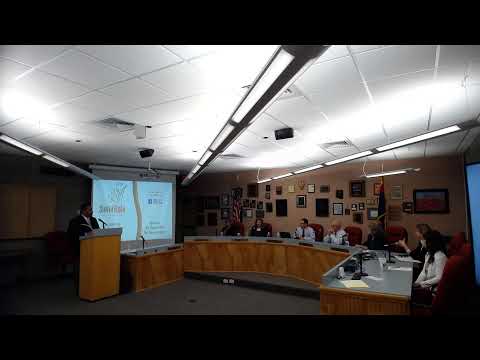
Sierra Vista Unified School District Superintendent Dr. Eric Holmes told the governing board at a work session that the district faces a roughly $4 million budget shortfall for 2025–26 driven primarily by falling enrollment and the end of pandemic‑era federal funding, and outlined short‑ and longer‑term steps the administration recommends to balance next year’s budget.
Sierra Vista Unified School District Superintendent Dr. Eric Holmes told the governing board at a work session that the district faces a roughly $4 million budget shortfall for 2025–26 driven primarily by falling enrollment and the end of pandemic-era federal funding, and outlined short‑ and longer‑term steps the administration recommends to balance next year’s budget.
Holmes said the district has lost about 1,500 to 1,600 students since 2019 and 310 students this year, reductions that decrease the district’s average daily membership (ADM) and the state funding tied to it. "You cannot have a premier school district unless you're willing to pay for it," Holmes said, summarizing the link between enrollment, ADM and revenue.
The administration presented a package of measures designed to cover the current deficit and reduce structural shortfalls for 2026–27. Holmes said the district has identified approximately $4,151,872 in total savings and funding‑source moves that would cover the existing 2025–26 shortfall, including more than $1 million estimated in salary savings from position reductions already enacted and several reclassifications of positions to grant or alternative funding sources.
Key short‑term steps described by Holmes include: - Transferring some staff salaries out of the district’s maintenance and operations (M&O) budget into other funds (classroom site funds, grant funds) to reduce recurring M&O expenditures. - Moving certain instructional positions currently funded by M&O into Indian gaming funds for one year (Holmes cited $409,000 and $81,008 for benefits related to that transfer) and moving several special‑education teacher salaries into IDEA and Medicaid reimbursement streams (Holmes identified roughly $430,000 moving into Medicaid reimbursement; the transcript’s figure for the IDEA move was unclear). - Citing that these funding‑source transfers are temporary fixes and noting the federal government could change Medicaid reimbursement rules, which would affect the district’s ability to rely on that funding.
Holmes also presented longer‑term structural recommendations the cabinet developed to reduce recurring costs and improve program alignment: - Restructure middle grades: Move all sixth‑grade students and their teachers to Joyce Clark Middle School to create a 6–8 middle school model rather than the current junior high configuration. Holmes proposed an internal reorganization called the Joyce Clark Innovation Academy with three themed academies (health and safety, STEM, and visual and performing arts). Sixth graders would be housed in separate pods, placed on two‑teacher teams, and given more elective and athletic opportunities than at elementary schools. - Elementary consolidation: Recommend closing two of the district’s six elementary schools for the 2026–27 school year and rezoning so four elementary schools serve K–5. The district estimates roughly $645,000 in savings tied to closing two buildings; that estimate does not include additional savings from attrition or unfilled vacancies.
Holmes framed the changes as efforts to preserve classroom instruction and avoid deeper cuts to core programs. He said ESSER (federal pandemic relief) funds had allowed the district to buy curriculum and offer temporary teacher incentives in recent years, but "that money does not last and ESSER money has gone away." He warned that the combination of one‑time funds ending and ongoing ADM decline creates a structural deficit that will reappear in 2026–27 unless the district restructures.
The administration described several retention and enrollment efforts the district will pursue alongside the structural changes, including a STEM expansion at Joyce Clark Middle School for 2025–26 (including a drone program and updated maker spaces funded by grants), expanded CTE and college‑credit opportunities at Buena High School (Buena Scholars Program, partnership with ASU Prep Global), and local outreach and marketing within the district’s limited PR budget. Holmes said the district surveyed fourth‑, fifth‑ and sixth‑grade families: 58% supported sixth grade at the middle school; 89% supported STEM as an option; 75% supported fine arts and CTE options.
Board members and other speakers during the session pressed for more community outreach and noted the work is time‑sensitive because the governing board will vote on the 2025–26 budget in June. Holmes urged the board to begin discussions this spring, saying several of the recommended staffing reductions and funding transfers already have been communicated to affected employees.
No formal board vote was taken on the budget recommendations at the work session; the meeting record shows routine procedural votes earlier and at adjournment (agenda adoption and adjournment passed 5–0). Holmes emphasized uncertainty around federal and state funding streams — in particular a possible federal action affecting Medicaid reimbursements — and said that if Medicaid reimbursement (used as a funding source for special‑education positions) were swept, the district would need to identify additional cuts for future budgets.
The presentation traced the district’s budget history, noting repeated override attempts and prior enrollment declines, and framed the administration’s recommendations as efforts to preserve instructional quality and protect classroom teachers from the deepest cuts. Holmes asked the board to keep an open mind, saying the cabinet’s proposals are advisory and that the board will make the final decisions on school closures and structural changes for 2026–27.
Holmes concluded by asking for questions; the board discussed advertising and word‑of‑mouth recruitment, the possibility of continued enrollment declines over the next several years, and how the proposed restructuring could support career and technical pathways and college readiness. The board did not take final action on the restructuring or school closures during the session.
Ending: The board scheduled further consideration of the budget ahead of the June budget vote. Holmes and board members repeatedly stressed the proposals aim to limit direct impacts on classroom instruction while addressing a structural revenue shortfall driven by ADM decline and the end of pandemic‑era funding.