Get Full Government Meeting Transcripts, Videos, & Alerts Forever!
Get email alerts on the Budget topic
No spam. Unsubscribe anytime.
Ketchikan school board approves FY2025–26 budget on first reading amid public criticism and state‑funding uncertainty
Summary
The Ketchikan Gateway Borough School Board approved the proposed FY2025–26 budget on first reading by a 5–1 vote on April 23 amid public criticism about missing figures and questions over restricted funds and state funding assumptions.
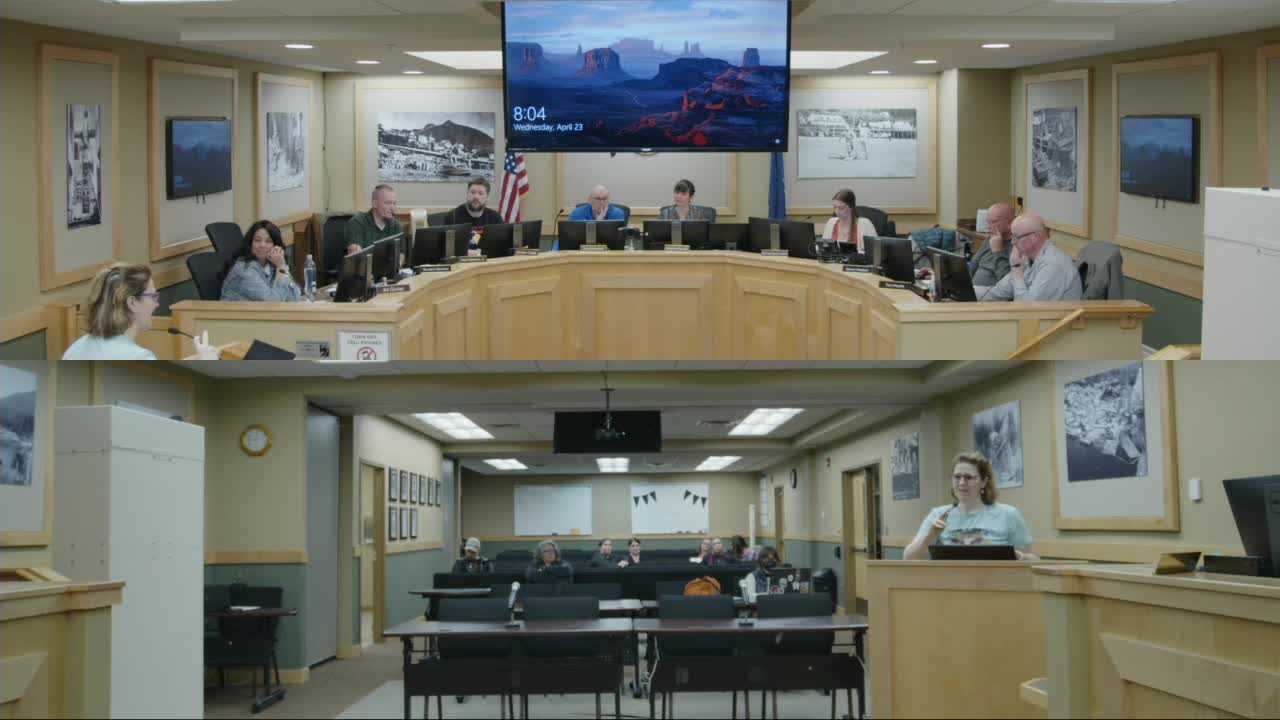
The Ketchikan Gateway Borough School Board voted 5–1 on April 23 to approve the district's proposed FY2025–26 budget on first reading, moving the measure to a second reading next week while several community members raised detailed objections about missing numbers, internal inconsistencies and possible misuse of restricted funds.
Business manager Daniel Schueller presented the budget and told the board the draft uses a set of assumptions about state funding when calculating revenues. Schueller said the draft assumes a Base Student Allocation (BSA) increase that local advocates have discussed with legislators and that the borough will provide the ordinance‑level in‑kind contributions the district requested; he cautioned that the final state appropriation remained uncertain. "What I can speak to is the fact that that is the beginning fund balance for fiscal year 25–26; that does not mean that this budget is in deficit," Schueller said during the meeting, explaining that the negative beginning balance resulted from prior years' operations and audit entries.
Several members of the public used the public‑comment and public‑hearing portions of the agenda to press the board to delay approval. One commenter, identified in the transcript as Urquhart, told the board, "This budget's $4,000,000 in the hole, in the red," and described multiple line‑item problems she said she found while reviewing the packet. Public speakers asked for clearer accounting about restricted funds — particularly the transportation and food service funds — and questioned a contract for leasing computers. A number of commenters said the budget packet contained missing figures, copied entries and inconsistent job titles.
Board discussion touched on the district's multi‑year health insurance note receivable and borough negotiations. Schueller told members the borough intends to apply in‑kind contributions under Borough Ordinance 2066 to reduce the district's health‑insurance note receivable; he said the board would have clearer appropriation numbers after the borough's second‑reading activity in May. Schueller also outlined the formula mechanics: the district's adjusted average daily membership (ADM) drives the foundation calculation and, with the assumptions used, the draft projects operating revenues and expenditures that balance in 2526 under the stated assumptions.
On staffing, the draft includes approximately 13 full‑time equivalent reductions compared with current staffing levels, Schueller said; several speakers and board members called for clearer, school‑by‑school detail on proposed changes. The budget also assumes a modest health‑insurance premium increase in the next year and includes contingency language tied to whether the legislature passes a larger BSA outside the base formula.
Board member Ali Ginter voted against the first reading, saying she was not prepared to approve the proposal based on information available at the meeting. "I feel it would be irresponsible since I'm not entirely wrapping my mind around this, so I'm gonna vote no," Ginter said during roll call.
The roll call on the motion to approve the budget in first reading recorded the following votes: Paul Robbins Jr. — Aye; Hewitt — Yes; Tabb — Aye; Thomas — Yes; Ginter — No; Tatsuta — Yes. The motion passed 5–1. Second reading and another public hearing are scheduled for the board's April 30 meeting; the board must submit appropriation requests to the borough by May 1 per the borough's ordinance schedule.
Public commenters also raised student‑safety concerns after reports of small plastic baggies found in the community; several asked the district to clarify campus safety plans. Schueller and the superintendent said the district would take public concerns into account and provide additional detail as the board prepares for second reading.
The board did not make final appropriations at the April 23 meeting; the first reading advances the draft while the district seeks final direction from the borough and waits for the legislature's action on the BSA.