Get Full Government Meeting Transcripts, Videos, & Alerts Forever!
Get email alerts on the Ems And Public Health topic
No spam. Unsubscribe anytime.
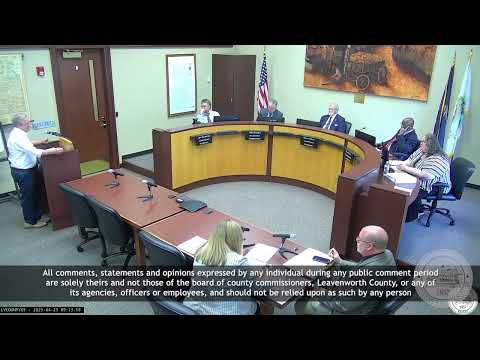
Commissioners discuss ambulance costs, Fort Leavenworth MOU and health department upgrades; staff report full EMS staffing and public‑health audits
Summary
Commissioners heard EMS and public-health quarterly reports and discussed a potential Fort Leavenworth contribution toward county ambulance costs.
Leavenworth County commissioners received quarterly reports from EMS and the public health department and discussed whether Fort Leavenworth should help pay for county ambulance service use.
Jamie, EMS director, told the board the service is “on track” financially for the year, averaging “right around that 36 calls mark per day.” He reported full staffing for the first quarter, replacement LifePak 35 cardiac monitors deployed without major problems, and vehicle maintenance at about 22% of budget year‑to‑date. A 2025 ambulance unit delivery was delayed by hurricane-related factory disruption; the director said that delivery is expected in late summer or early fall. Jamie also said fire departments that rely on a shared medical director had agreed to a uniform annual payment structure and staff are preparing an agreement; he said the departments would pay $1,500 per year under the arrangement discussed.
Several commissioners raised the county’s roughly $2 million annual shortfall in EMS costs — the gap the county says remains after billing and insurance reimbursements — and asked whether Fort Leavenworth should contribute. Commissioners said Fort Leavenworth uses county ambulance services under an MOU that expires Sept. 1 and that the post’s expanded on‑post housing and businesses change the county’s financial picture. One commissioner said he is seeking a contribution of about $1 million as a shared contribution toward the county’s annual EMS shortfall. Commissioners asked staff to prepare supporting figures for those discussions.
Public-health staff reported a successful WIC audit with no deficiencies and said the department is pursuing a workforce-development grant to fund a modern electronic health record (EHR) system for clinical services; staff said the grant could cover five years of vendor support. The health department also said it no longer provides COVID vaccines (that work shifted to pharmacies) and that routine infectious-disease reporting now follows state systems (KDHE ABBYTrax for reportable disease). Commissioners and staff discussed family‑planning services funded through Title X: staff said 207 clients were served in the period presented and that 23 were minors; they said Title X allows minors to receive certain family‑planning services without parental consent and that loss of Title X funding would reduce several health‑department programs.
Commissioners asked about rising measles reports elsewhere in the region and health staff said state monitoring showed most cases concentrated in southwest Kansas and that vaccination remains the primary prevention strategy. The board discussed scheduling a meeting with Fort Leavenworth leadership to negotiate the MOU before the September expiration.
No formal board action on the Fort MOU was taken at the meeting; commissioners directed staff to produce figures and continue discussions.