Get Full Government Meeting Transcripts, Videos, & Alerts Forever!
Get email alerts on the State Budget And Taxes topic
No spam. Unsubscribe anytime.
Revenue and Taxation committee advances tax, housing and entertainment bills; high‑speed rail and tax‑fraud expansion fail
Summary
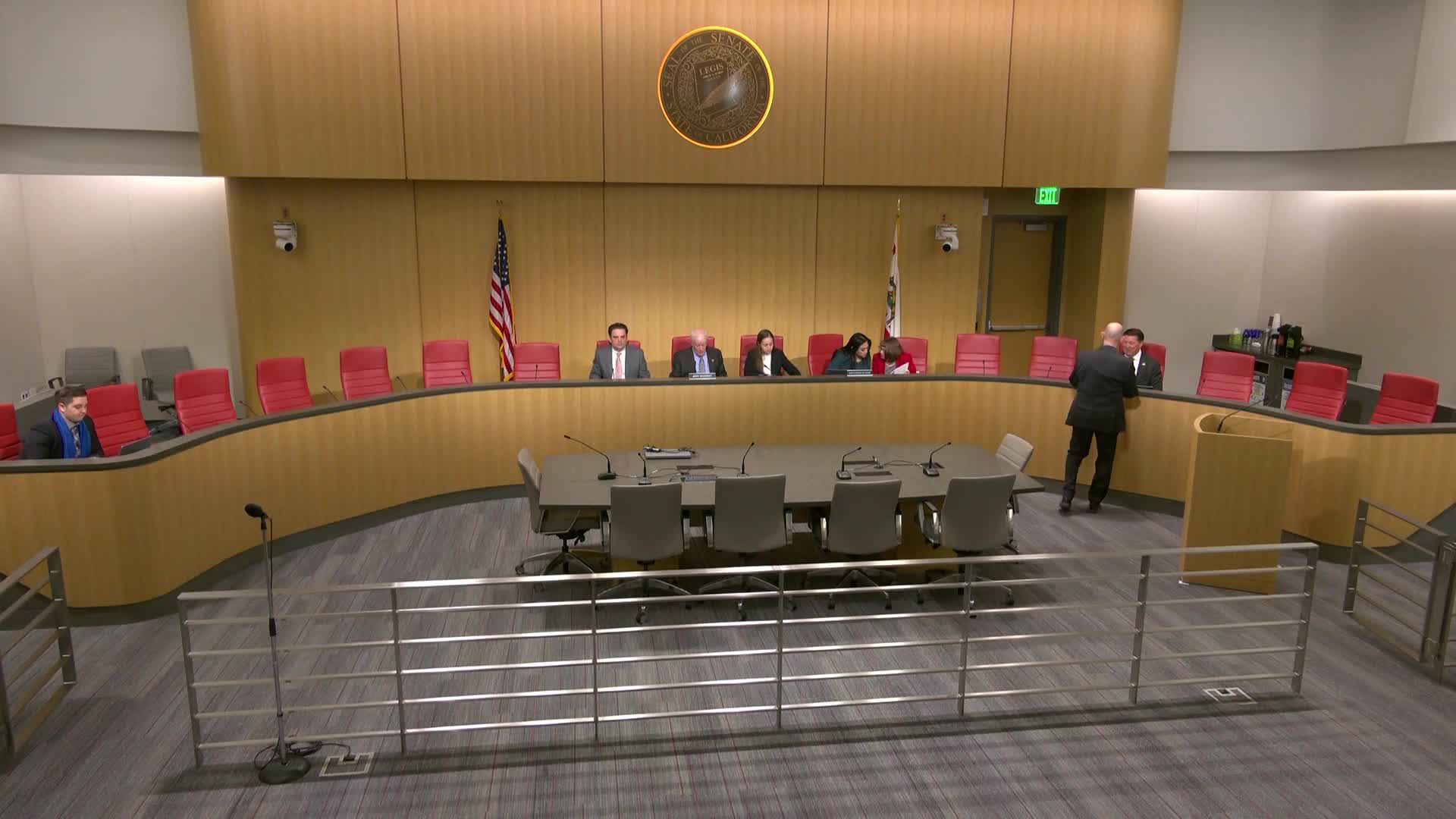
The California State Senate Committee on Revenue and Taxation debated a slate of bills on Oct. 26, 2025, advancing proposals on tips tax relief, film and TV tax credits, housing and transit funding while voting down measures to redirect high‑speed rail funding and to extend the False Claims Act to tax cases.
The California State Senate Committee on Revenue and Taxation met to consider more than a dozen bills affecting taxes, housing, transit and economic incentives. Lawmakers advanced several measures to the Appropriations Committee or other committees, adopted a committee consent item and rejected two high‑profile proposals.
Votes at a glance
- SB 17 (Ochoa Bogue) — Allow state tax exclusion/deduction treatment for tips for service and hospitality workers. Motion: do pass as amended to Labor, Public Employment and Retirement. Committee vote: aye 5, no 0. (McNerney; Valladares; Ashby; Grayson; Umberg — aye.)
- SB 630 (Allen / Menjivar) — Major expansion of film & television tax credit (higher base credit, expanded eligible productions, larger indie set‑aside). Motion: do pass as amended to Appropriations. Committee vote: aye 5, no 0.
- SB 328 (Grayson) — Cap on the Department of Toxic Substances Control (DTSC) hazardous waste generator fee for housing, nonprofits and parks; permit streamlining timelines. Motion: do pass as amended to Appropriations. Committee vote: aye 5, no 0.
- SB 661 (Hurtado) — Airport Expansion and Regional Optimization Act (redirect aviation fuel tax proceeds for airport infrastructure; FAA revenue‑use compliance). Motion: do pass to Appropriations. Committee vote: aye 5, no 0.
- SB 63 (Wiener / Arreguin) — Authorize a regional sales tax measure on the November 2026 ballot to stabilize Bay Area transit operations, with fiscal efficiency review. Motion: do pass as amended to Appropriations. Committee vote: aye 4, no 1.
- SB 592 (Smallwood Cuevas) — Exclude transfers into community land trusts (CLTs) and limited equity housing cooperatives (LEHCs) from property tax reassessment at conversion. Motion: do pass to Judiciary. Committee vote: aye 3, no 0.
- SB 789 (Menjivar) — Statewide commercial vacancy reporting requirement (five‑year data collection, electronic filing). Motion: do pass as amended to Appropriations. Committee vote: aye 3, no 1.
- SB 799 (Allen) — Extend California False Claims Act to certain egregious tax fraud cases (author threshold/dollar limits). Motion: failed in committee (final tally reported by the clerk: failed).
- SB 94 (Strickland) — Redirect greenhouse gas reduction funds to a temporary motor fuel tax cut and end state high‑speed rail funding. Motion: failed in committee (final tally reported by the clerk: failed).
- SB 591 (Valadares) — Tiered penalties for taxpayers who miss required electronic funds transfers (EFT); replaces uncapped penalties. Motion: do pass as amended to Appropriations. Committee vote: aye 5, no 0.
- SB 711 (McNerney) — Omnibus conformity to specified Internal Revenue Code provisions (updates to ease federal/state filing differences). Motion: do pass as amended to Appropriations. Committee vote: aye 4, no 0.
- SB 863 (Committee bill) — Consent calendar item adopted by the committee (consent vote recorded by the clerk).
Why it mattered
Committee members said the bills would affect jobs, housing affordability, local infrastructure and state revenues. Several measures were framed as immediate relief for workers and developers (SB 17, SB 328), while others were pitched as long‑term investments to keep industries and services — film production, airports, and mass transit — competitive and operational (SB 630, SB 661, SB 63). Two proposals generated sharp disagreement: SB 94 sought to divert greenhouse gas reduction funds earmarked for the California High‑Speed Rail Authority to cut fuel taxes, and SB 799 proposed opening a tax‑fraud path under the False Claims Act. Both failed to gain committee approval.
Key debates and excerpts
High‑speed rail and fuel tax relief (SB 94)
Senator Strickland framed SB 94 as emergency relief for drivers and a cessation of further state spending on the California High‑Speed Rail project. “This is a $37 billion tax cut for hardworking California families,” Strickland said, and described the project’s present cost as “$128,000,000,000 and counting.”
Jonathan Cole of Climate Action California opposed the bill, saying the California High‑Speed Rail project has supported construction jobs and broader economic activity and warning that diverting funds would strand significant structures and planned investments. Cole told the committee the bill would “threaten a long term transportation, climate, and economic goals in exchange for dubious temporary benefits.” The committee voted to reject SB 94.
False Claims Act expansion for tax fraud (SB 799)
Senator Allen said SB 799 was narrowly drawn to reach only “egregious” tax fraud (high dollar thresholds, consultation with tax agencies, and protections against disclosure of confidential tax documents). Representatives of the California Attorney General’s Office — Evan Ackron, Special Assistant Attorney General, and Rick Acker, Supervising Deputy Attorney General — testified they had worked with taxing authorities and wrote that the guardrails in the bill would prevent “shakedown” suits.
Business groups and tax professionals strongly opposed the bill in testimony to the committee, saying existing tax collection, audit and criminal enforcement tools make the expansion unnecessary and that the measure risked chilling legitimate tax positions. After debate, the committee did not approve the measure.
Tips tax relief (SB 17)
Senator Ochoa Bogue presented SB 17 as bipartisan tax relief for service and hospitality workers by allowing favorable state tax treatment for tips. Ochoa Bogue said tips “are not guaranteed” and framed the bill as putting money back “in the pockets of people who deserve it most.” Supporters included Kelly LaRue (Resilient Advocacy, speaking for the California Chamber of Commerce) and Scott Kaufman (Howard Jarvis Taxpayers Association), who highlighted the demographics of tipped workers and urged support. The committee moved SB 17 forward to Labor.
Film and TV tax credit expansion (SB 630)
Senators Allen and Menjivar described SB 630 as a broad overhaul of the state’s film and television tax incentive program: raising base credit levels, expanding eligibility (including short‑form and specified TV formats), increasing indie set‑asides and making the credit more refundable to compete with other states and countries. Rebecca Rein of the Directors Guild of America and numerous unions and industry groups testified in support, calling the bill “a jobs bill for working families in our industry.” The committee approved the measure to Appropriations.
DTSC fee cap for housing remediation (SB 328)
Senator Grayson said SB 328 would cap the DTSC hazardous waste generator fee at $100,000 for housing, nonprofit and park/open space projects and $250,000 for master‑developed projects; the bill also requires DTSC timelines for cleanup plan reviews. Industry witnesses (Louis Bronte, Bay Area Council; Ally Saberman, Housing Action Coalition) gave examples of projects whose budgets were substantially increased by the per‑ton fee, and argued the cap would restore feasibility to infill housing. The committee sent the measure to Appropriations.
Airport funding (SB 661)
Senator Hurtado presented SB 661 to redirect aviation fuel tax proceeds to airports and to align state practice with FAA revenue‑use rules; Jim Lights of the California Airports Council said the bill “finally moves California into compliance.” Airline and airport stakeholders testified in support; the committee advanced the bill to Appropriations.
Community land trusts and housing cooperatives (SB 592)
Senator Smallwood Cuevas told the committee SB 592 would exclude transfers into community land trusts and limited equity housing cooperatives from property tax reassessment at conversion, keeping tax bills low while resident purchasers finalize their ownership transition. Kyle Smele (San Francisco Community Land Trust) and Hope Williams (Sustainable Economies Law Center) described conversion examples and tenant‑owned outcomes. The California Assessors Association said it supported the intent but urged further technical fixes for consistent county administration. The committee approved SB 592 for Judiciary.
Commercial vacancy reporting (SB 789)
Senator Menjivar described SB 789 as a five‑year statewide data collection effort requiring commercial property owners to report vacancy status and reasons annually; the author said the data would help craft local and state policy to reduce blight. Business groups including the California Business Properties Association and the California Business Roundtable opposed the bill as an administrative burden that would hurt small owners and risk unintended consequences. The committee moved the bill to Appropriations nevertheless.
What happens next
Most measures approved by the committee were sent to the Senate Appropriations Committee or the next named committee for fiscal review and scheduling. Bills that failed in the Revenue and Taxation Committee (SB 94 and SB 799) may be returned to the author for revision or be reintroduced in future sessions.
Members and witnesses who spoke during the hearing emphasized recurring themes: protecting jobs and local economies, targeting relief to low‑income workers, complying with federal rules (aviation revenue use), and preventing unanticipated costs that could block housing and development projects.
Provenance
This summary is based on the Committee on Revenue and Taxation hearing (transcript excerpts): opening remarks at 8.24s (“The Committee on Revenue and Taxation will come to order.”) and the committee adjournment at 10267.575s (“Consent calendar is adopted. The committee is now adjourned.”).