Get Full Government Meeting Transcripts, Videos, & Alerts Forever!
Get email alerts on the Housing Rhid topic
No spam. Unsubscribe anytime.
Leavenworth County adopts policy to review reinvestment housing incentive districts after public debate
Summary
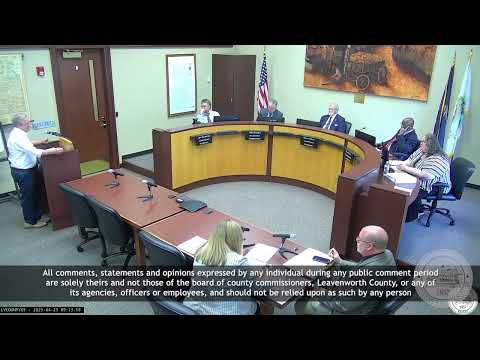
Leavenworth County commissioners voted to adopt a policy to evaluate, analyze and respond to proposed Reinvestment Housing Incentive Districts (RHIDs).
Leavenworth County commissioners voted to adopt a policy to evaluate, analyze and respond to proposed Reinvestment Housing Incentive Districts (RHIDs). The board approved the policy during its regular meeting; the vote was recorded as ayes from the commissioners present.
The policy formalizes notice requirements and factors the county will consider when a city or developer seeks a RHID that could affect county property-tax revenue. County staff said the policy adds a certified-mail notification schedule and language describing legislative intent drawn from statute and an executive summary prepared by the Legislative Research staff in Topeka.
Public commenters urged the board either to block RHIDs that reduce county revenue or to limit their duration. Paul Cromer told the commissioners, “There is no opt out option,” and cited “KSA 12-5246” as the statute that, in his view, leaves counties limited to either passing a resolution that makes a district “null and void” or doing nothing for 30 days and thus being included. April Cromer said she had reviewed developer materials and a feasibility study and raised two figures developers and county staff discussed in public comment: a developer estimate that infrastructure for a proposed 417-unit project would cost “$21,000,000 to $27,000,000” and a USD 469 mill-levy study she said showed about “$12,800,000 in tax revenue through 2045” under the longer RHID timeframe cited by the city. Rebecca Mahan and other residents asked the county to set limits to protect taxpaying residents.
Ross Vogel, principal with Hartland Housing Partners, represented developers’ perspective and urged the county not to set rules that make projects infeasible. He said housing is a supply-side problem and recommended allowing longer RHID terms in some cases, telling the board, “It takes about 17 to 19 years for an RHID to pay off normally.”
Several citizens and at least one developer recommended specific changes the board could consider; John Redden proposed items for the policy such as requiring developers who receive RHID funds to complete construction rather than sell improved lots, requiring county approval for annexations tied to RHIDs, and applying rezoning criteria from the Golden v. Overland Park “golden factors.” Redden also requested that the county reserve authority to rescind a RHID if it was approved under false pretenses.
Commissioners debated the policy’s term length, notification language and flexibility. County staff said the posted packet had an imperfect redline but that a clean final version would be the operative policy if the board voted to adopt. Multiple commissioners said they wanted a policy on the books quickly and emphasized that it provides an opportunity for notification and review, not an automatic approval or denial. The board approved the policy by roll call vote (ayes recorded by those present).
The policy establishes the county’s review framework but does not itself approve or deny any specific RHID. Staff and commissioners noted there is a 30-day statutory window tied to statutory procedures once a public hearing is concluded by the sponsoring city; commissioners repeatedly emphasized that the county can revisit or amend the policy in the future.