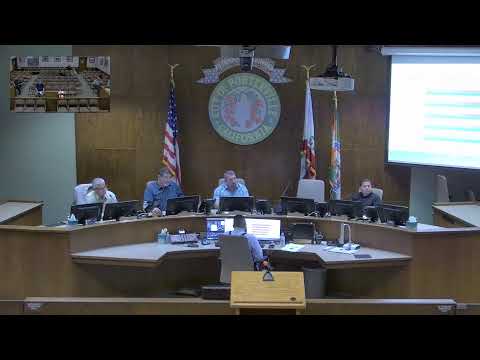
Porterville holds Budget 101 study session; managers outline funds, forecasts and major projects
Loading...
Summary
City staff presented a Budget 101 study session covering fund types, department budgets, capital funding sources, street maintenance costs, transit and water enterprise plans including a proposed tertiary treatment plant; no formal actions or votes were taken.
Porterville city staff presented a “Budget 101” study session to the City Council on general and enterprise fund structure, revenue forecasts, department budgets and major capital funding sources, city manager Jason said during the meeting.
The presentation explained that the city’s budget functions as a financial plan that reflects council priorities and that funds are governed by federal, state and local rules. Staff described fund types — general, special revenue, enterprise and reserve funds — and reviewed revenue mixes and constraints, including local sales-tax measures and multiple grant sources.
City Manager Jason told the council the general fund is the city’s most flexible fund and noted the council-established reserve policy under “ordinance 17 87,” which sets a 15% budget stabilization target and a 10% catastrophic fund threshold; staff also described a special-purpose fund with a $100,000 minimum annual appropriation. Jason summarized the city’s conservative revenue forecasting approach and said, “I would rather underpromise and overdeliver,” when discussing end-of-year savings expectations.
Staff reviewed two local sales taxes: Measure H (adopted 02/2005; a half-percent, earmarked for public safety, roads and parks originally) and Measure I (adopted 02/2018; a 1¢ general sales tax). The presentation showed the general fund relies heavily on property and sales taxes (roughly 27% and 23% of general fund revenue in the slide deck) and warned staff expect a modest sales-tax decline next year while property taxes may increase slightly.
Department-level summaries showed public safety as the largest general-fund cost. Staff reported the police budget exceeds $20 million, with about 129 total department positions and 86 sworn officers; roughly 69% of police funding currently comes from the general fund with other support from grants such as COPS and ARPA. The fire department also relies primarily on salaries and benefits and has used SAFER grant funding in past years to fund personnel.
Street maintenance and pavement work drew extended discussion. Streets staff and Public Works director Michael explained the city’s self-perform street program and showed a five-year lane-mile cost history. Michael said the current budget target is “right about a hundred thousand a lane mile,” and that the city maintains roughly 280 lane miles and aims to complete about 30 lane miles per year to begin catching up on deferred maintenance. Staff said most repairs use cold mix (about two-thirds) with hot mix used where a heavier grind/overlay is required; typical service lives discussed were about five years for cold-mix overlays and five to eight years for hot-mix overlays, depending on subbase and traffic.
Finance Director Janie and other staff reviewed enterprise funds. Staff said the water enterprise is self-supporting and carries debt service tied to a previous $36,000,000 loan used to construct the tertiary treatment plant and a 200-acre-foot ponding basin; annual water debt service on that borrowing is about $835,000. Staff discussed a long-term plan for a phased, tertiary recycled-water treatment project with an earlier feasibility estimate of roughly $160,000,000 and described efforts to phase construction and seek state funding.
Transit and airport enterprises were presented as largely self-funded: the transit fund uses a mix of Measure R, passenger fares and federal 5307 funds and staff noted expected decreases in some grant lines (staff flagged a roughly $600,000 reduction in Local Transportation Funds previously discussed). The airport operating fund is supported by fuel sales, hangar rents and leases; staff estimated the airport enterprise fund balance at about $3.5 million at year end.
Staff also walked the council through capital funding sources and examples of stacked funding: Federal Highway Administration (FHWA), CMAQ, Measure R (a countywide half-cent sales tax), SB 1, Clean California grants and other state and federal grants. As an example, staff said the Santa Fe Byway revitalization combined a $2.9 million Clean California grant with roughly $2.2 million in Measure R alternative-transportation funding.
Councilmembers asked clarifying questions about lane-mile costs, the role of Measure R for local street projects (including Union and J streets), the status of specific designs and construction funding, and the timing of grants such as ARPA (which will expire for spending). Staff said design work on Union Street is funded but construction remains unfunded and may be pushed out one to two years because of right-of-way needs.
On water and recycled-water planning, staff said they are finalizing a water master plan and environmental documents and are pursuing state consolidation and grant funding. Staff identified possible purple-pipe installations tied to planned reconstruction projects to reduce future disturbance and lower overall distribution costs.
No motions, formal votes or ordinance adoptions occurred during the study session. Staff invited the council to schedule a budget-setting work session in May to review details and councilmembers requested printed packets of the presentation. The city manager and finance director said current data to December indicate the city is in reasonable fiscal position for the current fiscal year and that staff expect at least a modest surplus at year-end, subject to actual sales-tax receipts and other revenue data that arrive later in the fiscal cycle.
The session closed with council members thanking staff for the overview and scheduling follow-up budget-detail conversations; staff remained available to provide departmental breakdowns and project-level capital information.