Get Full Government Meeting Transcripts, Videos, & Alerts Forever!
Get email alerts on the Municipal Budget topic
No spam. Unsubscribe anytime.
Encinitas council workshop narrows FY2025–26 capital priorities after requests exceed available funds
Summary
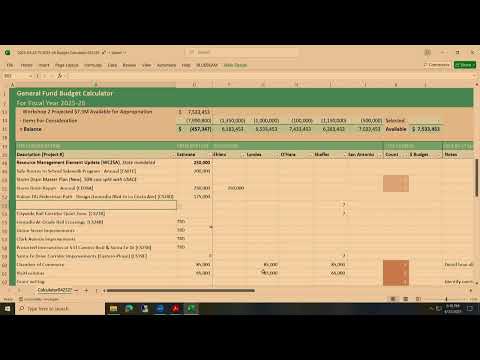
At a special City Council budget workshop, Encinitas staff presented the proposed fiscal year 2025–26 operating and capital budgets and sought direction on how to allocate roughly $7.5 million available for capital projects.
At a special City Council budget workshop, Encinitas staff presented the proposed fiscal year 2025–26 operating and capital budgets and asked the City Council for direction on allocating roughly $7.5 million available for capital projects.
Finance Director Tom Gallup summarized staff estimates, telling the council the city could borrow up to “13,100,000.0 to maintain and still maintain its existing AAA rating, which would add up to $750,000 in annual debt service per year.” He said an off-cycle emergency appropriation of about $1,000,000 for repair of the D Street beach access staircase reduced the staff’s previously reported $8.5 million available for capital to “approximately 7,500,000.0.”
The workshop focused on which projects to fund from that $7.5 million. Staff presented a long list of candidate capital projects — from pavement rehabilitation and storm drain lining to beach-stair repairs, an Encinitas Habitat Stewardship program, and a proposed “shared software and equipment replacement” internal service fund — and noted several projects already have outside funding or pending grants. Gallup said, “Staff is recommending a 500,000 payment to CalPERS this year as it prepares a pension policy and receives the latest annual valuation report from CalPERS,” and described other operating items included or proposed in the operating budget.
City Manager Jennifer Campbell reviewed the council’s nine adopted goals for 2025 and tied many proposed projects to those priorities, including beach access, mobility improvements, and storm drain work. Director of Engineering Gil Bankston and other staff explained the city’s “donut chart” of capital work, the funding status of project phases, and the meaning of graphic markers showing fully funded, partially funded, unfunded, or complete phases.
Key funding details and proposals discussed - Available for appropriation: staff reported about $7.5 million for capital projects after the emergency D Street repair estimate reduced the earlier $8.5 million figure. - One-time items and contingencies: staff proposed a $500,000 discretionary additional payment to CalPERS and a $500,000 minimum unassigned fund balance; staff said the midyear FEMA reimbursement for the Lake Drive sinkhole, timing unknown, would likely increase the unassigned fund balance when received. - Debt capacity: borrowing up to $13.1 million would preserve the city’s AAA rating but add about $750,000 annually in debt service, per staff analysis. - Grants and matches: staff said the city has won Caltrans HSIP grant awards (noting an estimated $400,000 match) and is awaiting results of other grant applications (including a proposed $350,000 match tied to separate sand/beach projects). Gallup clarified the city had already won certain HSIP grants and council would later decide whether to move those projects forward.
Infrastructure priorities and trade-offs Council and staff debated how to allocate limited dollars among competing needs. Major infrastructure items central to the discussion included: - Pavement rehabilitation: staff proposed $4.5 million for annual overlay and pavement rehab; several council members urged increasing pavement funding to arrest a multi-year decline in pavement condition, while others proposed smaller increases this year and phased boosts later. - Corrugated metal pipe (CMP) lining / storm drain rehab: staff said a five-year plan to line the worst corrugated metal pipes would cost about $5,000,000 (approximately $1,000,000 per year). Councilmembers proposed a range of near-term funding: some advocated $1,000,000 this year to start work, while others recommended smaller initial allocations (for example, $250,000) to fund planning/design and early lining rather than reserve the full multi-year sum. - Storm drain master plan vs. repairs: staff proposed a storm drain master plan (50% cost share with a partner entity) and annual storm drain repair funding. Councilmembers debated delaying the master plan and directing more funds this year to immediate repairs and lining to avoid higher failure-and-repair costs later. - Beach access and emergency repairs: staff identified the emergency repair to the D Street beach access staircase as a material near-term cost that reduced available capital funding for other projects.
Operations and staffing notes - A proposed new senior management analyst position for utilities was explained by Utilities Director Isam Heres: “This position ... will also provide administrative services, billing, rate studies, and customer service ... That’s 50% of that position. The other 50% will provide San Dieguito Water District support specifically with the new projects ... including the AMI (advanced metering infrastructure) ... an 8- to 10-year project.” Heres said that the position would be funded by enterprise funds (Cardiff Sanitary Division, Encinitas Sanitary Division, and San Dieguito Water District) and not the general fund. - Staff noted a proposed deputy fire marshal was included in the operating budget by moving an existing FTE to that role with no net FTE increase. - Staff described a new internal service fund for shared software and equipment replacement sized at $2.5 million to comply with GASB rules for subscription-based software and to centralize software and cybersecurity investments; staff said portions of that fund are supported by enterprise funds and partner contributions.
Public comment and outside requests Several speakers during the public-comment period urged the council to fund tourism- and business-oriented marketing and to preserve beach and pedestrian access: Visit Encinitas Director Carol Knight said, “We launched Visit Encinitas in June of last year,” and requested $65,000 to continue marketing and data collection. Michael Glenn, speaking for the Encinitas Chamber of Commerce, and Sherry Yardley (North County Chamber) asked the council to consider funding the Chamber and Visit Encinitas; the chamber requested $85,000 in total support. Councilmembers agreed to add those requests to the budget discussion for further consideration and asked the chamber and Visit Encinitas to provide program budgets.
Grants and external dependencies Staff emphasized that several projects depend on outside grants or matches: HSIP grants with Caltrans (with an estimated $400,000 match), potential San Diego-area grant awards for sand or pedestrian projects (with proposed local matches), and the timing of FEMA reimbursement for sinkhole repairs. Staff said some grant funding had been identified for the climate-action economic-impact analysis; thus the council’s decision could remove that $100,000 request from the general fund.
Council direction and next steps Council did not take formal votes on any capital appropriations at the workshop. Instead, members directed staff to refine options and funding trade-offs and scheduled another workshop to try to reach clearer consensus. Staff outlined the formal budget schedule: staff intends to introduce the FY2025–26 operating and capital budget on May 14 and anticipates council adoption on June 11; staff also targeted June 18 for a presentation on development impact (mitigation) fees and CPI adjustments for permitting fees. The mayor and staff agreed that one additional budget workshop would be scheduled to finalize priorities before introduction.
Why it matters The council must choose which limited capital projects to fund from the $7.5 million available now and which to defer or seek grant funding for later. Choices this year affect repair schedules for failing storm drains, pavement condition, beach access and safety, and one-time investments that could reduce long-term liabilities such as pension obligations. Several proposed investments are tied to external grants or reimbursements (Caltrans HSIP, FEMA), so the city’s ability to fund projects depends partly on outcomes outside local control.
What remains unresolved Council members diverged on near-term funding levels for pavement and corrugated metal pipe lining and on whether to fund a storm drain master plan this year or defer it while prioritizing immediate lining and repairs. Council also asked for additional detail on several items before final decisions, including clarifying the scope and first-year needs for the CMP lining plan, the historic-context statement scope and cost breakdown, and the details of proposed tourism and chamber funding. Staff will return with updated cost options and a revised calculator at the next workshop.
Ending Staff will prepare refined funding options and a revised budget calculator for a follow-up workshop; the council directed staff to return with detailed scopes and cost estimates for the highest-priority items and with the grant and match implications for projects now described as contingent on external awards.