Get Full Government Meeting Transcripts, Videos, & Alerts Forever!
Get email alerts on the Budget topic
No spam. Unsubscribe anytime.
Commission recommends approval of Parks & Recreation FY26–27 financial plan; commissioners press on allocated costs, forestry funding and golf reserves
Summary
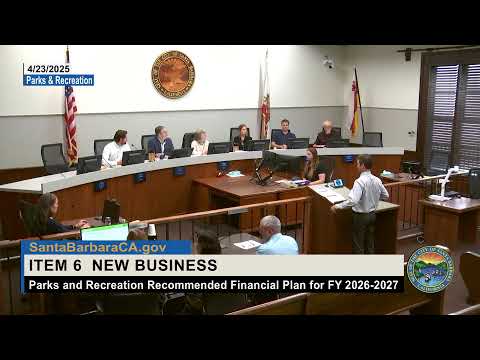
The Santa Barbara Parks and Recreation Commission on April 23 voted to recommend approval of the department’s proposed FY2026–27 Financial Plan, following a presentation by Business Manager Tina Nelson and discussion about allocated costs, forestry funding and golf reserves.
The Santa Barbara Parks and Recreation Commission on April 23 voted to recommend approval of the department’s proposed financial plan for fiscal years 2026–27, following a detailed presentation from Business Manager Tina Nelson and discussion with department leadership.
Tina Nelson, the department’s business manager, summarized the two‑year plan as including the general fund operating budget, a capital program and the golf enterprise fund. She told commissioners the department proposes general fund expenditures just over $28 million for FY26, with a net general‑fund subsidy of roughly $19.29 million after projected department revenues. The Recreation Division’s proposed revenue budget is described in the presentation as just over $6 million in FY26 and nearly $6.5 million in FY27; Parks Division revenues are shown at just over $2 million per year.
Nelson said the department proposes to rely on about 85 full‑time and 235 part‑time employees, and noted rising costs that affect the budget including a planned 10% water‑rate increase effective July 1 and inflationary pressures on supplies, fuel and chemicals. She also summarized the capital program, which includes ongoing projects and planned investments such as Carrillo gym renovations, Dwight Murphy Field loan repayment and construction, Franceschi Park design funds, and pool repairs at Los Baños. The capital plan also includes funding for an updated citywide parks and recreation master plan and an updated tree inventory to support long‑term urban‑forest management.
The golf enterprise fund was a focal point during questions. Nelson said the fund expects just under 75,000 paid rounds and revenues of $5.2 million in FY26 and $5.4 million in FY27, with expenditures just under $6 million and just over $6 million respectively. She said the golf fund holds a current reserve surplus of about $2.8 million that the department plans to use to cover an operating shortfall in FY26 and FY27 while pursuing deferred infrastructure work (maintenance road repaving, tee‑box and green renovations, parking lot work and other capital). Even with reserve use, Nelson said, the department projects roughly a $900,000 surplus by the end of FY27.
Commissioners pressed staff on several issues during the discussion. Commissioner Ramsey asked why Parks’ salary and benefits rose faster than the citywide projection; Nelson said the department requested and received targeted increases for hourly parks staff to keep seasonal and maintenance wages competitive in the local labor market. Several commissioners — including Ramsey and Vice Chair Clark — returned to a recurring concern about the city’s allocated internal‑service charges (IT, facilities, motor pool, insurance), which Nelson and Director Jill Zachary said the department cannot directly control. Staff explained some recent allocation changes have shifted costs (for example, IT allocation by headcount rather than station), and noted the allocations reflect citywide charges that departments are billed for.
Forestry funding drew sustained attention. Commissioners asked for clearer, ongoing reporting on what the utility‑user‑tax (UUT) allocation for street trees and medians buys in practice. Nelson and Director Zachary said staff will prepare a division‑level presentation with performance outputs and will report on the proposed tree‑inventory project and how the UUT monies and general‐fund support are applied to forestry operations.
Commissioners also questioned golf‑fund limitations and community access. Nelson and Director Zachary said the golf fund is an enterprise fund restricted to golf operations and capital; the commission was told the course now has a multi‑year program of deferred‑maintenance work that will use reserves, and that the course offers free community events (family easter event, movie nights, family holiday activities) to broaden community access.
After discussion the commission moved, seconded and voted to recommend approval of the Parks and Recreation Financial Plan for FY26 and FY27 covering the general fund, golf fund, capital program and the fees and charges schedule. The recommendation will be forwarded to the City Council as part of the citywide budget process.
Why it matters: the two‑year financial plan sets staffing levels, fee strategies and capital investments for parks, recreation, urban forestry and the golf course. Commissioners’ questions about allocated costs and forestry output reflect tradeoffs between maintenance demands, rising operating costs and limited citywide resources.
Follow up: staff said they will provide a parks division presentation with forestry performance outputs and more detail about the proposed parks and recreation master plan, and will confirm golf capital timing as projects proceed.