Get Full Government Meeting Transcripts, Videos, & Alerts Forever!
Get email alerts on the School Budget topic
No spam. Unsubscribe anytime.
Lake Oswego legal budget committee hears $10 million gap; district to cut 64 positions and raise secondary class sizes
Summary
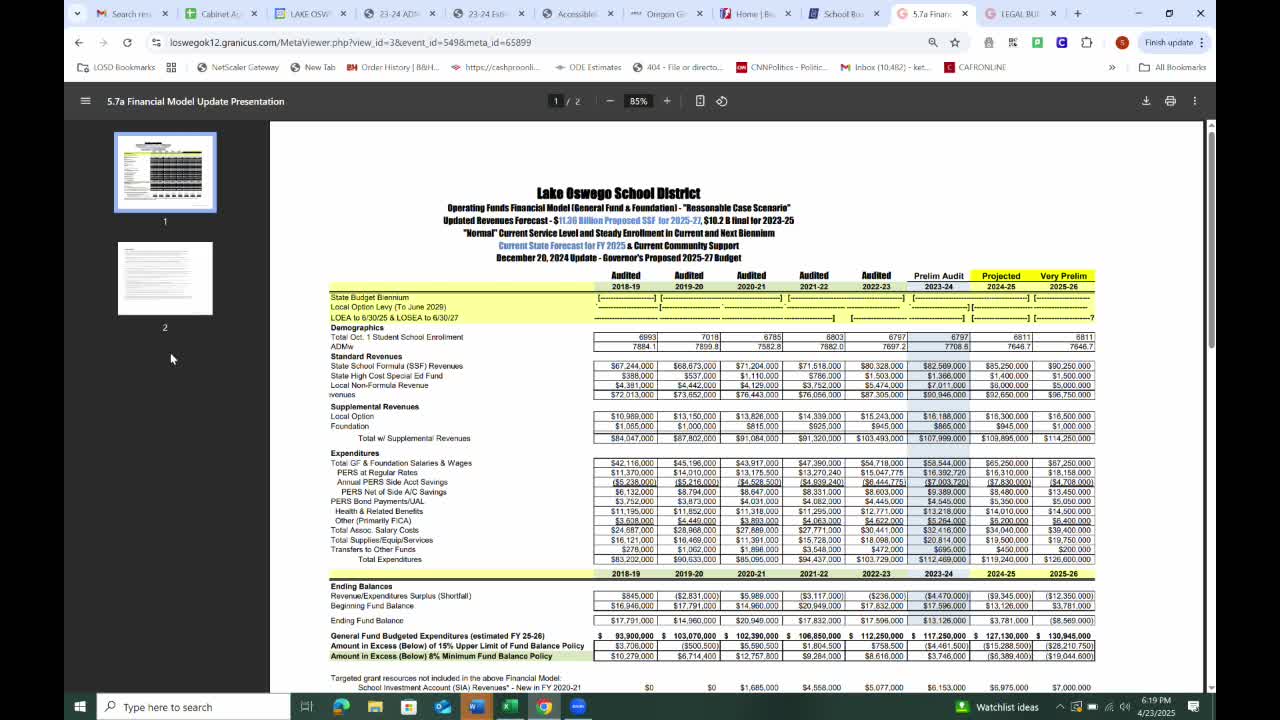
Lake Oswego School District officials told the district’s Legal Budget Committee on April 23 that a projected shortfall in state funding and rising costs will require more than $10 million in reductions for the 2025–26 budget year, including 64 district- and site-level position eliminations and cuts to classroom staffing.
Lake Oswego School District officials told the district’s Legal Budget Committee on April 23 that a projected shortfall in state funding and rising costs will require more than $10 million in reductions for the 2025–26 budget year, including 64 district- and site-level position eliminations and cuts to classroom staffing.
The district’s budget officer, Stuart Kessler, said the financial model prepared in December indicated a “very significant gap” if the district maintained current service levels, and that the district has already identified more than $10,000,000 in reductions to close it. “We’ve already identified cuts of of over $10,000,000 for for next year,” Kessler said.
Why it matters: the reductions affect classroom instruction, student support services and central office positions as the district prepares the proposed budget it will present to the committee May 7. The committee’s work, if finalized, will move to the full school board in June for adoption.
Details of reductions and classroom impacts Dr. Anthony (Tony) Shealy, superintendent, described the staffing reductions the district proposes to align spending with available revenue. “We have made a reduction of 64 positions across district and site levels,” Shealy said. Those district- and site-level cuts include administrators, administrative assistants, facilities staff, librarians, specialists, wellness professionals and academic support staff.
At the school level the district proposes to reduce seven elementary classroom teachers. Shealy said those cuts were achieved by reducing PE and innovation time rather than increasing elementary class sizes beyond the district’s targets: kindergarten 1:25; grades 1–3, 1:26; grades 4–5, 1:28. At the secondary level (middle and high school) the district plans to reduce 20 classroom staff. “We still wanted to have the elective options for all of our students, but we'll have fewer sections of those classes, which means you have increased class size,” Shealy said, citing an increase in average secondary class size from about 29 to about 33 students.
Revenue uncertainties and possible offsets Kessler and other staff emphasized that the district’s revenue outlook depends on the final state school fund that the Oregon Legislature will adopt in mid to late June. The district’s December model used the governor’s proposed budget as a baseline; officials said legislative changes and the district’s internal reductions will alter the final picture.
School business director Margaret Breithaupt, CPA, and staff noted several potential changes at the state and federal levels that could materially affect the district’s budget: proposals in the Legislature to raise the special education cap from 11% to 15% (the district’s special education proportion is 14.3%), additional state funding for high-cost disability, and temporary PERS rate relief under consideration by the Legislature. Dr. Shealy said a 3.3–4.3 percentage-point improvement in coverage would be worth roughly $2.5 million; combined changes to special-education funding and high-cost disability could yield up to about $4.5 million if both produced new, additional money to the state school fund rather than reallocating existing dollars.
Kessler cautioned that his modeling takes a conservative approach: “I try to be conservative because I’ve been here long enough to know that if I get overly optimistic…that can result in situations where you're having to make drastic actions in very short time periods.” He added that the district has already reduced spending in the current fiscal year and plans further reductions next year.
Other fiscal factors mentioned - PERS: Kessler warned that the PERS employer-rate setting would raise the district’s costs, with a simple-average increase shown in the actuarial tables of about 7.7 percent for affected tiers. He said temporary rate relief under discussion could be worth roughly $900,000 to the district if enacted, but he had not built that relief into the district’s conservative projections.
- Federal grants and reimbursements: staff said federal funding is modest but important (roughly $2.5 million annually, including IDEA and various Title grants). Those funds are typically claimed on a reimbursement basis; staff noted that grants can be a month or more in arrears and that major shifts at the federal level would require program adjustments.
- Enrollment and tuition: staff presented enrollment data and projections from Portland State University. The district’s October 1, 2024 enrollment was 6,811 students, higher than PSU’s prior projection of 6,691. Tuition revenue from out‑of‑district students has grown (about $700,000 last year and on track to exceed $800,000 this year). District staff noted the upcoming tuition rate is planned at roughly $11,050 for next year (up from about $10,500 for the current year).
- Local option and bond planning: Kessler reported projected local-option revenue of roughly $16.2 million for the coming year and reiterated that capital bonds and operating funds are distinct. Shealy and staff said a bond measure to rebuild Lake Grove and Forest Hills schools is planned for the November ballot; proceeds would be restricted to capital projects.
Process and next steps Kessler said the committee will consider the proposed 2025–26 budget at its May 7 meeting and, if the committee is prepared, the committee could conclude work with a budget recommendation on May 21 before the school board review in June. Staff also said the district typically updates its financial model two or three times a year as new state and local data become available.
Votes and committee business The committee held routine business and procedural votes by voice. The committee elected Kirsten Ayer as chair by voice vote. The committee also approved minutes from its May 22, 2024 meeting. Those procedural items were taken by voice and recorded as approved in the meeting minutes.
What’s next The Legal Budget Committee will receive the staff‑prepared proposed budget on May 7 and resume deliberations. Final legislative actions on the state school fund and any enacted changes to special education or PERS before June will affect the district’s final figures and may change assumptions staff are using in the proposed budget.