Get Full Government Meeting Transcripts, Videos, & Alerts Forever!
Get email alerts on the Critical Areas Ordinance topic
No spam. Unsubscribe anytime.
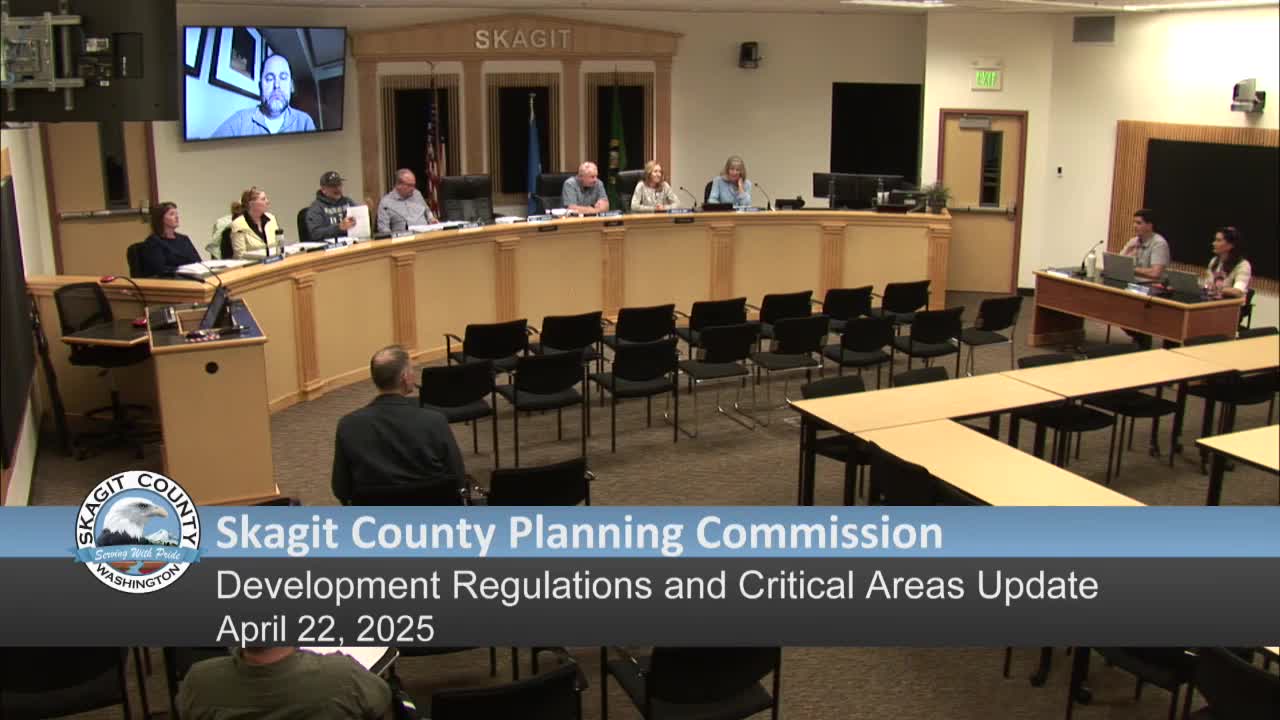
Planning commission reviews draft Critical Areas Ordinance: larger buffers, reasonable‑use exception draw questions
Summary
The Skagit County Planning Commission on April 22 reviewed a draft update to the county's Critical Areas Ordinance, including proposed increases to some stream buffers and procedural changes for reasonable‑use review.
The Skagit County Planning Commission on April 22 reviewed a draft update to the county's Critical Areas Ordinance (CAO), focusing on how best available science (BAS) and state guidance would affect wetland, stream, aquifer and habitat protections. The commission heard the presentation from a consultant team and engaged in detailed questioning about buffer dimensions, the legal role of the director, and how reasonable‑use exceptions and variances would operate.
Dan (consultant with FASET) told the commission the draft ties county regulations to the state’s BAS review and incorporates a "no net loss" objective for critical area functions and values. "It requires the review of best available science during, an update just like this," the consultant said, noting the county's last comprehensive update was in 2006. The draft CAO includes updated wetland delineation references, clarified Critical Aquifer Recharge Area (CARA) categories, reorganized geologically hazardous provisions, and a reworked fish and wildlife habitat section that responds to recent Department of Fish and Wildlife materials.
Key proposals discussed - Streams and riparian buffers: The draft retains a 50‑foot standard for Type F (fish‑bearing) streams but proposes increasing Type N (non‑fish bearing) stream buffers from 50 to 100 feet, citing water‑quality efficiency and BAS. The consultant explained that a 100‑foot buffer typically achieves about 95% pollutant removal efficiency and that the Department of Fish and Wildlife guidance on site‑potential tree height (SPTH) points toward larger riparian dimensions in some locations. - Wetlands: The draft generally aligns county wetland buffers with Department of Ecology recommendations. The proposed code removes the "buffer reduction" mechanism for wetlands and streams (but retains buffer averaging), saying reduction is not supported by BAS. - Aquifer protection: The CAO draft refines Critical Aquifer Recharge Area categories (Category 1 and 2) and shifts language from "mitigation" to "protection," noting impacts to aquifers are difficult to mitigate once they occur. - Reasonable‑use and variances: Staff proposed that the reasonable‑use pathway be used first for qualifying single‑family situations (the draft references a 4,000‑square‑foot maximum impact area for reasonable‑use review), making it a quicker administrative review before a variance would be considered. Larger or more complex deviations would still proceed through the variance process. - No net loss and BAS: The draft emphasizes a no‑net‑loss standard for critical area functions and documents where the county follows or deviates from BAS. The consultant said deviations must be justified and documented.
Commissioner concerns and staff responses Commissioners asked detailed questions about the empirical basis for the larger buffers. Several commissioners said they were sympathetic to environmental goals but pressed for local data or analysis showing the scale of change in Skagit County. One commissioner characterized the BAS guidance as a broadly distributed model and urged careful local review: "Getting handed out everywhere ... basically, more is better. And if it's more, it's better." (comment as recorded in the meeting transcript). The consultant responded that BAS syntheses and state guidance drive the recommendations and that site‑specific analyses and mitigation sequencing (including buffer averaging and the reasonable‑use process) would remain available to applicants.
Other procedural clarifications: staff said the public comment period opened the day before the meeting and closes May 8; the Planning Commission is scheduled to hold a public hearing May 6 and deliberate May 20. The consultant and staff also said that any Planning Commission changes forwarded to the Board of County Commissioners would likely prompt a second public comment period.
Direct quotes from the meeting included the consultant's statements that jurisdictions "must review the best available science based recommendations and determine the best regulatory approach for Skagit County" and that the code update seeks to ensure "no net loss" of critical area functions and values.
Next steps: The CAO draft will proceed through the public comment period, a May 6 hearing and May 20 deliberations; commissioners and staff indicated further analysis and public input will inform final recommendations to the Board of County Commissioners.