
South Kingstown committee hears design-development update for new high school; 2027 opening targeted
Get AI-powered insights, summaries, and transcripts
Sign Up Free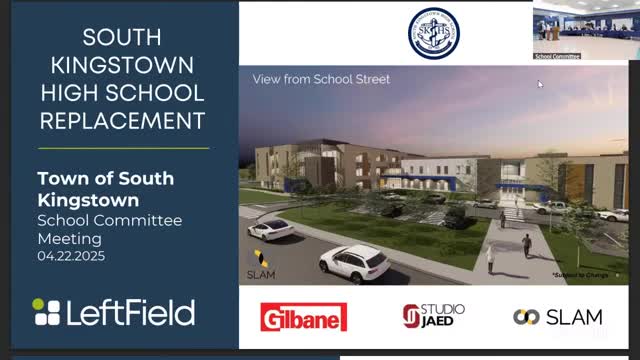
Summary
South Kingstown School Committee members heard a design-development update Wednesday from Left Field, SLAM Collaborative and Gilbane Construction on the new South Kingstown High School, with the project team saying construction would run through 2027 and that the team is working to improve the schedule.
South Kingstown School Committee members heard a design-development update Wednesday from Left Field, SLAM Collaborative and Gilbane Construction on the new South Kingstown High School, with the project team saying construction would run through 2027 and that the team is working to improve the schedule."The end date that was presented is October of 2027," said Kate Turner, senior project manager with Left Field, the owner's representative assigned to the project.
The presentation covered the project schedule, estimating milestones, floor plans, site circulation, construction logistics and outstanding design decisions. Turner said the design-development estimating set was due the week of May 19–20 and that Gilbane's and a third-party estimator's reconciled cost estimates would follow; the team plans a public engagement session on the estimates before seeking formal approvals from the school building committee and town council.
"That is the goal, and the team is working really hard to get there," Turner said, describing an effort to prepare early-release bid packages for site work and structure so some construction could begin in fall 2025.
SLAM's Cathy Allathorpe walked the committee through the three-story academic "tower," the two-story dining commons and auditorium mezzanine, science and CTE wings, and athletic facilities. She said most circulation is centered on a main secure entrance from School Street with dedicated visitor check-in, parent drop-off queued at the rear of the site and bus drop-off at the front."If you're credentialed in, you're let into the office," Allathorpe said, describing the secure check-in window and a set of drop-off cubbies for forgotten items.
The team described program adjacencies: an auditorium with a mezzanine and roughly 748 seats across upper and lower levels (per the presenters), a large cafeteria/learning commons, an 800-seat (presenter figure) main gym with an adjacent "flex gym" for wrestling and fitness, a suite of art and media spaces, high-bay construction-technology spaces with direct pathing into the auditorium for set movement, and a science/plant-science suite with space for a new greenhouse.
Site and construction logistics dominated committee questions. The plan places the new building where current fields are located; the existing campus will remain in use during demolition and phased construction. Turner and Gilbane said they expect demolition to take about eight months and that team planning aims to establish a new parent drop-off lane and looped traffic pattern for the first day of school, though they cautioned some interim traffic disruption is likely until site work is complete.
"We're going to have to have clear plans and solid communication to our families and to the community as to what the traffic impacts will be," Turner said. The team said they will produce two-week look-ahead schedules and meet weekly with school administration and facilities staff to coordinate times when louder work will occur, and to adjust planning for finals or other sensitive school activities.
Gilbane and Left Field addressed construction impacts and mitigation: chain-link fencing with visual scrim to secure the site, use of low-noise backup devices on heavy equipment, water trucks and dust suppression during excavation, a fenced construction parking area and on-site staging, and a weekly communication cadence with school leaders. The team said Gilbane's number-one mission for the project is safety and that the daily construction team will be locally based for rapid response.
On energy and long-lead technical items, the presenters said the project will be an all-electric building (geothermal removed during schematic design) with a focus on photovoltaic arrays for renewables; a test well drilled in the existing field will still be used as a teaching opportunity and for limited HVAC support in CTE spaces. The team noted tariffs and material-price volatility as open cost risks but said recent steel bids in nearby Rhode Island projects have come in under budget; Turner estimated that, after labor and domestic manufacturing are accounted for, steel represents a relatively small share of total project cost and that exact impact will be clearer once May estimates are reconciled.
Turner and SLAM also described phased work for Curtis Corner (demolition, field construction, additional site improvements) and said the project team is parsing that scope into separate bid packages to reduce individual bid cost exposure. The team warned that the new fields will need an establishment period before being fully playable after construction and that the district should expect interim field limitations.
Community members on the committee raised stormwater and landscape questions; the presenters identified multiple infiltration basins on the site plan and said they are designing to current standards while anticipating more extreme future rainfall events. Allathorpe said the design team is working toward a warmer masonry-and-brick exterior palette in response to community feedback; the next formal exterior-palette presentation was scheduled to the school building committee on May 1.
The team said next steps include completing design-development estimating, holding the public engagement session on the estimates and returning to the school committee to request approval to submit the design-development package to the Rhode Island Department of Education (RIDE). If the district and town council can expedite approvals and early-release packages, the presenters said, that will mitigate schedule risk.
Committee members asked about interim logistics the first days after construction fencing and early demo begin and about abatement during demolition; the team said asbestos- and lead-abatement studies and fully contained abatement will precede any demolition and that hazardous materials will be handled per standard protocols.
The presentation concluded with the committee's acknowledgement that some items — exterior materials, final cost reconciliation, Curtis Corner phasing and field-establishment timing — remain open and will be addressed in forthcoming submissions and meetings.