Get Full Government Meeting Transcripts, Videos, & Alerts Forever!
Get email alerts on the Affordable Housing topic
No spam. Unsubscribe anytime.
Dallas committee holds public hearing on proposed HFC and PFC rule changes as developers and boards urge caution
Summary
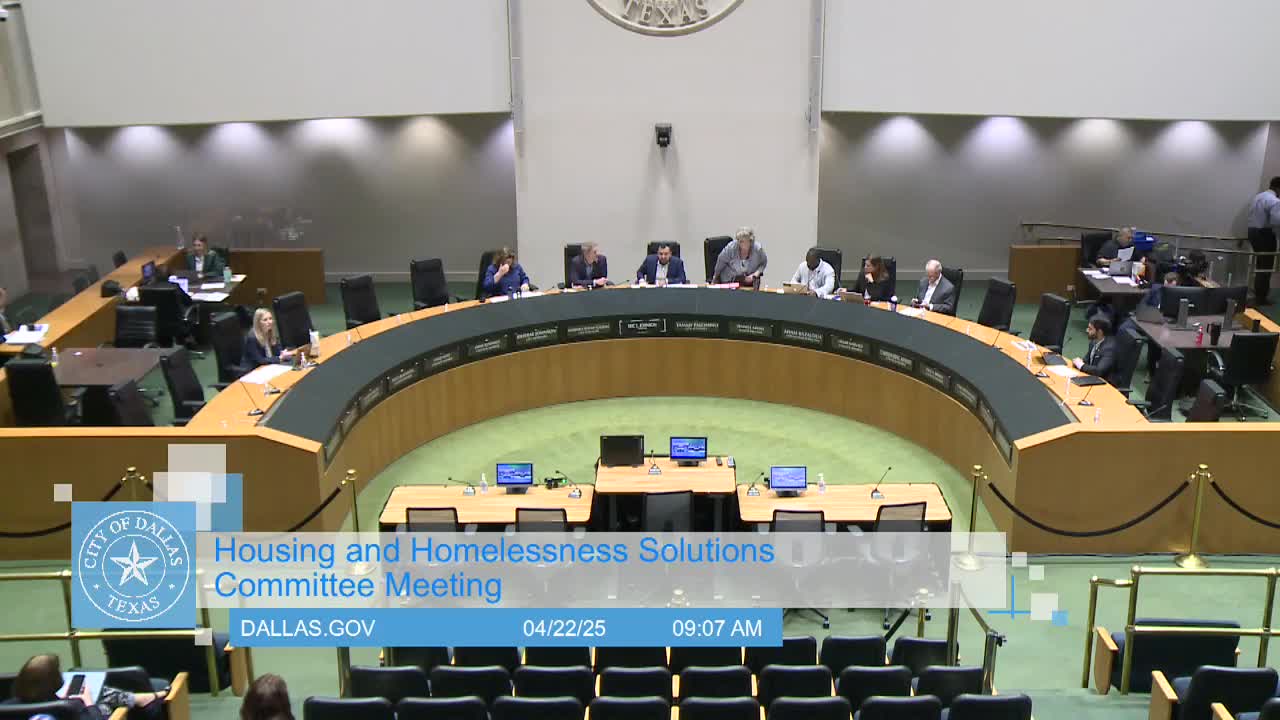
The Housing and Homelessness Solutions Committee held a public hearing April 22 to take comments on proposed changes to the Dallas Housing Finance Corporation and Dallas Public Facility Corporation program statements and bylaws.
The Housing and Homelessness Solutions Committee held a public hearing April 22 to take comments on proposed changes to the Dallas Housing Finance Corporation (DHFC) and Dallas Public Facility Corporation (DPFC) program statements and bylaws.
The hearing drew more than two dozen speakers including developers, board members, housing advocates and city staff. Developers and industry groups urged the committee to delay or abandon the proposals, saying several recommended changes — notably a proposed requirement that PFC projects be limited to census tracts with 20 percent or greater poverty and a push for deeper income targeting below 50 percent of area median income (AMI) — would make many projects financially infeasible. "If these changes were in place, neither would have moved forward," said Reinhardt "Swede" Hansen, founder of Smart Living Residential.
Why it matters: The proposed changes touch how two local quasi‑public entities use tax exemptions and other tools to finance workforce and affordable housing across Dallas. Proponents of preserving the current program structure argued DHFC and DPFC have produced the majority of the city’s recent affordable units and that adding mandated geographic or deeper‑AMI constraints now could halt projects in the pipeline.
Developers’ concerns and market context David Ellis, who identified himself as the District 10 representative on the DHFC board, explained why some DHFC projects include units at higher AMI bands to qualify for tax benefits: "If we were to require all restricted units to be banded to 80% AMI or below, then this will negate the benefit of the property tax abatement, and these projects will no longer become viable," he said. Ellis described typical per‑unit development costs and explained how tax abatement mechanics shape project underwriting.
Multiple developers and industry groups repeated that theme. Carsten Loan, affordable housing development manager at JPI, told the committee the city should evaluate proposals "on a project‑by‑project basis" because real estate costs and financing structures differ across neighborhoods. Brad Griggs, a longtime local real estate professional, warned that requiring PFC projects to be limited to high‑poverty tracts would force the corporations to acquire older, more capital‑intensive assets and would reduce competitiveness for acquisition deals.
Several outside experts and developers cited the Child Poverty Action Lab (CPAL) and its recommendations against concentrating affordable units in high‑poverty neighborhoods. Barrett Lindberg of Savoy Equity Partners read a prepared quote from CPAL into the record, saying the organization cautioned against using a static poverty map as a gating tool.
Boards, staff and legal perspectives Marcy Helfand, chair of the DHFC board, and Keith Pommecall (Pommecall spelled as in the record), president of the DPFC, urged caution in adopting governance or operational changes. Pommecall warned that limiting the DPFC's authority over its budget or adding an ex officio city staff seat could "jeopardize the DPFC's independence," a point echoed by other board members and the DPFC's attorney, Summer Greathouse.
Cynthia Ellickson, director of the Department of Housing and Community Development, summarized why staff brought the changes forward: the department compiled recurring council questions about location, revenue use, approval processes, administration caps and monitoring and proposed adjustments intended to align DHFC and DPFC activity with adopted housing priorities. Ellickson said staff and the boards have reconciled many items but that several issues remained contested, including administrative caps, location limits, AMI targets, community notice and whether the housing director should sit as an ex officio board member with authority over certain revenue uses.
Calls for a collaborative, data‑driven review Tony Page, board secretary for the DHFC, urged a collaborative, transparent and data‑driven process and cautioned that some recommendations could "significantly weaken" the statutory independence granted under chapters 303 and 394 of the Texas Local Government Code. Aaron Quinto, general manager of the DHFC, said board members have acquired specialized expertise and asked the committee to "have trust in your boards" while continuing collaboration.
Council reactions and next steps Chair Moreno (Housing and Homelessness Solutions Committee) closed the public hearing at 10:02 a.m. and directed staff to continue working with board chairs and other stakeholders. Several council members urged patience and additional analysis before taking final action: Vice Chair Mendelson said she preferred to avoid major action during election season and suggested any numerical cap be expressed as a dollar limit on tax exemptions rather than a hard project count; Council Member West pressed staff and board chairs on the timeline of meetings and said a May 9 joint meeting of staff and board representatives offered a realistic opportunity to resolve outstanding differences; Council Member Willis stressed the scale of production delivered by the two corporations and asked staff to provide data showing how the proposed limits would affect future unit production.
Clarifying details captured at the hearing - DHFC and DPFC production cited by speakers: DHFC has helped produce more than 7,000 homes with about $8,000,000 in city support (figures stated publicly during the hearing). The PFC has approved 23 projects, representing roughly $1.2 billion in projected costs and 5,286 homes (figures provided by advocates in testimony). - Staff said remaining contested items include: administration caps, location restrictions (the suggested 20% poverty gating rule for some PFC activity), AMI targets (proposals to require deeper affordability below 50% AMI in some projects), expanded community notice, and an ex officio housing director role with approval over certain revenue uses. - Legal/administrative sources cited in testimony: chapter 303 and chapter 394 of the Texas Local Government Code; Texas Department of Housing and Community Affairs (TDHCA) rules affecting tax‑credit projects; a 2023 Texas legislative update to PFC statutes referenced by multiple speakers; Child Poverty Action Lab (CPAL) analysis; a Texas Comptroller report on statewide housing deficits.
What the meeting did not decide The committee took public testimony but did not vote on policy changes. Multiple council members and staff said they want the May 9 meeting between staff, board chairs and the city attorney’s office before considering final action.
Ending: the committee scheduled follow‑up work Members asked staff to return with data on how the proposed changes would affect project feasibility and affordable unit production. Staff and board chairs agreed to continue discussions, and the committee signaled it would withhold final policy action until those collaborative, data‑driven conversations conclude.