Get Full Government Meeting Transcripts, Videos, & Alerts Forever!
Get email alerts on the Higher Education Funding topic
No spam. Unsubscribe anytime.
Assembly subcommittee hears warnings that proposed UC cuts, deferrals would deepen hiring freeze and squeeze students
Summary
Chair David Alvarez convened a state Assembly budget subcommittee hearing where UC officials warned that the governor's proposed roughly 8% reduction and deferred compact payments would deepen hiring freezes, risk larger class sizes and lengthen time to degree; the Legislative Analyst's Office recommended rejecting the proposed deferrals.
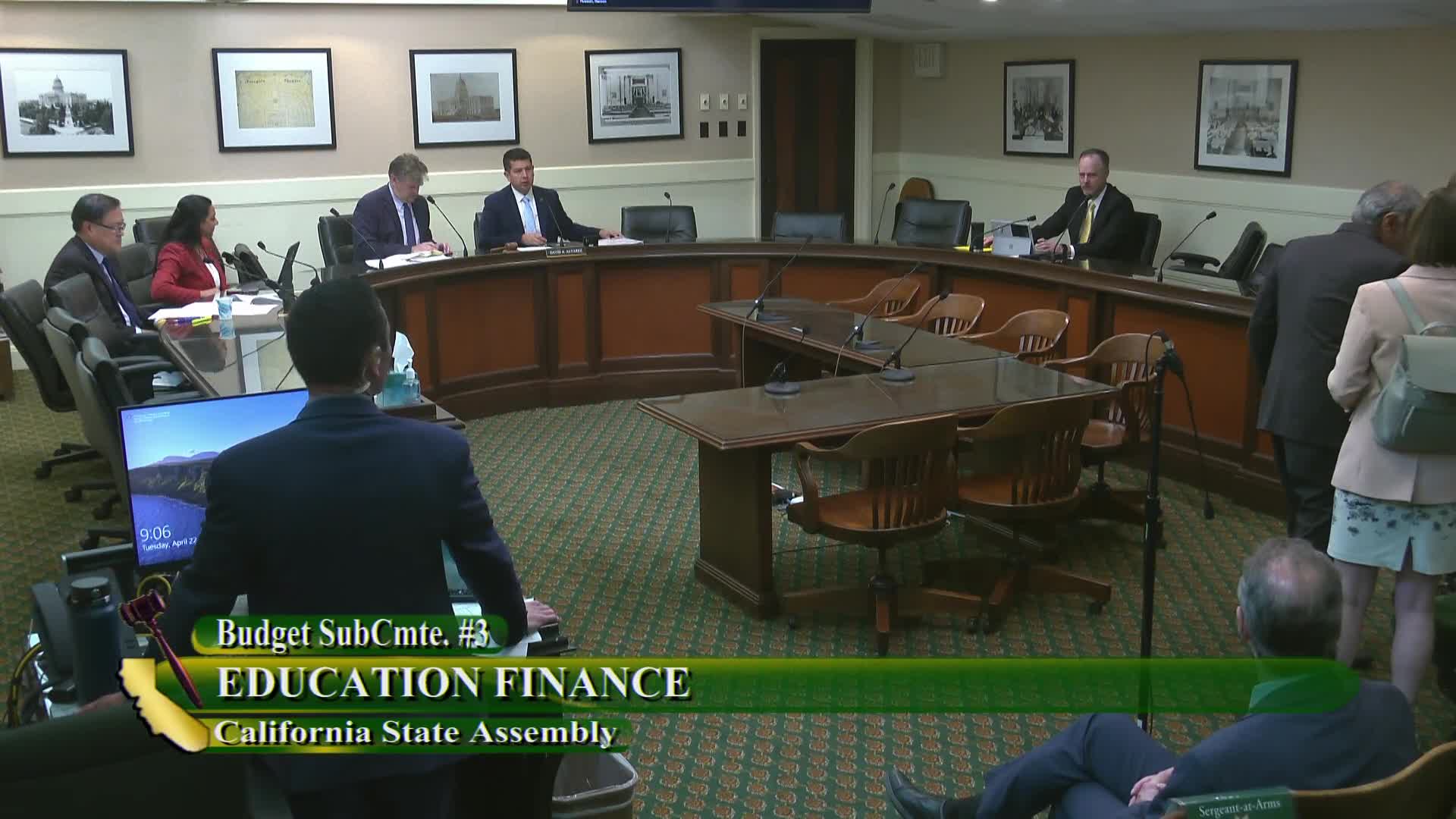
Chair David Alvarez convened the California State Assembly Budget Subcommittee No. 3 on Education Finance for a hearing on proposed state budget changes to the University of California, saying the panel would focus on the UC system's compact funding, enrollment and related items.
The hearing centered on the governor's proposal to defer portions of the multi‑year compact and to reduce UC's ongoing general fund support by roughly 7.95–8%. Jessica Deichman of the Department of Finance described that plan as “the fourth year of the multi year compact” and said the administration had proposed a deferral of some compact payments and continuation of reductions first included in the 2024 Budget Act. Ian Klein of the Legislative Analyst's Office recommended rejecting the proposed deferrals, saying the state has not identified how it would pay them and that deferrals could come at the expense of other programs.
Why it matters
The university and campus leaders said the combined effect of the cuts and the delayed compact payments would force immediate cost‑saving moves that are already underway at many campuses and would damage students' access and progress. Chancellor Pradeep Khosla of UC San Diego said the campus faces about a $42 million reduction from an 8% cut plus a $31 million shortfall if the nonresident‑replacement payment is deferred, creating a roughly $73 million gap for San Diego. "I ask you to reconsider the magnitude and the severity of these cuts," Khosla told the subcommittee.
What panelists said
- Ian Klein, Legislative Analyst's Office: The LAO told the committee UC's total core funding would likely be roughly flat in 2025–26 if the state's plan is adopted, but UC faces rising nondiscretionary costs (employee compensation, health and retirement). Klein said some campus actions already taken include university‑wide hiring freezes and reduced maintenance spending and advised the Legislature to reject the proposed deferrals.
- Jessica Deichman, Department of Finance: Deichman explained the administration's proposal maintains language from the 2024 Budget Act and reflects the compact's fourth year. She said the administration 'expects campuses to plan for an approximate $396.6 million reduction systemwide beginning in 2025–26 and reiterated the budget as submitted would include the deferrals.
- Chancellor Pradeep Khosla, UC San Diego: Khosla described campus steps already in place, including a system and campus hiring freeze, pausing capital projects not yet under construction, and preparing for potential layoffs. He warned that larger class sizes and longer times to degree would be likely outcomes if the cuts stand.
- Seiya Verkainen and Catherine Newman, University of California Office of the President (UCOP): UCOP representatives told the committee campuses have limited alternative core funds, described legal and donor restrictions on endowment usage, and said UCOP holds small unallocated reserves. UCOP said the proposed reductions would push available core funds for students to a low point compared with the compact period and earlier recessions.
Public comment and campus voices
Several campus employees and students spoke during the hearing's public comment periods asking the subcommittee to restore funding or end interim hiring freezes. Amy Fletcher, a staff researcher (SRA) at UC Davis, said the systemwide hiring freeze “would worsen the short staffing crisis we've been living with since the COVID pandemic” and urged the committee to restore cuts. Other UC Davis clinicians and staff echoed that concern, describing potential impacts on patient care and clinical research.
Budget options discussed
Committee staff and the LAO presented options aimed at narrowing reductions that would minimize direct student impacts, including focusing cuts on UCOP administrative spending, or targeting institutional support lines and non‑student operational spending before affecting academic affairs and student services. UC representatives responded that while administrative savings are reasonable to consider, many UCOP services support campus responses to federal funding changes and other regulatory burdens and would need to be cut carefully.
Enrollment implications
UC reported continued growth in California undergraduate enrollment across many campuses and noted that campuses have met or exceeded resident enrollment and nonresident‑replacement targets in recent years. The provost, Catherine Newman, said UC had added more than 16,000 full‑time equivalent California undergraduates in five years. But she cautioned that the university cannot sustain further enrollment increases without funding: "The University of California cannot afford to continue increasing enrollment with less funding," Newman said, adding that with an 8% cut UC would be forced to reduce enrollment for the 2026 admission cycle.
LAO advice and policy language
The LAO recommended the Legislature reject the deferral of base augmentations and nonresident replacement funding and suggested provisional budget language to protect recent gains in nonresident replacement: campuses exceeding an 18% nonresident threshold should not increase that percentage above 2025 levels while the Legislature evaluates funding.
No formal action recorded
The hearing was informational; subcommittee members asked questions and explored alternatives but recorded no final votes or formal actions on the items. Chair Alvarez and members said they would continue discussions and hold the issue open for further negotiation as the May budget process proceeds.
Ending note
Multiple witnesses asked the Legislature to consider the compound pressures facing UC campuses, including federal research uncertainties and enrollment commitments, and to balance any reductions to preserve student access and degree completion. The committee left the issue open for follow‑up as the state budget process continues.