Get Full Government Meeting Transcripts, Videos, & Alerts Forever!
Get email alerts on the Budget Finance topic
No spam. Unsubscribe anytime.
Queen Anne’s County schools face $2.6 million projected shortfall; board pauses budget approval for two weeks
Summary
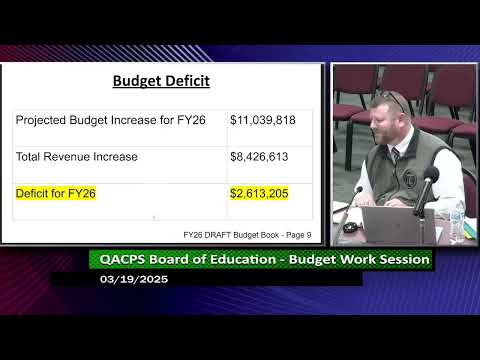
Interim finance staff told the Queen Anne’s County Board of Education on March 19 that the draft FY26 operating budget shows a roughly $2.6 million deficit even after a county pledge of $7 million in local funds.
Interim finance staff presented the draft fiscal year 2026 operating budget at the Queen Anne’s County Board of Education budget work session on March 19, saying the document still is a work in progress and currently shows a budget shortfall.
Rob Watkins, interim supervisor of finance, told the board the district is modeling revenue with the county’s preliminary offer of $7,000,000 in local funds and noted additional state costs being allocated to local governments. After the projected revenue increases are applied to the district’s spending plan, Watkins said the draft budget shows a remaining deficit of about $2,613,205.
Watkins and other staff told members roughly 83.5 percent of the proposed budget is devoted to salaries and benefits, with about 59 percent for pay and 25 percent for fixed charges such as retirement and insurance. Staff said most of the year‑over‑year budget increase is tied to salary step increases and fixed employee costs.
Board members and district staff discussed a wide range of line items and policy initiatives during a multi‑hour session. Key items that drew extended public discussion included Marathon Health (the district’s onsite health center program), changes to food service after ending the Sodexo contract, prekindergarten expansion tied to state “Blueprint” funding, transportation and bus contracting, substitute teachers and custodial staffing, and restricted federal and state grants.
Marathon Health and employee clinic
District staff said Marathon Health represents a roughly $1.6 million addition to the budget this year, after start‑up and grant funds used in year one ended. Staff said the center is in its second year of full operation under a multi‑year contract and that roughly 27 percent of eligible employees currently use the service, with a participation goal of about 35 percent. Staff and board members disagreed about how quickly the district will see insurance‑cost savings; estimates discussed during the meeting ranged from three to five years before measurable insurance reductions, while some board members said a realistic breakeven could take longer and remains uncertain.
Board members asked for the Marathon Health contract so they could examine terms, including the district’s options — if any — for early termination. District staff said the center was built with one‑time grant funds for facility build‑out and equipment and that some operating costs have shifted to local budgets now that grant funding concluded.
Food service, grants and restricted funds
Staff clarified that food service now operates in a separate fund (Fund 5) after the district moved away from Sodexo; those revenues and expenses do not appear in the operating budget book. Officials said food service was designed to be self‑supporting and that federal reimbursements and school meal revenues cover most program costs, while some central office staffing moves reduced previous contracted costs.
The board also reviewed restricted grants (federal and state funds) and grant timing. Staff warned some federal funds may not be finalized by June 30 and that historic grants such as the Family Support Center and Judy Centers have been flat‑funded for years, creating recurring local costs when salary bases rise faster than the grant award. Staff said social services will assume administration for one Family Support Center this coming year to preserve services while relieving the district’s operating budget of the gap.
Transportation and substitutes
Board members asked about bus contracts and replacement schedules. Staff said the current contractor agreement is being renegotiated and that the district seeks multi‑year contracts to support vehicle financing; the county and district also discussed joint fleet decisions. Staff described PVA (per‑vehicle allowance) and mileage components used in bus contractor pay formulas and said the existing bus contract expires June 30, 2025.
Substitute teacher funding and staffing was another focus. Staff said the district spent roughly $640,000 on teacher substitutes in FY24 and about $755,000 in FY23; previous years included building‑based permanent substitutes funded by a grant. Board members asked whether restoring permanent building substitutes would be cost‑effective; staff said the district has added more day‑to‑day substitutes this year but that substitute coverage remains a significant budget pressure.
Next steps
Board members declined to approve the draft budget at the March 19 meeting. Trustees asked district staff to produce additional expenditure analysis (including actuals-to‑date and five‑year trend comparisons), a prioritized list of potential non‑personnel savings, and contract materials (for Marathon Health and transportation) for closer review. The board asked staff to return with a more detailed package and to take up formal action at the regularly scheduled April 2 meeting.
What the board did not decide
No final cuts to personnel were proposed or approved in open session; board members and staff emphasized that personnel‑level decisions would be handled under the appropriate statutory and contractual processes. Staff said the draft numbers do not assume staff reductions and that retirements and resignations occurring this spring will factor into final staffing and budget work but should not be the sole basis for planning.