Get Full Government Meeting Transcripts, Videos, & Alerts Forever!
Get email alerts on the Digital Privacy And Safety topic
No spam. Unsubscribe anytime.
Committee advances bill to require verification and takedown procedures for nonconsensual explicit content
Summary
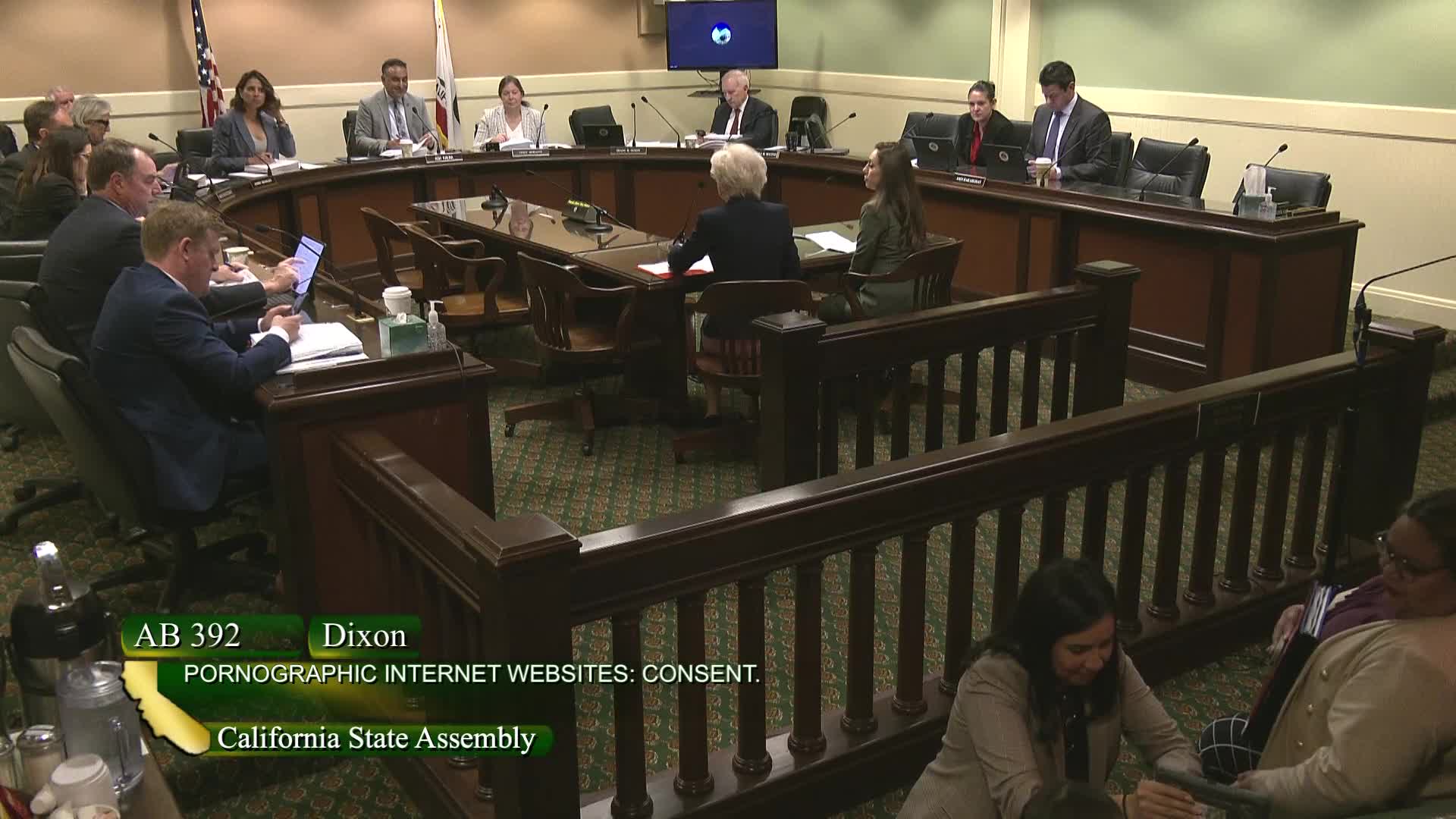
AB 392, the "Protect Act," would require adult-content sites to verify uploader declarations and remove nonconsensual or minor-recorded explicit content within 48 hours of a complaint and allow civil claims against operators and uploaders.
The committee heard AB 392, a bill aimed at preventing the nonconsensual distribution of explicit images and videos, particularly when minors are depicted. The author said the measure would require uploaders to sign a statement, under penalty of perjury, affirming that each depicted person consented and was an adult; platforms that receive a complaint would be required to remove disputed content within 48 hours. The bill also creates a private civil cause of action against both the uploader and the hosting operator.
An actress and survivor of a widely publicized image-leak testified about the damage caused by nonconsensual distribution. "My private photos and a video were stolen, leaked, and spread across the Internet, and it destroyed my life," said survivor Udo Swallows. She described the limits of existing remedies, the costs of takedown attempts and the additional threat posed by AI-generated nonconsensual imagery.
Committee members asked about implementation details and enforcement mechanics. Supporters described technologies such as fingerprint-stamped hashing tools that can help platforms identify and block reuploads, and several members encouraged the author to consult further with platform- and free-speech-focused groups to refine compliance mechanics. The committee passed AB 392 as amended to appropriations.