Get Full Government Meeting Transcripts, Videos, & Alerts Forever!
Get email alerts on the Land Use Zoning topic
No spam. Unsubscribe anytime.
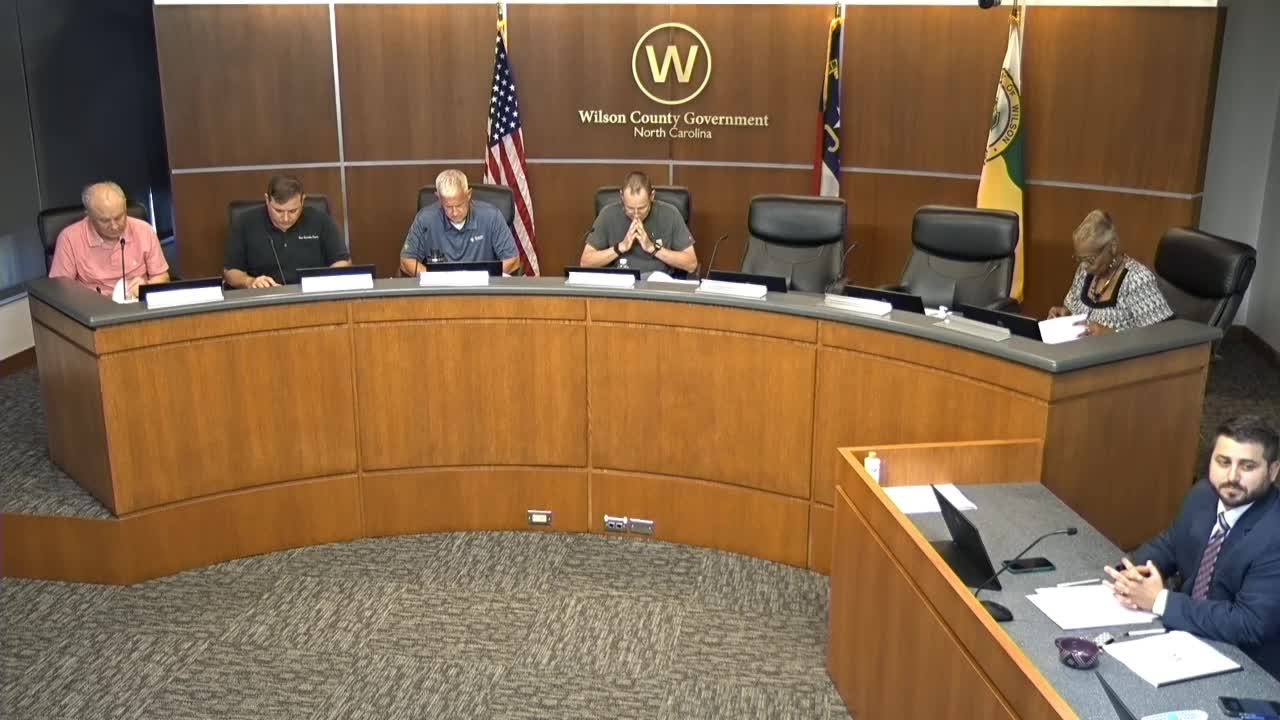
Planning board recommends conditional rezoning for concrete plant on Tar River Ranch parcel
Summary
At its April meeting the Wilson County Planning Board voted to recommend conditional rezoning of 15.4 acres of the Tar River Ranch parcel to allow a single-use cement/concrete manufacturing facility, subject to staff conditions including buffering, stormwater approvals and an NCDOT driveway permit.
At its April meeting, the Wilson County Planning Board recommended approval of a conditional rezoning to allow construction and operation of a cement/concrete manufacturing facility on 15.4 acres of a larger Tar River Ranch parcel.
The rezoning request, submitted by ELA LLC for property owned by Tar River Ranch LLC, would change the 15.4-acre tract from AR (agricultural/residential) to M2CD (heavy industrial, conditional district) but would be limited by condition to the concrete/cement manufacturing use only. A county planner told the board the change would not authorize other M2 uses unless they were also allowed in AR.
Why it matters: the parcel lies adjacent to U.S. 264 Bypass and within a public water-supply watershed subject to Neuse River Basin guidelines, and the board discussed measures intended to reduce noise and visual impacts on nearby residences. Staff said the plant would employ about eight people and generate roughly 15–20 vehicle trips per day; the proposal is intended to serve a local need for a concrete facility.
Board discussion centered on buffering, driveway access and compliance with state and county permits. North Carolina Department of Transportation staff recommended that all truck traffic enter and exit via Green Pond Road to keep heavy vehicles off local residential streets; the planning staff included that DOT recommendation in the conditions the board adopted. The staff also noted that the site lacks county water, so operations would rely on wells and septic systems, and that stormwater approval under Neuse River Basin guidelines and the county stormwater ordinance is required before final zoning.
Several board members said the standard 50-foot planted buffer set out in the Unified Development Ordinance (UDO) is insufficiently detailed for this site and asked that the rezoning approval require a berm with plantings to screen residences. A planning attorney (staff) advised the board that it can articulate general buffering requirements in its rezoning motion and leave the exact planting/engineering details to the zoning administrator and subsequent site-plan review, subject to appeal to the Board of Adjustment. The board amended the staff recommendation language to require buffering "consisting of a berm of sufficient height and width to screen existing residential properties adjoining the property, planted with a mix of pine and canopy trees, and suitable undergrowth."
Other staff-recommended conditions the board included in its recommendation were: obtain an NCDOT driveway permit (and follow DOT access restrictions), secure any required erosion and sedimentation control/DEQ approvals, record a subdivision plat showing the 15.4 acres carved from the larger parcel, and meet all applicable county, state and federal requirements before final zoning.
Motion and outcome: a motion to recommend approval, with the staff conditions and the expanded buffering language, passed by voice vote. The motion as stated on the record asked that the rezoning be limited to the concrete/cement manufacturing facility and incorporated the DOT recommendation and the staff development conditions. The board did not record a roll-call tally in the transcript; members voted by voice and the presiding chair declared the motion carried.
Looking ahead: if the board’s conditional rezoning is approved through the county’s formal zoning process, the zoning administrator will work with the applicant on detailed site-plan elements (berm and plantings, driveway surfacing, gate/Knox Box access for emergency services and engineered stormwater controls). If the applicant disputes the administrator’s implementation of the board’s buffering direction, that decision could be appealed to the Board of Adjustment.
Sources and limitations: staff presentation and applicant statements during the Wilson County Planning Board meeting in April. The transcript records staff estimates of employment (8 employees) and daily trips (about 15–20); these figures were presented by staff and not detailed in supporting materials in the meeting record. The meeting did not specify an effective date for final zoning or a recorded vote tally.