Get Full Government Meeting Transcripts, Videos, & Alerts Forever!
Get email alerts on the Wastewater Treatment topic
No spam. Unsubscribe anytime.
Bellaire council hears HDR estimates: new plant could cost $105–130M; hookup to Houston far cheaper
Summary
City staff and HDR presented three options for Bellaire's aging wastewater plant: rehabilitate on-site ($105M estimate), build a new plant adjacent to Public Works ($130M), or decommission and connect to Houston (roughly $11.5M plus a $2.1M lift station). Council heard questions and public comment and did not take a vote.
Bellaire city officials and consultants on April 21 presented refined cost and timeline estimates for replacing, rebuilding or decommissioning the city's wastewater treatment plant, concluding the least-expensive technical option is to pipe flows to the City of Houston and discontinue Bellaire's plant.
The council heard HDR Engineering's updated work order and cost refinements from HDR engineer Chris Malinowski and a summary from Bellaire Assistant City Manager and City Engineer Beth Jones. Malinowski told the council "the least expensive option is to connect to the city of Houston and decommission the existing site." Jones said, "Honestly, my recommendation would be option 2 over option 1," referring to building a new plant on the Public Works site rather than rebuilding in the existing footprint.
Why it matters: Bellaire's plant is decades old, has subsided in places and is surrounded by homes, which creates regulatory and construction complexities. The council must weigh capital cost, long-term debt service and stormwater-detention tradeoffs as it considers whether to preserve municipal control of treatment or outsource treatment to Houston.
HDR presented three options and HDR's refined Level 5 cost estimates: rehabilitate and partly replace the existing plant on its current site (option 1) at about $105 million; build a new plant on the adjacent Public Works site (option 2) at about $130 million; or decommission the plant, build a force main and connect to Houston (option 3), about $4.8 million in construction plus one-time impact fees that HDR and staff estimated together at roughly $11.5 million before a potential $5 million credit from a land swap. The council was told the BelAir lift station necessary for any option is estimated at about $2.1 million (this cost is separate from the three option totals).
HDR said several site constraints drive up costs for on-site options: tight property footprints that make meeting the Texas Commission on Environmental Quality (TCEQ) 50-foot odor buffer difficult; flood-plain and subsidence issues that require raising structures; replacement of old buried concrete basins; and the need for a temporary treatment plant during construction. Malinowski noted economies of scale also work against Bellaire because a 2.5 million gallons-per-day (MGD) plant is small relative to contractors' preferred projects.
Timelines and detention: Staff gave approximate schedules of roughly 3 to 3.5 years to design and construct a rebuilt plant on the existing or adjacent site and about 2.5 years to design and construct a force main to Houston. The three options also differ in stormwater detention yield: rehabilitate-on-site would produce about 10 acre-feet of usable detention; a new plant on the Public Works site could yield about 32 acre-feet; and decommissioning and using the freed land would allow roughly 50 acre-feet. Council and staff discussed how detention volume affects the city's Cypress Stitch flood-control design.
Operational costs and rates: Jones presented per-thousand-gallon treatment-cost projections. Bellaire's current cost to treat (FY25) was cited as $2.44 per 1,000 gallons; Houston's FY25 wholesale treatment charge was cited as $1.90 per 1,000 gallons. Using debt service assumptions, HDR's estimates would raise Bellaire's treatment cost dramatically if the city issued the higher debt amounts: the $105M scenario would raise treatment-cost-equivalent to about $14.52 per 1,000 gallons and the $130M scenario to about $16.78 per 1,000 gallons (staff stressed these are system-cost calculations, not customer-bill line items).
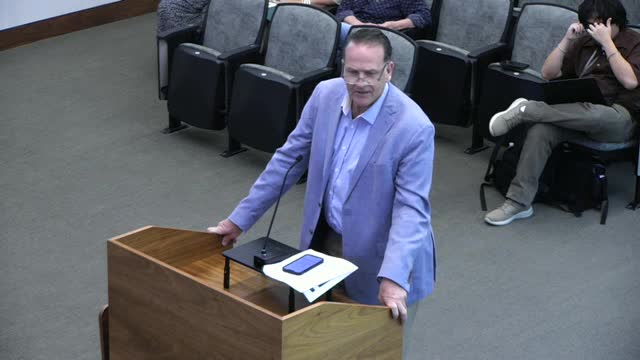
Public comment and council questions: Several residents addressing council during the public-comment period urged different outcomes. Some speakers opposed outsourcing treatment to Houston and urged rehabilitating Bellaire's plant; others supported decommissioning and piping to Houston to remove odors and the plant footprint. Council members pressed HDR and staff on specifics: whether TCEQ variances for odor setbacks can be obtained; why a temporary plant is likely needed for on-site construction; what the condition of Houston's Southwest Wastewater Treatment Plant is and whether Houston's consent-decree-driven capital program affects rates; and how the city would preserve optionality if it decommissions the plant now and later wanted to rebuild.
Regulatory points and risks: HDR and staff said a TCEQ 50-foot setback applies to odor-generating equipment; the city would need an odor-control plan and a variance if it cannot meet that setback. Staff also noted that new permits and evolving regulations (for example, potential future testing for PFAS in biosolids) could add requirements and cost. HDR flagged that much of Houston's Southwest plant work is already planned (a major rehabilitation estimated at $250M–$350M), and HDR said those capital costs are incorporated into Houston's rates.
Next steps: No vote was taken. Mayor Gussie Pappas and staff said the HDR analysis was commissioned so council could make an informed decision and indicated the city will continue the community engagement and follow-up. Jones and staff said they expect to bring a land-swap and impact-fee agreement with Houston back for council consideration; staff also said the city must act relatively quickly to avoid compliance and operating risks at the existing plant. The council scheduled additional budget and strategic planning workshops in coming weeks and indicated further public discussion and council deliberation on wastewater will follow.
Quotes (attributed to speakers in the meeting record): "The least expensive option is to connect to the city of Houston and decommission the existing site," Chris Malinowski, HDR engineer.
"Honestly, my recommendation would be option 2 over option 1," Beth Jones, assistant city manager and city engineer.
What the council did not do tonight: No formal motion or vote on any of the three options. No final agreement with Houston was approved. Staff said additional work and public engagement will precede any binding decision.
Context and background: Bellaire's wastewater plant dates to the 1940s with multiple upgrades over decades; consultants used an average-daily-flow design basis of 2.5 MGD and a 2-hour wet-weather peak of 6.25 MGD for the cost estimates. Council and staff repeatedly framed the choices as trade-offs among capital cost, operating cost, regulatory complexity and stormwater-detention needs for the Cypress Stitch flood-mitigation project.
Ending: Council members and staff said they would continue outreach and return to the subject in coming weeks; Mayor Pappas said the city needs to "move and do something fairly quickly" to address the plant's condition and its downstream effects on compliance, rates and flood mitigation.