Cochise County supervisors review public works budget, focus on solid waste funds, fleet charges and rural road maintenance
Loading...
Summary
In an April work session the Cochise County Board of Supervisors heard Public Works Director Jason Fazio and staff explain solid waste revenues and required closure funds, outline fleet replacement charges and underutilization reports, and discuss rural road maintenance and state Highway User Revenue Fund formulas.
Public Works Director Jason Fazio told the Cochise County Board of Supervisors on April 1 that the department’s budget review would concentrate on three divisions: solid waste, light fleet and heavy fleet.
Fazio said the county must hold statutory funds for landfill closure and landfill development and described revenue sources for solid waste operations, including tipping fees, a state waste-tire program and limited recyclable sales. "This is one of those statutes that we have to put money away so that we can care for the landfills, indefinitely," Fazio said.
Why it matters: the work session was a departmental budget briefing, not a formal vote. Supervisors used the discussion to press staff for clarifications about fleet charges, underwriting of replacement vehicles, and options for stabilizing costs on rural roads. Staff described specific budget lines, existing practices for recycling and hauling, and follow-up tasks the board requested.
Solid waste revenue and costs
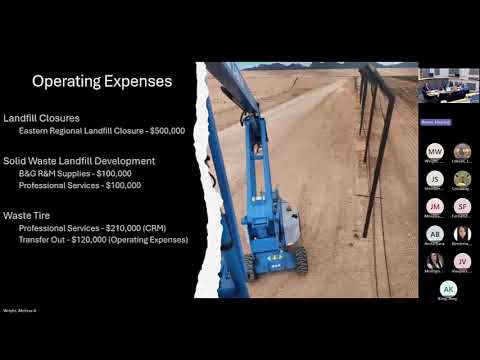
Fazio presented the solid waste revenue and expenditure lines shown in the department packet. He described a landfill-closure fund (listed in materials at roughly $3.32 million), a solid-waste landfill development line, and annual operating revenue from scalehouse fees and recyclables (materials showed roughly $6.89 million of solid-waste operations revenue). Fazio said Cochise County receives a state-funded waste-tire program allocation (funded by the $5-per-tire disposal fee) and pays a private contractor, identified in the session as CRM/Crumb Rubber in Phoenix, to haul and grind tires.
Fazio told the board the county accepts approximately 82,000 tons of material a year at the regional facility and hauls 2,000–5,000 tons of metal and roughly 2,000 tons of cardboard to Tucson for recycling. He explained the county’s approach: removing recyclables reduces the volume ("airspace") that otherwise would occupy landfill capacity and helps stabilize tipping fees.
On expenses, Fazio said the landfill-closure budget includes a liability calculation set by auditors and finance and noted a roughly $500,000 liability line that funds methane and water testing and long-term care for closed facilities. He described transfer-station maintenance (professional services/building and grounds) at about $200,000 a year and said some work is shifting from contractors to the county facilities group.
Fleet operations, replacement charges and auctions
A large portion of the conversation focused on fleet management. Fazio and Joe Hutchison (identified in the session as fleet superintendent) explained revenue and expense lines for light fleet and heavy fleet and described how the county charges departments for vehicle usage, fuel and replacement.
Key figures discussed in the session: light-fleet operations revenue appeared in the packet near $3.7 million with fleet-management charges shown near $3.5 million; a light-fleet capital line showed roughly $2.5 million. Fazio said the county currently collects about $0.17 per mile for replacement on many vehicles but that rate will need to rise (Fazio estimated a likely increase into the mid-20¢ range for sedans and noted Tahoe-style pursuit vehicles require substantially higher recovery rates because outfitting and purchase costs push total unit cost closer to $75,000). "We really should be collecting closer to 45¢ or 44¢ a mile somewhere in there" for fully outfitted pursuit vehicles, Fazio said as an illustration of the funding gap.
Staff told supervisors they plan to adjust replacement charges to reflect rising vehicle prices and upfit costs, but emphasized this is an internal accounting change to align charges with replacement needs rather than a board vote during the work session.
Staff also reviewed the county’s approach to reusing or “mothballing” vehicles: higher-mileage vehicles replaced by new units are often repurposed for lower-mileage county uses (for example transfer-station trucks), reducing the need to buy new vehicles for those duties. Fazio said underutilized-vehicle reports are being built to identify county vehicles that log very low annual mileage (many with under 2,000–5,000 miles annually) and to ask departments whether those vehicles should be repurposed or returned to the motor pool.
The group discussed recent auction strategies—mixing, timing and advertising of surplused fleet to avoid diluting buyer demand—and the budget impact of grant-funded vehicles. Fazio said the sheriff’s department obtained 10 grant vehicles that will substitute for county replacement purchases this year and will reduce county outlays by roughly $500,000 for that replacement cycle.
Leasing versus buying
Supervisors raised leasing as an option; Fazio and others said short-term leases can make sense for short-duration needs but that long-term leasing generally costs more than ownership for the county’s usage patterns and in-house maintenance capacity. "If you're going to keep that vehicle for more than three years, buy it," Fazio said, summarizing the county’s experience and an analysis the department has run with a commercial rental vendor.
Heavy fleet capital and equipment priorities
For heavy fleet, staff described capital requests the packet showed for chip spreaders, graders and loaders and identified a plan to rebuild or extend the life of an existing landfill scraper engine rather than buy a new million-dollar machine. Solid waste capital items listed included a walking-floor trailer and a high-side trailer to improve efficiency hauling metal to recyclers.
Roads, county maintenance and HURF formula concerns
Supervisors and staff discussed rural road maintenance, grading frequency and the limits of county responsibility. Fazio recommended creating a clear online pamphlet or PDF that shows which roads are county-maintained and how often they are scheduled for grading. He and supervisors also returned to a long-running funding question: the distribution formula for the state Highway User Revenue Fund (HURF) and whether current formulas disadvantage rural counties with many miles of low-traffic roads. A supervisor asked staff for help developing suggested formula changes or advocacy language to present to state officials.
Follow-up items and next steps
Board members directed staff to continue developing the underutilized-vehicle report and to reach out to department heads for vehicle-use justifications for units under the low-mileage threshold. Staff said they will refine fleet-recovery rates in the budget and provide more roll-up views showing total fleet charges across departments. Fazio offered to prepare or post an informational map/PDF of county-maintained roads and their maintenance schedules.
No formal actions or votes were taken during the work session; the meeting was a departmental briefing and staff follow-up was requested by the board.
Ending: The county will carry these proposals into the department’s budget process and return with more detailed figures and the underutilization analysis at a later work session.