Get Full Government Meeting Transcripts, Videos, & Alerts Forever!
Get email alerts on the Tenant Anti Harassment Ordinance topic
No spam. Unsubscribe anytime.
Oxnard housing staff propose tenant anti-harassment ordinance, request two enforcement positions
Summary
Housing staff recommended the City Council introduce a tenant anti-harassment ordinance to address reported coercive tactics by landlords and requested two enforcement positions and budget authority during the FY 2025–26 budget process; final adoption and funding remain pending.
Alba Marshall, rent stabilization and just cause eviction program supervisor for the Oxnard housing department, recommended that the City Council introduce a tenant anti-harassment ordinance and authorize two positions to enforce it. Marshall made the presentation during a council meeting staff report, saying the measure responds to an increase in reported landlord tactics aimed at forcing tenants to vacate rent‑stabilized units.
The proposed ordinance would prohibit specific landlord acts and omissions identified as harassment, allow a tenant, the city or an organization to pursue civil damages and attorney fees, and make the most serious violations misdemeanors subject to criminal prosecution. Marshall said staff engaged Stephen Lewis, Esquire, a private attorney with nearly 30 years of experience drafting rent‑stabilization and tenant‑protection ordinances, to prepare the draft and to incorporate best practices from other California cities while avoiding conflicts with constitutional protections and published appellate opinions.
Why it matters: Marshall told the council that reported landlord tactics in Oxnard include reducing housing services, issuing eviction notices on false grounds, threatening to contact immigration authorities, and refusing required repairs — actions that staff say can coerce tenants to leave and then allow landlords to raise rents without following the city’s rent‑cap and fair return processes. Staff cited similar ordinances in Santa Monica, West Hollywood, Oakland, San Jose and Los Angeles as models that jurisdictions have used to deter illegal conduct and support tenants’ legal defenses.
Key provisions and amendments: The draft identifies specific prohibited conduct and, in response to community input, includes two substantive clarifications requested by stakeholders and a council committee. First, the ordinance defines “normal business hours” for owner entry as 7 a.m. to 7 p.m. Monday through Friday and 8 a.m. to 12 p.m. Saturday; entry outside those hours is allowed only in an emergency, when a tenant has abandoned the premises, or if the tenant consents at the time of entry. Second, the ordinance clarifies that a “good faith” exception does not apply to communications or conduct made in connection with actual pending litigation or litigation preparation, including communications subject to Civil Code section 47, consistent with the legal standard cited in the presentation.
Implementation and timing: Staff estimated the ordinance would apply citywide to residential tenancies and provided an estimate of housing units subject to the law. Marshall said launching a comprehensive enforcement program would require staffing and resources and recommended authorization to add two positions for FY 2025–26: one partially dedicated assistant city attorney and one full‑time housing investigator. The assistant city attorney would conduct legal research, prepare opinions and regulations, and prosecute civil or criminal violations; the housing investigator would handle complaint intake, investigate and prepare reports, and make referrals for prosecution or nonprofit services.
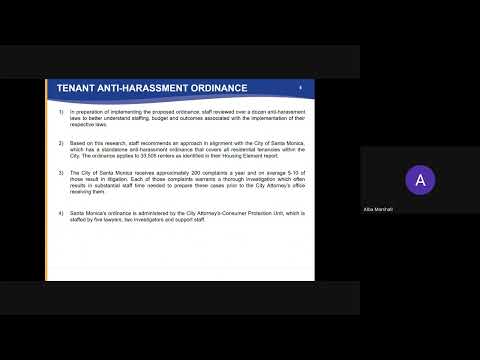
Marshall told the council that staff’s review of other jurisdictions showed enforcement can require substantial staff time — for example, Santa Monica receives about 200 complaints a year and pursues litigation in about five to 10 cases annually — and that those programs are often administered by a city attorney’s consumer protection unit with multiple attorneys and investigators. Staff said the requested positions and associated costs would be included in the FY 2025–26 budget process; if the council approves introduction of the ordinance on April 29 as requested, Marshall said the ordinance would not come back for adoption until after the budget is considered and, if adopted, would take effect 30 days after adoption (Marshall said “at the earliest, this ordinance would not be effective until at least July”).
Budget and outstanding details: In the presentation staff stated an annual budget figure needed to support the two positions but the transcript phrasing was unclear; staff characterized the amount as an approximate annual cost and said the positions and funding would be considered as part of the FY 2025–26 budget. The City Council had not yet taken a formal vote on the ordinance during the staff presentation.
What’s next: Staff recommended the council review and approve the first reading of the ordinance by title only, waive further reading, and authorize inclusion of two full‑time equivalent positions and the associated budget in the FY 2025–26 budget for implementation. Because council action on the ordinance and the budget were separate steps in the process, Marshall indicated the ordinance could not take effect until after budget approval and the required post‑adoption waiting period.