Get Full Government Meeting Transcripts, Videos, & Alerts Forever!
Get email alerts on the Development Wildhorse Roads topic
No spam. Unsubscribe anytime.
Planning commission continues Wildhorse development after dispute over public vs. private roads
Summary
The Hideout Planning Commission on April 17 continued consideration of the Wildhorse development after an extended debate over whether roads in the project should be public or private and directed staff and the applicant to meet to resolve right-of-way and utility questions before a May 15 or special meeting.
The Hideout Planning Commission on April 17 continued consideration of the Wildhorse development after an extended debate over whether internal roads should be built and dedicated as public streets or remain private, and how that choice affects setbacks, eligibility for a public infrastructure district (PID) and the design of utilities.
The commission voted to continue the item to the regular May 15 meeting and said it will try to schedule a special meeting earlier if staff, the applicant and the town engineer can resolve outstanding technical issues.
Why it matters: The commission and staff said whether the streets are public or private will change required road widths, right-of-way, front-yard setbacks for lots that face those streets, and whether the developer can use a PID to finance infrastructure. The applicant says switching to public roads is necessary for PID financing; staff warned public roads trigger wider town standards that will increase grading, retaining walls and infrastructure costs.
What commissioners heard - Thomas (staff member) summarized the change the applicant recently proposed: “they are now proposing an amendment to the application, and they would like for the planning commission to consider their request that the roads be public.” He said that switch could affect setbacks and other MDA exceptions that the commission will later consider.
- Jerry Krieland, development adviser for the applicant, said the original road design mirrored the adjacent Wolf Road and that the team intended to extend that design into the project. He described the design rationale and stated the team’s willingness to work with the town on some stretches: “we initially designed the roads for the extension of Wolf Road, to mirror the exact dimensions and size as the existing Wolf Road that was, developed by, the adjacent, developer.”
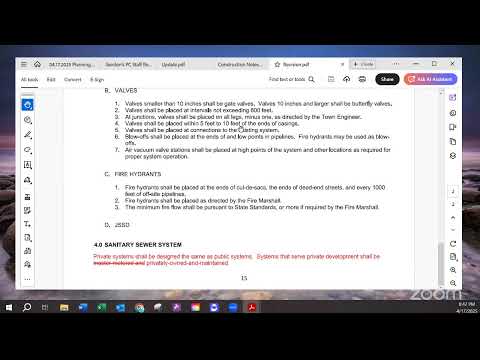
- Gordon Miner, the town engineer, said the late change to propose public, narrower streets put the town at a disadvantage because it was not part of the original public notice and staff review: “the town's at a disadvantage to have the applicant spring something new at the last second.” He and other staff emphasized that town standards require a wider pavement and larger right-of-way than the 26-foot pavement the applicant proposed for private streets: the current public standard the commission discussed is roughly 34 feet of pavement and approximately a 53-foot right-of-way (including space for sidewalks and utilities). By contrast, the applicant’s private-street proposal had a 26-foot pavement and a 26-foot right-of-way with 10-foot public-utility easements on each side.
- Applicant counsel Justin Keys argued the project’s submission predates a January code change and said the code in effect at the time of a submittal matters for vesting: “the code that would apply to our application would be the code that was in place at the time that we put our submission in and paid the fee.” Commission counsel Cameron responded that vesting is not something the commission should decide at the hearing and that what vests depends on what is formally applied for: “I don't think we're gonna determine vesting here tonight… it depends on what's applied for and what's before the Planning Commission.”
Costs and constraints: The applicant said widening the road to meet current public standards would require substantial grading and higher retaining walls because of steep slopes, and would increase project cost. Krieland estimated that widening a particular stretch would add “a couple hundred thousand dollars of additional project cost.” The applicant also said certain utilities (storm, sewer, water) were intended to be public infrastructure and that gating would be removed to allow public trail connections.
What the commission directed The commission did not make a final recommendation. Instead it asked staff, the applicant and the town engineer to meet and reconcile the applicant’s proposed roadway dimensions with what was built adjacent on the Claim property and with the town’s current standards. Commissioners said they were open to a compromise in which the portion of Wolf Road that serves the commercial frontage would be widened to town standards while the short private spur serving seven estate lots might be treated differently — but no formal exception was approved.
Formal action - The commission voted to continue the Wildhorse item to the May 15 meeting (with the option to call a special meeting earlier if the parties can meet and resolve issues). Motion carried (roll call: Joel Yes; Rachel Yes; Linus Yes; Donna Yes; Tony Yes).
Next steps: Staff and the applicant will attempt to reconcile right-of-way widths and pavement sections with the adjacent Claim development and the town engineer; if they reach agreement the commission may consider the item at a special meeting or at the May 15 agenda.
The discussion was administrative and technical; no zoning rezone, MDA amendment or final approvals were adopted by the commission at this meeting.