Get Full Government Meeting Transcripts, Videos, & Alerts Forever!
Get email alerts on the Affordable Housing Community Development topic
No spam. Unsubscribe anytime.
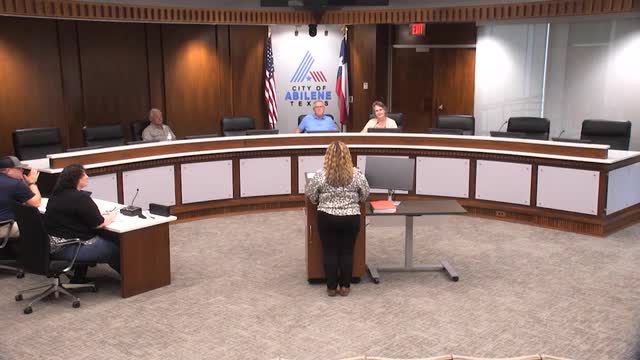
Abilene holds public hearing on 2025–29 consolidated plan; staff outlines CDBG and HOME programs
Summary
City staff reviewed HOME and CDBG programs, eligibility rules and planned community meetings for input on Abilene’s 2025–2029 consolidated plan and the 2025 action plan. No vote was taken at the hearing.
At a public hearing, City of Abilene Neighborhood Services staff described programs funded by Community Development Block Grant (CDBG) and HOME Investment Partnerships Program (HOME) and invited public input on the 2025–2029 consolidated plan and the 2025 action plan. City staff said there would be no vote at the hearing.
Neighborhood Services Division Manager Leticia Reeves outlined program offerings and eligibility criteria and encouraged residents to attend a series of community meetings scheduled at local libraries and other community sites. The consolidated plan and action plan will guide how the city allocates CDBG and HOME funds to housing and community development projects.
Reeves said HOME-funded offerings include a first-time homebuyer assistance program that provides up to $5,000 for down payment and closing-cost assistance and a single-family rehabilitation program that performs comprehensive repairs when homeowners meet stricter criteria. "We offer CDBG and HOME funds," Reeves said, describing the programs run by Neighborhood Services.
Under CDBG, staff described a critical repair program for urgent, unforeseen repairs (examples cited included loss of water service, gas system repairs, roof replacement, or nonworking HVAC) and a neighborhood revitalization program that provides new siding and trim to improve exterior appearance. Reeves said CDBG-funded critical repairs and revitalization require that the dwelling be located inside Abilene city limits, be a single-family residence (not townhomes or duplexes), be owner-occupied, and be free of outstanding county taxes or city debt in some programs. She said properties in flood zones may be ineligible or limited.
Reeves described program-specific residency and ownership tests: applicants for first-time homebuyer assistance must have lived in Abilene at least six months or have worked in the city within the past two years; first-time homebuyer applicants must be purchasing their first home and meet HUD income limits based on household size (Reeves said exact income limits are set by HUD and were not recited). For the HOME single-family full-rehabilitation program, Reeves said owners generally must have owned the property a minimum of three years and must vacate the property during the work.
Reeves said applicants must document income, employment, property ownership (warranty deed or deed of trust), and property location. For properties with code-compliance problems such as high weeds or junk vehicles, she said staff will generally allow time for remediation before moving forward rather than automatically disqualifying the applicant.
The city funds nonprofit partners through CDBG; Reeves identified Habitat for Humanity as the city’s Community Housing Development Organization (CHDO) that receives the HUD-required 15% CHDO set-aside each year. A resident in the hearing said Habitat receives about $70,000 per year from that set-aside. Reeves said Habitat and other partners use those funds to produce affordable houses and that CHDO-funded houses often also use first-time homebuyer assistance.
On anticipated funding levels, Reeves said the city had not yet received HUD’s 2025 allocations. She reviewed recent historical ranges used for planning: roughly $800,000 annually for CDBG entitlement and about $400,000 for HOME in most years, with one past HOME allocation at about $521,000. Reeves attributed the absence of a final 2025 allocation to delays at HUD and said the department usually posts allocations later in the spring; she did not provide a confirmed 2025 dollar figure at the hearing.
Reeves listed upcoming community meetings to collect input; she said the meetings would be posted at city libraries (Mockingbird and South libraries were named) and that staff would also meet at the Christian Service Center. She noted some practical barriers: phones and internal systems were temporarily down at the time of the hearing, and staff advised residents to check library postings or visit the Neighborhood Services office for flyers.
No formal motion or vote occurred during the hearing. Reeves described the session as a kickoff and encouraged public input and questions. The hearing closed after residents and staff exchanged brief questions about meeting locations, Habitat activities in College Heights, and the city’s progress on spending current funds.