Get Full Government Meeting Transcripts, Videos, & Alerts Forever!
Get email alerts on the Water And Sewer Cip topic
No spam. Unsubscribe anytime.
City details I‑65 sewer routing and near‑term water/sewer capital plan; oxidation ditch and fleet relocation are critical path items
Summary
Engineering consultants and city staff presented a coordinated near‑term water and sewer capital program that prioritizes an oxidation ditch expansion — which requires relocating fleet and Public Works facilities — and an interceptor under I‑65 to serve east‑side growth.
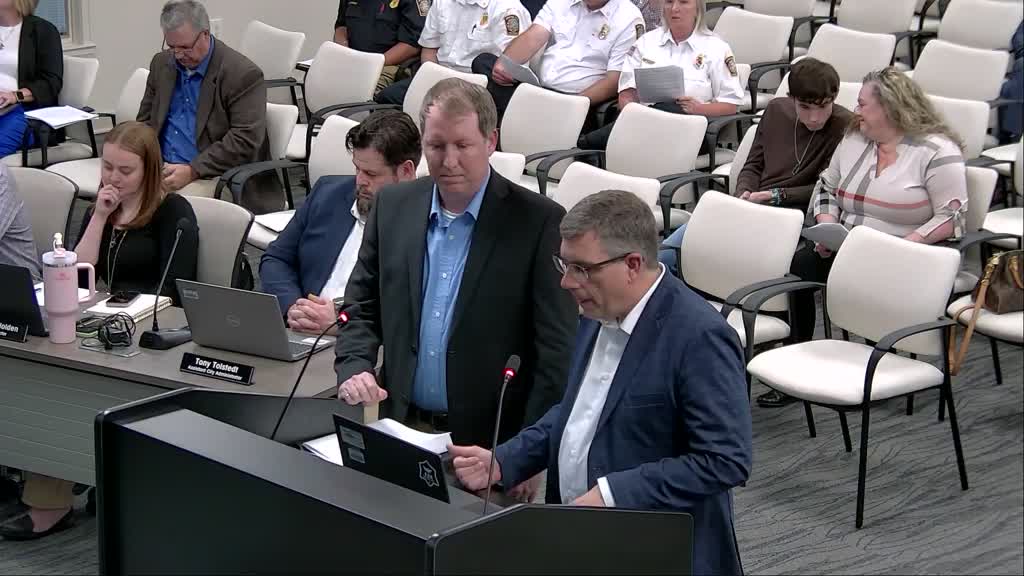
City staff and the engineering consultant Thomas & Hutton presented a multi-year, near-term water and sewer capital program during the April 21 work session, describing projects the city must complete to keep pace with anticipated growth and planned plant expansions.
The presentation identified a critical path item: construction of a new oxidation ditch at the existing sewer plant site. The proposed site for the oxidation ditch overlaps the current Public Works and fleet facilities; to proceed the city will need to relocate fleet operations and Public Works staff temporarily (likely to trailers) while a permanent fleet building is constructed at a new site. Staff said locking the location of the fleet building is now a critical step to enable demolition and construction of the oxidation ditch and future plant expansion.
The consultant, Ryan Chamblee of Thomas & Hutton, explained the city’s modeling shows the need to upsize existing trunk sewer lines (for example in the downtown/DTN basin and along Keegan Road) and to add a parallel trunk line to an existing Saturn Parkway crossing that currently limits capacity. A major planning question is how to route sewer from the east side of I‑65 (near the June Lake area) back to the plant. Consultants recommended routing an interceptor under I‑65 in an alignment where survey easements and property access look most promising; the interceptor will ultimately require parallel upgrades to a long downstream trunk (referred to as Grassy Branch) to carry the additional flow back to the plant.
Staff emphasized the importance of timing: building the trunk/interceptor and the oxidation ditch in a coordinated schedule is necessary to ensure the system can accept new flow as plant capacity is expanded. Design submittals for the oxidation ditch are nearing completion and staff expects the project to be shovel-ready in about a month, contingent on final revisions and timing for the community services site that must be built in coordination.
Why it matters: The city projects large water and sewer investments over the next five to 10 years to support development east of I‑65 and other growth areas. Sequencing these projects correctly — fleet relocation, oxidation ditch construction, interceptor routing and trunk upsizing — will reduce the risk of being unable to accept new development once plant expansions are complete.
Next steps: Staff will circulate project exhibits and Gantt-style schedules to the board and plans to return with more detailed funding strategies during upcoming capital budget discussions. The board asked for a funding overview at the capital meeting, and staff committed to provide additional documentation.
Speakers quoted in this article are recorded in the meeting transcript at the times cited in provenance.