Get Full Government Meeting Transcripts, Videos, & Alerts Forever!
Get email alerts on the Affordable Housing topic
No spam. Unsubscribe anytime.
Eugene approves Eugene–Springfield 2025 consolidated plan and 2025 HUD annual action plan summary
Summary
On April 28 the Eugene City Council adopted a resolution approving the Eugene–Springfield 2025 consolidated plan and approved the 2025 HUD annual action plan summary allocating Community Development Block Grant and HOME funds; both measures passed unanimously, 8-0.
Eugene City Council on April 28 adopted a resolution approving the Eugene–Springfield 2025 consolidated plan and approved the 2025 annual action plan summary for federal HUD Community Development Block Grant (CDBG) and HOME Investment Partnerships (HOME) funds. Both measures passed on voice or raised-hand counts, 8-0.
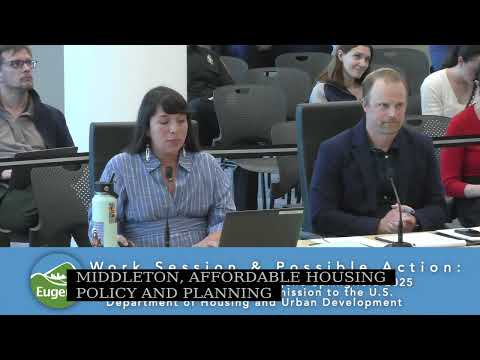
The consolidated plan sets the five-year priorities and strategies that Eugene and Springfield will use to allocate CDBG and HOME funds. Genevieve Middleton, the city’s affordable housing policy and planning manager, told council the two jurisdictions expect an estimated $13,000,000 in CDBG and HOME entitlements over the coming five years based on last year’s HUD entitlement and an additional approximately $4,000,000 in program income from revolving loans. Middleton said those figures are estimates and do not reflect future federal changes.
Middleton said the consolidated plan aligns with the city’s Housing Implementation Pipeline and Eugene’s strategic goals, and establishes six recommended strategic goals for 2025–2030: increase supply of affordable housing; rehabilitate existing housing; provide homeownership assistance; support the human services system; promote economic development; and improve low-income neighborhoods. She said the full draft consolidated plan and the detailed needs-assessment and market-analysis chapters are available online at the city’s HUD plans page.
Middleton summarized the federal process: a multi-step, five-year plan that includes data collection, stakeholder consultation, public comment periods and hearings, and an annual action plan and consolidated annual performance evaluation report (CAPER). She also reported a long-term decline in entitlement funding when adjusted for inflation: a roughly 48% drop for Eugene CDBG entitlement and a roughly 60% drop for HOME entitlement since fiscal 2005, which she said reduces the number of projects the entitlement can support while project costs have risen.
Council questions focused on funding certainty, program details and implementation. When Councilor Kishinski asked whether staff had seen signals that entitlement funding might change, Middleton said, "Congress passed a continuing resolution into law on March 14, which keeps HOME and CDBG entitlement funding at the same level as fiscal year 25. We haven't heard anything specific from HUD about our allocations, and allocations may shift slightly depending on the total number of jurisdictions receiving funding."
Councilor Leach asked about typical CDBG award amounts and how many recipients receive funding in a given year; Middleton said amounts vary by program and that human services awards typically support multiple recipients while housing rehabilitation typically funds about one project per year in each city. Councilor Groves asked about the alternate inclusion mechanism (MUPD) trust fund payments; Will Doughty, Community Development Director, said, "We've received, dollars 400,000, from from 1 project. That's, the only 1 I think that's been paid to date. We have others that are coming soon... but they first have to reach their tax their assessment before they start paying."
Middleton noted that HOME funds are explicitly for affordable housing for low-income households and that CDBG activities must meet one of HUD’s national objectives: benefit to low- and moderate-income people, prevention of slum and blight, or meeting urgent needs such as disaster response. She also said the existing consolidated plan expires June 30, 2025, and the new plan would take effect July 1, 2025, after HUD submission.
Council President moved adoption of the resolution approving the consolidated plan; the motion passed 8-0. The council then moved and seconded approval of the annual action plan summary for use of the federal CDBG and HOME entitlements, with the proposed allocation for the coming fiscal year shown at $3,300,000; that motion likewise passed 8-0.
The council did not change the strategic goals or allocations during the meeting. Middleton and staff offered to meet with councilors who wanted additional detail about specific programs or award amounts.
The city will submit the consolidated plan and annual action plan summary to HUD per HUD guidance to take effect July 1, 2025.
Ending: The adopted consolidated plan and annual action plan establish the framework for distributing federal housing and community development funds in Eugene and Springfield for the next five years; staff said more detailed program awards and performance reports will be presented annually and that Councilors may request follow-up briefings on specific programs or funding questions.