Get Full Government Meeting Transcripts, Videos, & Alerts Forever!
Get email alerts on the Solid Waste topic
No spam. Unsubscribe anytime.
Tulsa staff proposes 4% trash-rate increase, outlines hauling RFP and plans to commercialize green-waste operations
Summary
City staff told the Budget Committee they plan a 4% FY26 increase to trash collection rates, will issue an RFP for the municipal hauling contract that expires Sept. 30, 2026, and expects a commercial operator to run the green-waste commercial gate as early as July.
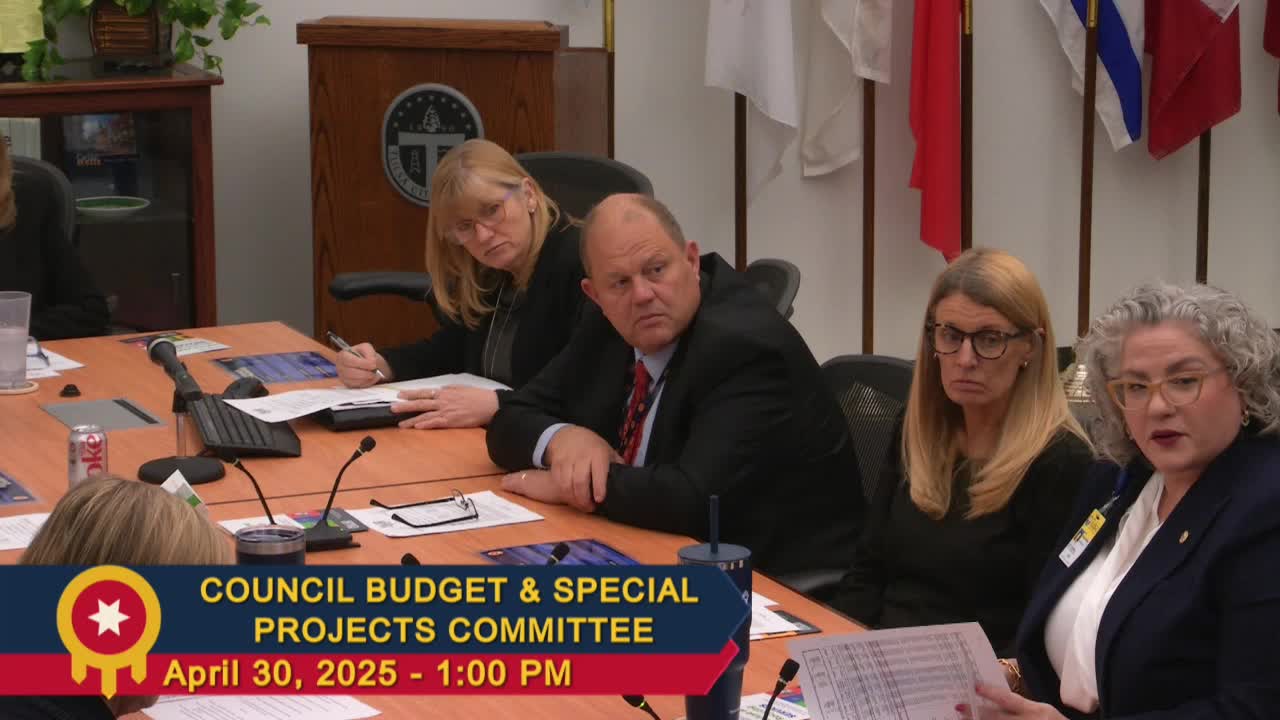
Cheryl Paul, designee for the director of public works, told the Budget Committee on the proposed fiscal 2026 solid-waste budget that staff plans a 4% rate increase for trash collection and is preparing a request for proposals for the city’s municipal hauling contract.
The rate increase is intended to cover annual contract escalation tied to the consumer-price index and other operating costs, Paul said, and is 1 percentage point lower than the 5% modeled last year. "We're proposing a 4% rate increase," Paul said.
Why it matters: the city’s hauling contract for curbside pickup expires Sept. 30, 2026; staff said it will issue an RFP in June, receive bids in August and execute a successor contract by Oct. 1, 2026. The hauling contract, the recycling handler and the trash‑to‑energy operator together determine much of the city’s annual solid-waste expense, so the new contract will shape customer costs for years.
Paul said Tulsa currently has four major solid-waste contracts and that three of them were rebid in recent years. She described the hauling contract as a planned 10‑year agreement with renewal options. "Our last contract is the hauling contract that currently New Solution has. The current contract expires September thirtieth of 20 26. We are currently in the process of an RFP," Paul said.
Operational details and service changes
- Trash-to-energy and landfill: Paul said the city’s trash-to-energy partner (referred to in the presentation as Reworld, the company previously known as Covanta) has contract language and capacity limits that affect where municipal waste is delivered. Under the city's contract, the plant can accept up to 100,000 tons of municipal waste without special approval; anything above that is routed to landfill unless the operator approves additional deliveries. Paul described ongoing plant maintenance and capital work at the operator that have affected deliveries and tonnage in recent years.
- Tonnage and recycling: Paul gave an estimated current annual municipal waste tonnage of about 16,000 tons and recycling at about 18,000 tons. She described TRT as the city’s recycling handler and noted there is currently only one provider for that service in the region.
- CPI caps and contract escalation: Paul said most of the city’s solid‑waste contracts include consumer‑price‑index escalation with a contractual cap of 5%. "All of our contracts have a price index, CPI, with a max of 5%," she said; she noted inflation has exceeded that cap in some recent years and that CPI pass‑throughs are a principal driver of annual budget increases.
- Green‑waste facility changes: staff described a planned separation of the green‑waste site into two gates: a commercial gate operated by a contracted operator and a residential gate run by city staff. Paul said about 80% of green‑waste volume at the site is commercial, and the operator will handle the commercial intake and processing; residents will continue to use the city gate free as before. Staff said they expect to award the commercial contract and have the operator on site in mid‑summer, with a target date around July 1, pending final contract terms and permits.
- Mulch and swap shop: the city will continue to offer free, uncolored mulch to residents and to provide some mulch to nonprofits; a commercial operator would offer dyed/colored mulch and bulk sales. Paul described a popular on‑site swap shop for reusable items and noted the household hazardous‑waste (HHP) facility is free to Tulsa residents and has seen record months of use.
- Special services and accessibility: Paul said the city continues a special‑service program for residents with physical limitations (for example, seniors who cannot roll a cart to the curb). She said staff recently reissued communications about that program and that the city will maintain assistance options under the new service structure.
- Commercial subsidy, enforcement and operational tools: Councilors raised concerns about small landscapers and commercial users who bring large volumes to the green‑waste site, a dynamic staff said had effectively subsidized commercial operations in prior years. To reduce misuse, staff said it will deploy a tag‑reader system (referred to in the presentation as a Flock camera/tag reader) to track vehicle tags and redirect repeat commercial trips to the commercial gate; staff described the RFP and staged rate increases as a response to prior cross‑subsidization.
Committee discussion and next steps
Council members asked for more outreach to small landscapers and for clearer communications about the schedule of rate changes, the special‑services process and hours at the green‑waste and HHP facilities. Several council members pressed staff for a plain‑language handout or "sample bill" that shows the combined effect of the trash, stormwater, water and sewer changes on a typical household bill; staff said communications would prepare such a sample bill.
Staff identified a timeline for next actions: issue the hauling RFP in June, receive bids in August and have a successor contract begin Oct. 1, 2026; finalize commercial operator terms for the green‑waste site and complete required permitting (including DEQ permitting for dyeing and processing) before the operator begins service. No formal council vote occurred during the presentation; the document presented to the committee was a rate model and summary for discussion.
The committee heard multiple operational clarifications — capacity limits at the trash‑to‑energy plant, the five‑percent CPI cap in contracts, the 100,000‑ton municipal limit on the plant, and details about HHP vouchers and hours — that staff said they would follow up on with written materials for council members.
Ending
Staff said the trash fund is in generally good shape and that the multi‑year schedule of contract rebids will stabilize solid‑waste pricing into the 2030s once the hauling contract is awarded. Committee members asked staff to return with a concise summary for public distribution that shows the dollar impact for a median household and the sample monthly bill reflecting the combined utility increases.