Get Full Government Meeting Transcripts, Videos, & Alerts Forever!
Get email alerts on the Land Use And Growth topic
No spam. Unsubscribe anytime.
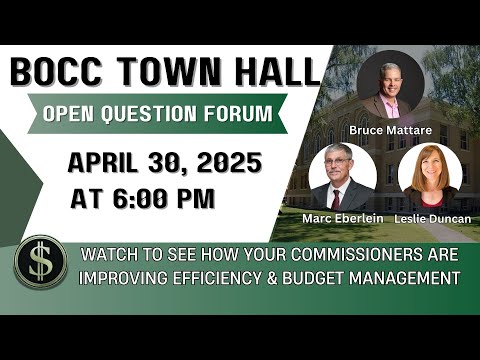
Kootenai County commissioners outline growth pressures, comp plan update and limits of impact fees
Summary
At an April 30 town-hall, Kootenai County commissioners described rapid residential growth, rising jail medical and construction costs, and limits of the countyimpact-fee statute; they urged updated comprehensive planning and discussed an open-space bond as one tool.
Kootenai County commissioners told residents at an April 30 town-hall that sustained population growth is the primary driver of demands on roads, schools and jail capacity and that county officials are pursuing a range of planning and funding tools to respond.
Commissioner Eberline said the county is "in an excellent position" fiscally but warned that growth creates recurring needs: "just to complete the 2 empty shells that we have at our jail it's about $9,000,000." He and other commissioners described an updated comprehensive plan, impact fees, and an open-space bond as possible parts of a response.
Why it matters: County leaders said rapid residential development inflates demand for public infrastructure and services, can raise long-term costs for residents, and creates timing mismatches between when fees are collected and when infrastructure is needed.
Most important facts: Commissioners cited regional planning data from the Kootenai Metropolitan Planning Organization (KMPO) showing recent building rates and projected population increases. They reported a five-year residential building-permit average of about 2,261 units per year (2019'023), split roughly into 1,447 single-family units and 814 apartments, and said KMPO projects roughly 50,815 new residents over the next 8—.5 years.
Jail capacity and medical costs were singled out. Commissioners gave operational and physical capacity numbers: an operational-capacity threshold of about 361 inmates (80% of physical capacity) and a physical capacity of 451. "Since 2019, 4 out of 5 months our jail was beyond its operational capacity," a commissioner said. They also said inmate medical expenses are approaching $3,000,000 annually.
Impact-fee limits: Commissioners criticized Idaho's impact-fee framework as written for developers rather than counties, noting a statutory mismatch that lets an authority levy a fee tied to assets with a useful life of 10 years but requires spending within eight years; if unused after eight years the money generally must be returned. One commissioner summarized the practical result: the county would need extremely large amounts of new development (tens of thousands of homes and millions of square feet of commercial space under an older analysis) to generate significant jail-related fee revenues.
Comparisons: The commissioners said their recent study produced a residential-unit impact-fee estimate of about $1,228 per single-family home (up from roughly $500 previously) and a commercial rate they cited as about $14.25 per 1,000 square feet for certain uses; they compared that to other counties (Elmore, Payette) whose single-family rates they quoted as roughly $1,664 and $1,421 respectively.
Open space and bond discussion: Commissioners discussed a proposed open-space funding approach and potential bond amounts. One commissioner described a hypothetical $50 million bond that, if used to acquire open land, would prevent future development of those parcels; the speaker estimated a $45-per-year county-tax increase on a $500,000 house at a maximum $50 million bond level, saying county-owned open space "could never be developed" if purchased with those funds.
County authority and cities: Commissioners emphasized limits on county authority where incorporated cities control zoning and annexation inside city limits. They said effective county planning requires cooperation from cities; the county cannot unilaterally stop city annexations. Several commissioners said they are meeting with city attorneys and mayors to pursue shared approaches to implementing impact fees and to coordinate comp-plan updates.
What commissioners will do next: They said the board will discuss reserve policy and budget priorities during the upcoming budget season, continue meetings with cities on the impact-fee implementation, and evaluate a potential open-space bond and comp-plan update while weighing legal and fiscal constraints.
Ending: Commissioners asked citizens to participate in further public discussions as work on the comprehensive plan, impact-fee methodology, and budget continues.