Get Full Government Meeting Transcripts, Videos, & Alerts Forever!
Get email alerts on the Land Use Solar Williamson Act topic
No spam. Unsubscribe anytime.
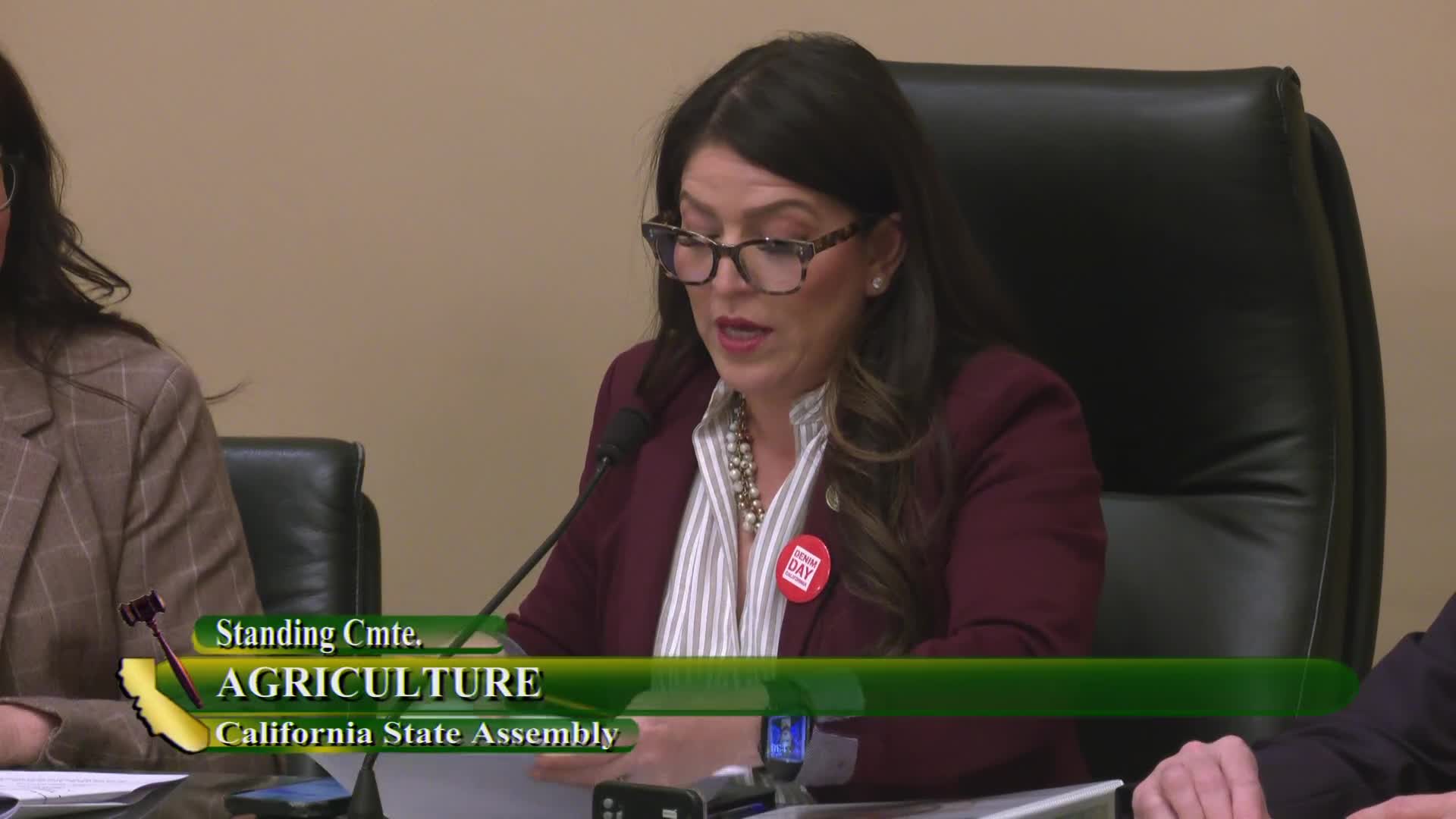
Assembly panel advances bill to allow suspension of Williamson Act contracts for solar on water-constrained farmland
Summary
Assemblymember Buffy Wicks on behalf of AB 1156 told the Assembly Agriculture subcommittee that the bill would update California’s solar use easement statute to permit landowners on agriculturally constrained, water-limited parcels to suspend Williamson Act contracts and place renewable energy projects on those parcels for the life of a solar easement.
Assemblymember Buffy Wicks on behalf of AB 1156 told the Assembly Agriculture subcommittee that the bill would update California’s solar use easement statute to permit landowners on agriculturally constrained, water-limited parcels to suspend Williamson Act contracts and place renewable energy projects on those parcels for the life of a solar easement.
Why it matters: Wicks and supporters said the proposal aims to create an option for landowners who can no longer irrigate so the land can produce local revenue and local tax receipts while preserving the option to return the land to agriculture if water conditions improve. Opposition warned the bill could open a loophole that lets solar development leave productive farmland permanently unprotected without repaying the public investment that conservation programs require.
AB 1156’s changes and goals
Wicks said AB 1156 would modernize eligibility criteria and easement terms for the state’s solar use easement program, which she called “not working” — noting state data presented to the committee showing only three projects permitted under the current program since 2011. She described the proposal as allowing an owner to “pause” a Williamson Act contract to establish a solar use easement, build a solar project, and return to agricultural production should water conditions improve. Wicks also told the committee she is committed to further amendments if the bill moves to Appropriations, including clarifying what constitutes commercially viable land, defining insufficient water, and moving the community-benefits component from voluntary to mandatory if needed.
Supporters’ arguments
Shannon Eddy, executive director of the Large Scale Solar Association, told the committee the bill would address the state’s clean-energy needs while offering an alternative use for irrigated farmland that is losing water. Eddy and other industry witnesses said updated rules would produce new local revenue because solar projects constructed after 2026 will generally pay full property taxes rather than the lower Williamson Act valuation. John Norwood of the Almond Alliance and representatives of developers and labor groups said the measure would give landowners an option that keeps landowners’ property rights intact and can provide local economic benefits.
Opposition and concerns
Peter Ansell of the California Farm Bureau told the committee the bill should not repeal solar-use-easement cancellation fees that currently help repay the public investment made under the Williamson Act. He said those fees are not penalties but contract cancellation payments and that eliminating them could encourage speculative early withdrawals and undermine incentives to keep land in agriculture. Ansell also warned the bill’s expansion of eligibility to include prime farmland, lands of statewide importance, and farmland security zones — and any repeal of mitigation requirements — would increase the risk of losing highly productive soils and co-benefits such as habitat and groundwater recharge.
John Kennedy of the Rural County Representatives of California (RCRC) said earlier draft concerns about the California Energy Commission making determinations had been removed and that, after negotiation and amendments preserving local police powers, RCRC had moved from opposition to support pending printing of the amendments. Other conservation and local land-holding organizations — including Peninsula Open Space Trust and the Santa Clara Valley Open Space Authority — signaled either opposition or “oppose unless amended” positions while noting ongoing discussions with the author’s office.
Committee discussion and clarifications
Committee members pressed the author on several points: whether the measure would incentivize permanent conversion of farmland, how the bill defines “commercially viable” land and “insufficient water,” and whether community benefits should be mandatory. Multiple members asked for clarifying definitions on commercially viable land and on prime farmland. Wicks and the chair pledged to continue negotiations and adopt further amendments as the bill advances.
Vote and next steps
The committee voted to pass AB 1156 as amended and send it to the Appropriations Committee. The clerk reported the bill is out of committee by a 6–1 margin. The author committed to additional amendments addressing RCRC and other stakeholders’ concerns before Appropriations.
Ending
AB 1156 will move to the Appropriations Committee where the author and committee staff expect to bring additional clarifying amendments. The committee record shows the measure remains contested on cancellation fees, protections for prime farmland and the scope of local mitigation authority.