Get Full Government Meeting Transcripts, Videos, & Alerts Forever!
Get email alerts on the Development Services Budget topic
No spam. Unsubscribe anytime.
Cochise County interim development director outlines budget shortfall, grant projects and staffing plans
Summary
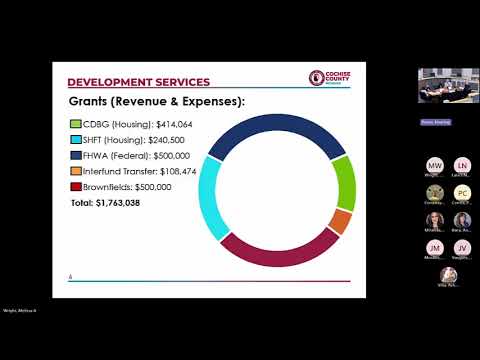
Interim Development Services Director Christine McLaughlin told the Board of Supervisors the department is funded largely by permit fees and grants, is operating with 12.5 full‑time equivalents, and is pursuing multiple federal grants including brownfields funding and Federal Highway Administration money for electric vehicle chargers.
Interim Development Services Director Christine McLaughlin told the Cochise County Board of Supervisors during a May work session that the department relies primarily on permit and inspection fees, is operating with 12.5 full‑time equivalents and is pursuing federal grants to expand infrastructure and site remediation.
McLaughlin said approximately 86.5% of the department’s recent revenue—about $1,158,283—came from permit and inspection fees, while salary, wages and benefits totaled roughly $1.2 million last year. She said the department receives an 18% general‑fund subsidy this year and that “largest contributor is grants shortly behind our current fees.”
The funding picture matters because Development Services provides planning and building review for several small Cochise County cities under intergovernmental agreements and operates divisions for planning, building and facility management, McLaughlin told the board. She presented grants the department has secured since 2019 and described planned grant work.
Why it matters: the department administers countywide planning activities, airport sponsorship duties at Cochise Airport and redevelopment efforts tied to federal brownfields resources. Funding choices affect staffing, enforcement capacity and the county’s ability to pursue redevelopment and infrastructure projects.
McLaughlin said the county has received multiple brownfield grants through the U.S. Environmental Protection Agency, including two brownfield assessment grants and a brownfield revolving loan grant totaling about $2,100,000 since 2019. She described the assessment grants as the step that helps identify potentially contaminated sites (often former gas stations, industrial parcels or mine‑impacted land) and said revolving‑loan funds can be used to clean sites up. She noted past county assessment awards of about $600,000 and $500,000 and said staff intends to apply this year for a $1,000,000 assessment grant.
McLaughlin also said the department secured Federal Highway Administration grant funding to install electric vehicle chargers at county facilities in Bisbee, Wilcox and Sierra Vista. She said the chargers will be located at county buildings and that the county plans one charger in each supervisory district; ribbon‑cuttings and scheduling were in progress at the time of the meeting. McLaughlin said the county will recover electricity charges paid by users, quoted on a per‑kilowatt‑hour basis.
On staffing and recruitment, McLaughlin said she is serving as interim director and planning manager and that the department has 12.5 full‑time equivalents (a shared administrative resource was noted). She said a recruitment for the permanent director was open and interviews were under way.
Board members pressed on revenue variability from intergovernmental agreements, fines and miscellaneous revenue. McLaughlin described the IGA reimbursements as “on demand”—the county is paid when it performs permit review or planning services for a city, so yearly receipts fluctuate. On fines, she said no fines were levied in the reported period, which is why the actual line items for fines showed zero.
The presentation closed with a list of upcoming tasks for the department: complete a comprehensive plan update, consider adopting the 2024 building code, and develop an affordable‑housing plan. McLaughlin said a consultant‑led six‑month housing study would be presented to the board the following week.
Ending: board members asked for follow‑up on grant applications and recruitment progress; McLaughlin said staff would pursue available funding and return with more detail as applications and work sessions progress.