Get Full Government Meeting Transcripts, Videos, & Alerts Forever!
Get email alerts on the Indigent Defense topic
No spam. Unsubscribe anytime.
Cochise County officials discuss indigent defense budget, request funds for expert reviews and training
Summary
Public defender and legal advocate leaders told the Cochise County Board of Supervisors that vacancies, rising trial-related expert costs and growing digital evidence workloads are straining indigent defense budgets; they requested a $15,000 professional-services fund and an increase to training and judicial-related expense lines.
Cochise County public defender leaders told the Board of Supervisors on Oct. 26, 2025, that vacancies and rising trial and evidence-review costs are straining the county’s indigent defense budget and asked the board to create a $15,000 professional-services fund and increase training and judicial-related expense lines.
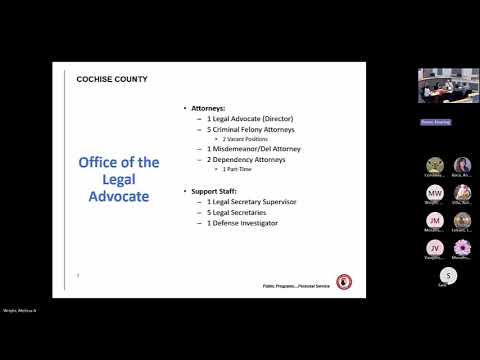
The county’s public defender, Charles, and Andrew Marcy, director of the legal advocate, presented staffing, caseload and cost details during a work session that was held in person and via Microsoft Teams. Charles said the public defender’s office expects a senior dependency attorney to retire in June and proposed increasing three part-time dependency attorneys from 21 to 30 hours per week rather than creating a new full-time replacement.
Why it matters: County officials said the offices face both shortfalls in experienced staff and variable, sometimes large, trial-related expenses — including accident reconstruction, fire investigation and specialized forensic work — that make year-to-year budgeting unpredictable. Charles and Marcy said investing in pre-screening of voluminous digital and records evidence could reduce larger expert-fee bills later in cases.
Key facts and requests
- Staffing and caseloads: Charles described the public defender office as including five felony attorneys (two part time), a mental-health attorney and multiple dependency, misdemeanor and delinquency attorneys, several of whom are part time. Marcy said the legal advocate’s office has five criminal attorney positions but two vacancies; most attorneys there are newer and have less trial experience.
- Mental-health and felony caseloads: Charles said the office has handled about 130 Title 36 mental-health cases so far this fiscal year and that the public defender’s office has taken roughly 294 felony cases in the current fiscal year, with seven cases on a trial path so far.
- Expert and trial costs: Examples cited by the public defender’s office include a $1,600 engagement with an accident-reconstruction vendor (Top Gun) plus $250 in blood-alcohol testing that persuaded a client to accept a plea; and roughly $22,000 in fire- and trajectory-related consultant fees in an arson-related matter. The office reported $46,558 spent to date on expert and judicial-related expenses against a $23,000 line this fiscal year.
- Digital evidence work and a proposed professional-services fund: The offices described frequent, large “Cellebrite” cell‑phone data dumps and other voluminous records that require review. Charles requested a one-time professional-services fund of $15,000 to pay for lower-cost screening (for example, $20/hour reviewers) to determine whether full expert review is needed before incurring large expert fees.
- Training: Both offices requested increases to training budgets so newer attorneys can receive multi‑day, in‑depth trial training and staff can attend annual database training (described as a CARPEL/PDK system conference in St. Louis). Charles requested a $5,000 increase to training and additional funds in judicial-related expense lines to cover anticipated trials.
Other details and context
- Contract counsel and misdemeanor handling: The indigent defense coordinator manages contracts and assigns cases the offices cannot take. The presentation said some contract attorneys are paid a flat negotiated rate for misdemeanors — cited in the meeting as $200 per case — and that high-volume contract counsel can handle hundreds of misdemeanor matters annually under that rate structure.
- Case-resolution procedures: The public defender described the county’s early resolution court (ERC) practice, characterizing it as a prevalent way many felony matters are resolved and observing that ERC can prompt defendants to accept plea offers because of the time and custody consequences of waiting for trial.
- Budget management: Charles said he has shifted funds this year (for example, from indigent defense coordinator expenses) to cover expert fees and would return unspent funds to the general fund if they are not used. He noted that increasing the pre-screening capacity could, in some cases, keep more matters within the county’s fixed-cost structure rather than paying higher contract or expert fees.
Ending
Supervisors did not take a formal vote during the work session; the presentation closed with the board moving on to its next agenda item (finance). County staff and supervisors may consider the requests during the regular budget process.