Get Full Government Meeting Transcripts, Videos, & Alerts Forever!
Get email alerts on the State Legislation topic
No spam. Unsubscribe anytime.
San Antonio officials warn state bills could sharply limit bonding, shift telecom costs and cut franchise fees
Summary
City staff and councilmembers at the April 30 meeting said several pending state bills — including a debt-cap proposal often referred to as SB 19 and bills on telecommunications and property-tax exemptions — could shrink the city's ability to finance capital projects, shift costs to local governments and reduce franchise-fee revenue.
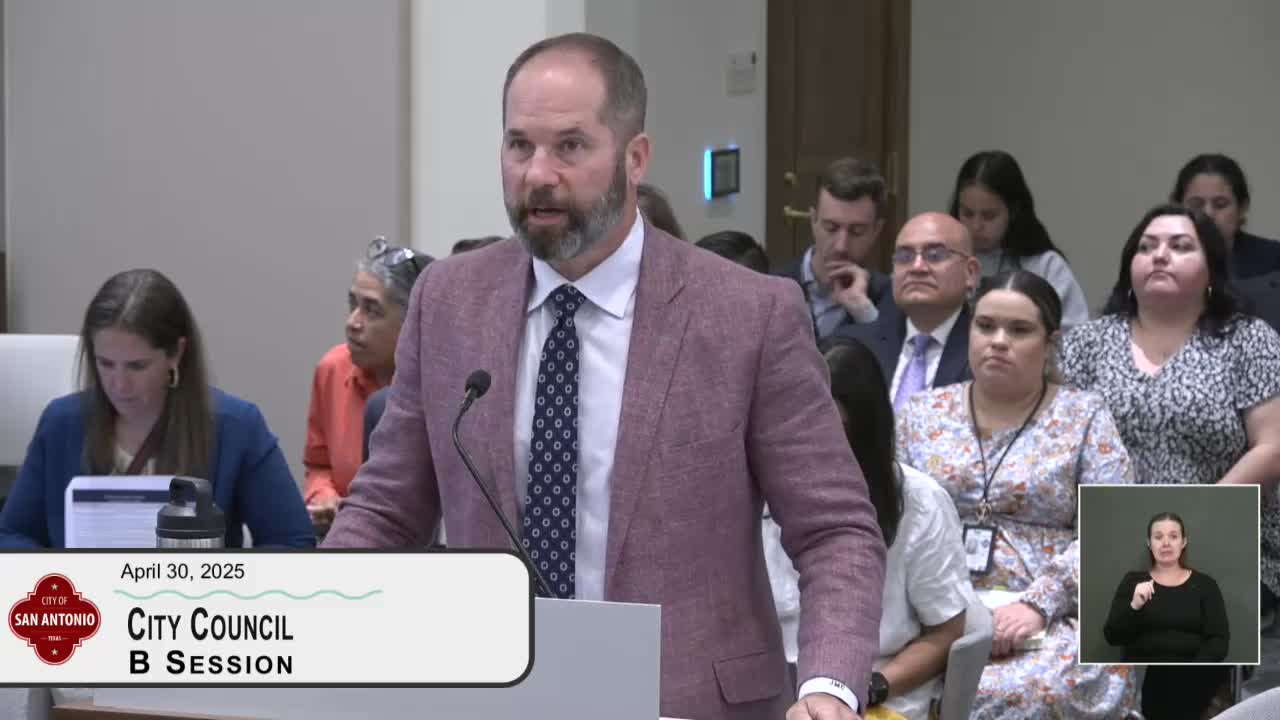
San Antonio City Council members and city staff on April 30 reviewed a package of pending state bills they said could substantially constrain the city's ability to fund capital projects, shift costs for telecommunications infrastructure onto municipalities and reduce franchise-fee revenue that supports local programs.
City legislative staff presented the update during the council's Session B briefing and repeatedly urged vigilance as the Texas legislative session proceeds toward its June 1 adjournment. Jeff (city legislative staff) described one proposal as ‘‘Esencialmente, es una proyecto de ley que tiene restricciones severas en en el gobierno local, específicamente en las escuelas, en los sistemas de hospital, etcétera.’’ He said that bill would impose a strict cap on local debt by limiting new debt to a small number of future payments equal to a set percentage of property-tax collections.
The cap would, as presented by staff, limit issuance of new long-term debt and certificates of obligation, which city officials said they and local partners routinely use to finance streets, drainage, public-safety facilities and other capital projects. Councilmembers said losing those financing tools would end or delay planned projects such as street maintenance, cybersecurity upgrades and certain facility improvements.
Staff also flagged two telecommunications-related proposals. One would make municipalities responsible for relocation costs when telecommunications providers must move lines or equipment for a city public-works project; staff noted an example where relocation costs for a Broadway-area project approached $4 million. A separate bill changes the statutory definition of “cable” or video service in a way staff warned could exempt many streaming and nontraditional video providers from franchise fees. As presented, staff estimated potential statewide revenue losses on the order of the billions: figures offered during the briefing included approximately $7.4 billion and $1.7 billion in different categories, which staff aggregated when illustrating statewide scale. The city characterized the local share of those reductions as materially damaging to the general fund and to the city's public-television program.
Councilmembers also discussed proposals to expand personal-property exemptions and other changes affecting property-tax collections. Staff described draft amendments that would increase homestead or personal-property exemptions and modify inventory-tax treatment; the council heard a cited estimate that one set of changes could reduce local revenues by about $6 million (noted by staff as an estimated fiscal impact for the county-level area referenced).
Separately, staff warned of proposed changes to annexation and deannexation rules that could allow areas that do not receive municipal services to petition to leave city limits. The presentation flagged the risk that some areas relying on on-site septic systems and private wells might pursue deannexation if the city could not or did not provide full municipal services.
Councilmembers voiced broad concern. Councilmember Peláez said the measures ‘‘Va a causar mucho dolor’’ and that restrictions on bonding and certificates of obligation would constrain investment in hospitals, military-support infrastructure and neighborhood projects. Councilmember Rocha García and others urged the city to coordinate with other municipalities, industry groups and banks to press legislators for changes and to explain local consequences.
Councilmembers also heard brief updates on several other bills: a dangerous-dogs measure (staff said portions remain under consideration in committee), a parks-officers bill that passed committee language regarding federal properties such as the missions, and a film-incentive measure that staff said would invest about $5,000,000 in the state's film industry and has moved through the Senate.
No formal votes or council actions were taken on the floor; the session item was an informational update. Staff said the city maintains a publicly accessible legislative tracker updated weekly and will continue outreach with authors, committee members and stakeholder groups as bills advance or are amended ahead of the June 1 deadline.
City officials asked staff to return with additional analysis, including credit-impact scenarios and more precise local fiscal estimates if draft bill language changes. The council's discussion closed with staff reminding members the legislative session ends June 1 and that the city will continue monitoring and advocating on these measures.