Get Full Government Meeting Transcripts, Videos, & Alerts Forever!
Assembly Human Services Committee advances array of bills on childcare, immigrant services, respite care and benefits
Summary
The Assembly Human Services Committee advanced more than a dozen bills affecting childcare, language access, immigrant services, respite care, regional center transparency and protections for safety‑net benefits, moving most measures to the Assembly Appropriations Committee after hours of testimony from authors, service providers and family advocates.
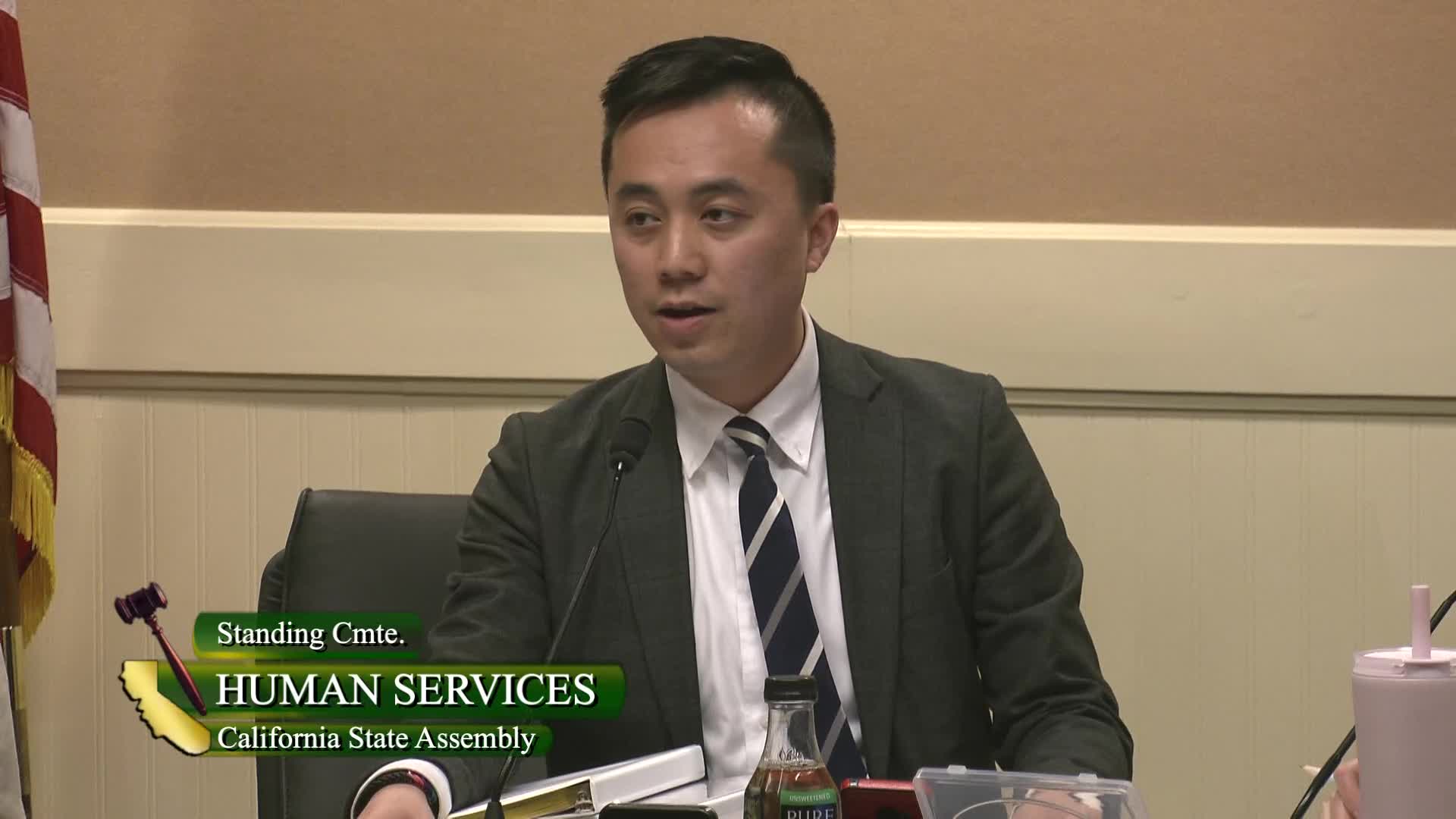
The Assembly Human Services Committee met in Sacramento to hear testimony and advance a slate of bills on May 20, 2025. Committee members heard hours of testimony from bill authors, service providers and advocates on measures affecting childcare eligibility, language access in health and social services, supports for asylum seekers and other vulnerable noncitizens, respite services and licensing, regional center transparency, and protections for safety-net benefits for foster youth and guaranteed-income pilot participants. Several measures were voted out of committee or ordered to the Assembly Appropriations Committee.
Many witnesses described practical problems they said the bills aim to fix: gaps that cause parents to lose subsidized childcare during short leaves (AB 904); inconsistent access to in-home respite and confusion about vendorization across the 21 regional centers (AB 617); a lapse in funding for a case-management pilot for asylees and other vulnerable noncitizens (AB 548); and the loss or misuse of federal benefits intended for foster youth with disabilities (AB 1080). Advocates for language access urged the committee to create a director-level role and human review requirements when state agencies use machine translation (AB 1242).
Why it matters: the committee’s package touches multiple daily supports—child care, food assistance outreach, direct-care staffing and respite, legal and benefits navigation for newcomers, and protections for safety-net benefits—that advocates say affect families’ ability to work, care for loved ones and avoid deeper poverty. Committee members repeatedly emphasized the goal of reducing bureaucracy while protecting oversight and program integrity.
Key testimony highlights and policy points
- Undocumented older adults: Assemblymember Juan Carrillo presented AB 450 to create a Department of Aging task force to recommend policies to support undocumented adults age 55 and older. Carrillo noted state-level demographic figures cited in the hearing: roughly 2.7 million undocumented Californians overall, about 293,000 who are 55 or older and more than 856,000 who have lived in California more than 20 years; the bill’s author said undocumented residents paid roughly $8.5 billion in state and local taxes in 2022. The bill was moved and later taken up for a roll call.
- CalFresh data sharing cleanup: AB 593 (author presented as Arambula) would allow the California Department of Social Services (CDSS) to identify data-sharing opportunities with state public entities and narrow what CDSS may share to information necessary for improving CalFresh administration and participation. The author said the measure is a follow-up to work from last year and that committee amendments were accepted.
- Childcare continuity for parents on short leave: AB 904 (Aguirre-Curry) would clarify eligibility so parents do not lose subsidized childcare during…
Already have an account? Log in
Subscribe to keep reading
Unlock the rest of this article — and every article on Citizen Portal.
- Unlimited articles
- AI-powered breakdowns of topics, speakers, decisions, and budgets
- Instant alerts when your location has a new meeting
- Follow topics and more locations
- 1,000 AI Insights / month, plus AI Chat