Get Full Government Meeting Transcripts, Videos, & Alerts Forever!
Get email alerts on the Social Services topic
No spam. Unsubscribe anytime.
Assembly Human Services Committee advances array of bills on childcare, immigrant services, respite care and benefits
Summary
The Assembly Human Services Committee advanced more than a dozen bills affecting childcare, language access, immigrant services, respite care, regional center transparency and protections for safety‑net benefits, moving most measures to the Assembly Appropriations Committee after hours of testimony from authors, service providers and family advocates.
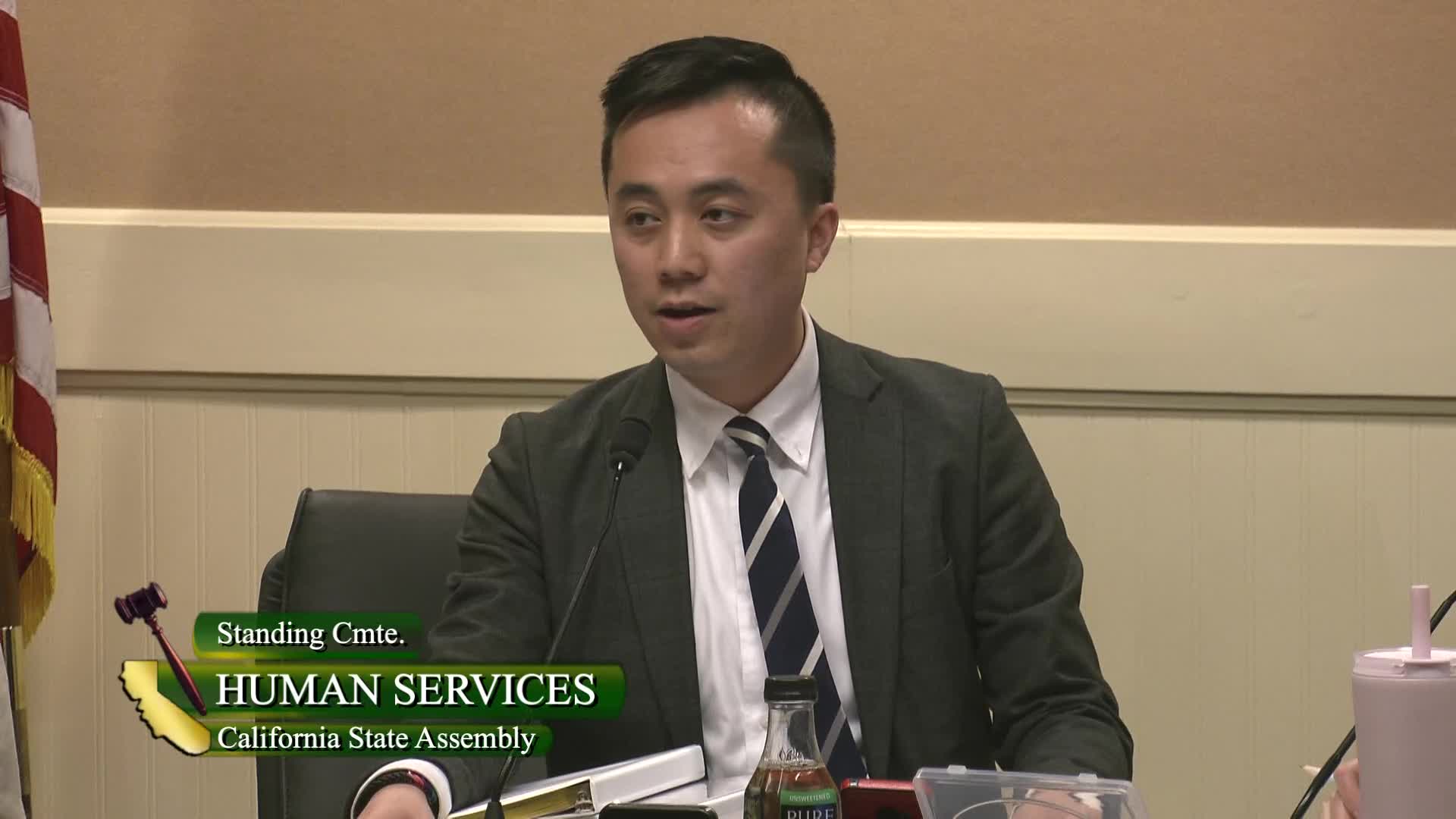
The Assembly Human Services Committee met in Sacramento to hear testimony and advance a slate of bills on May 20, 2025. Committee members heard hours of testimony from bill authors, service providers and advocates on measures affecting childcare eligibility, language access in health and social services, supports for asylum seekers and other vulnerable noncitizens, respite services and licensing, regional center transparency, and protections for safety-net benefits for foster youth and guaranteed-income pilot participants. Several measures were voted out of committee or ordered to the Assembly Appropriations Committee.
Many witnesses described practical problems they said the bills aim to fix: gaps that cause parents to lose subsidized childcare during short leaves (AB 904); inconsistent access to in-home respite and confusion about vendorization across the 21 regional centers (AB 617); a lapse in funding for a case-management pilot for asylees and other vulnerable noncitizens (AB 548); and the loss or misuse of federal benefits intended for foster youth with disabilities (AB 1080). Advocates for language access urged the committee to create a director-level role and human review requirements when state agencies use machine translation (AB 1242).
Why it matters: the committee’s package touches multiple daily supports—child care, food assistance outreach, direct-care staffing and respite, legal and benefits navigation for newcomers, and protections for safety-net benefits—that advocates say affect families’ ability to work, care for loved ones and avoid deeper poverty. Committee members repeatedly emphasized the goal of reducing bureaucracy while protecting oversight and program integrity.
Key testimony highlights and policy points
- Undocumented older adults: Assemblymember Juan Carrillo presented AB 450 to create a Department of Aging task force to recommend policies to support undocumented adults age 55 and older. Carrillo noted state-level demographic figures cited in the hearing: roughly 2.7 million undocumented Californians overall, about 293,000 who are 55 or older and more than 856,000 who have lived in California more than 20 years; the bill’s author said undocumented residents paid roughly $8.5 billion in state and local taxes in 2022. The bill was moved and later taken up for a roll call.
- CalFresh data sharing cleanup: AB 593 (author presented as Arambula) would allow the California Department of Social Services (CDSS) to identify data-sharing opportunities with state public entities and narrow what CDSS may share to information necessary for improving CalFresh administration and participation. The author said the measure is a follow-up to work from last year and that committee amendments were accepted.
- Childcare continuity for parents on short leave: AB 904 (Aguirre-Curry) would clarify eligibility so parents do not lose subsidized childcare during brief job searches, pregnancy leave, or family caregiving. Providers, county welfare staff and child-care advocates testified that the change would reduce paperwork, reduce disruptions for children and help families keep jobs. The committee moved the bill toward the appropriations committee.
- Respite licensing and registry changes: AB 617 (McKenner) would require in‑home respite providers contracted through regional centers to obtain Department of Social Services (DSS) licensing and be listed on the statewide home care registry, with a phased-in effective date and vendorization streamlining directed at the Department of Developmental Services (DDS). Supporters, including SEIU and family caregivers, said the change would increase transparency and expand the pool of qualified providers; opposition letters and witnesses representing respite agencies and regional center providers warned the measure could impose costs, duplicate oversight or shrink the existing provider pool and said additional work between stakeholders was needed.
- Regional center transparency on denials and appeals: AB 1220 (Arambula) would require regional centers to document service denials, notices of action and appeals in individual program plans and include those data in annual reports to the department, a change supporters said would surface disparities and help Spanish‑speaking and other limited‑English families understand and appeal denials.
- Language access in CalHHS: AB 1242 (Wynne) would establish a language access director position within the California Health and Human Services Agency (CalHHS), require human review when machine translation or AI is used, and improve how entities determine which languages require covered assistance. Witnesses described cases where lack of language access led to worse clinical or social outcomes; sponsors said the bill would produce long‑term savings and better outcomes.
- Continuation of services for asylum seekers and vulnerable noncitizens: AB 548 (presented by a colleague on behalf of Assemblymember Solache) would continue and expand the Enhanced Services for Asylees and Vulnerable Noncitizen Program (often abbreviated in testimony as the eSaving or USAVEN pilot), which provided short-term case management, benefit navigation and other supports to recently granted asylees and certain T/U visa holders after 2021 pilot funding ended.
- Family Preparedness tools for mixed‑status families: AB 495 (Rodriguez) would create a set of family‑preparedness options and require the attorney general to publish model policies limiting immigration‑enforcement assistance at child‑care facilities. The bill would also clarify the caregiver authorization affidavit and create a short‑term joint guardianship process to help families plan for unplanned separations.
- Guaranteed-income pilots and safety-net interactions: AB 1357 (Rodriguez) would ensure guaranteed‑income payments provided in pilot programs are not treated as countable income for state public assistance programs (examples cited include CalFresh, Medi‑Cal and CalWORKs), a change sponsors said is needed to avoid penalizing participants.
- Reunification services and individualized assessment: AB 1201 (Jackson) — titled in testimony as the Reunity Act — would narrow automatic denials of reunification services for parents with violent felony convictions (except within a limited recent window) and require courts to undertake individualized, trauma‑informed assessments before denying reunification services.
- Protecting SSI and other federal benefits for foster youth: AB 1080 (author presented by Jackson) would require counties acting as representative payees to use Social Security Administration benefits, including Supplemental Security Income (SSI), in the best interest of the child, conserve certain funds for future use, and take steps to maintain eligibility during foster care so youth do not lose benefits at transition.
- Developmental services outcome measures: AB 1208 (Addis) would direct the Department of Developmental Services to develop uniform outcome, quality and performance standards to shift the system toward person‑centered measures, aligning with master‑plan recommendations and previous statutes expanding transparency.
- CalWORKs modernization: AB 1324 (Sharp Collins) would update CalWORKs rules for gig and self‑employment, change how infrequent or in‑kind income is counted, protect striking workers from losing aid, and direct a feasibility study to continue program improvements.
Votes at a glance
(The committee advanced most bills to the Assembly Appropriations Committee or otherwise reported them out of committee. When the transcript recorded a formal roll call and a numeric result, that tally is noted; where the transcript did not record a final numeric roll call in a single, unambiguous place, the tally is listed as not specified.)
- AB 450 (task force on older undocumented adults): Moved as amended; outcome: passed out of committee as recorded in the hearing; final roll call tally: not specified. - AB 593 (CDSS data sharing / CalFresh outreach): Moved as amended to Appropriations; final roll call tally: not specified. - AB 904 (childcare eligibility during transitional periods): Passed to Assembly Appropriations Committee (motion carried on roll call; secretary recorded the motion as moved); final roll call tally: not specified. - AB 617 (respite provider licensing and registry): Passed to Assembly Appropriations Committee (moved, then seconded); final roll call tally: not specified (members commented that further stakeholder work will continue). - AB 1220 (regional center denials and appeals reporting): Passed out of committee — recorded in hearing as “5 to 0, that bill's out.” - AB 1242 (language access director / CalHHS): Passed to Assembly Appropriations Committee (motion carried on roll call; recorded as out of committee in the hearing transcript; final roll call tally: not specified). - AB 548 (continuation of asylee/vulnerable noncitizen enhanced services): Passed to Assembly Appropriations Committee; final roll call tally: not specified. - AB 495 (Family Preparedness Plan Act): Passed to Assembly Appropriations Committee; final roll call tally: not specified. - AB 1357 (guaranteed income non-counting for state benefits): Passed as amended to Assembly Appropriations Committee; final roll call tally: not specified. - AB 1201 (Reunity Act — reunification services): Passed to Assembly Appropriations Committee (committee recorded the motion as carried); final roll call tally: not specified. - AB 1080 (preserve SSA/SSI benefits for foster youth): Passed to Assembly Appropriations Committee; final roll call tally: not specified. - AB 1208 (developmental services performance and outcome measures): Passed as amended to Assembly Appropriations Committee; final roll call tally: not specified. - AB 1324 (CalWORKs modernization): Moved and placed on call; at time of adjournment the bill was still listed on call with the committee; final roll call tally: not specified. - AB 1318 (protecting nonprofit eligibility for state funds): Passed as amended to Assembly Appropriations Committee with an urgency request recorded in committee; final roll call tally on the motion: 5–2 (as recorded in the hearing sequence).
What committee members and advocates said
Committee members emphasized the need to balance reducing red tape and protecting families with clear oversight and fiscal accountability. Authors and witnesses repeatedly asked for continued stakeholder work where concerns were raised — for example, AB 617’s opponents urged further conversations about cost and duplication of oversight for respite providers; the author agreed to continue dialogue. Testimony repeatedly stressed practical, on‑the‑ground examples — parents losing childcare during maternity leave, caregivers without reliable respite, and foster youth losing benefits at transition — as the rationale for statutory clarification or administrative fixes.
What’s next
Most measures were ordered to the Assembly Appropriations Committee or were otherwise reported out by the Human Services Committee for further floor or fiscal committee consideration. Sponsors and committee members signaled continued negotiations on several measures (notably AB 617 and AB 1201) where stakeholders raised implementation questions. Several authors said they will accept or are working with committee amendments.
Ending note: multiple members and witnesses urged that bills be refined through continued stakeholder engagement before reaching implementation deadlines or broader fiscal committees; several authors agreed to follow up with opposition groups to refine language and address administrative questions.