Get Full Government Meeting Transcripts, Videos, & Alerts Forever!
Get email alerts on the Procurement And Contracting topic
No spam. Unsubscribe anytime.
City Council, nonprofits press agencies to speed payments and create centralized contracting office
Summary
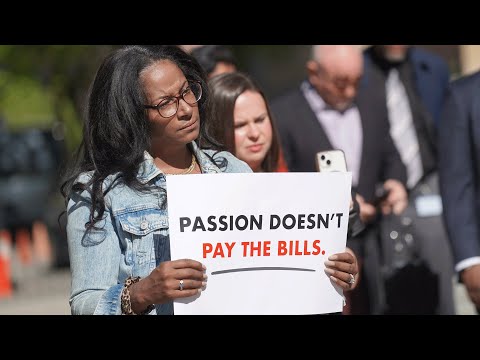
Council members and nonprofit leaders held a City Council event to press for faster payment of city contracts, citing more than $1 billion in outstanding invoices, and outlined three bills to require corrective action plans, speed payments and create a central contracting department.
Council members and nonprofit leaders gathered at a New York City Council event to demand faster payment of city contracts and to announce three proposed bills intended to reduce delays that speakers said have left providers unable to pay staff or sustain services.
Council member Julie Wan, who identified herself as the representative for Long Island City, told the audience that nonprofit providers “deserve more than our gratitude. Gratitude won't pay the rent.” Wan and other council members said delayed contracting and slow reimbursements have left nonprofits carrying debt while continuing to deliver services ranging from home-delivered meals to housing and child care.
The issue is widespread, speakers said. Julie Wan and others cited a controller's report showing “more than a billion dollars in invoices” outstanding and a Human Services Council survey figure of about $548,000,000 in late payments. Wan said, in her council district alone, “we're due $23,000,000 for 20 local organizations.”
Why it matters: nonprofit providers deliver many of the city's direct services to vulnerable New Yorkers, speakers said, and long payment delays can force layoffs, program closures and returned contracts. Sophie Charles of the Council of Family and Child Caring Agencies said agencies “can't keep the lights on, pay their staff salaries, and keep the services running for children and families in this city” when payments are late.
The bills announced
Council speakers described three legislative measures they plan to advance: a bill referenced in the transcript as “Intro December” (name not specified in the record) that would require city agencies to create corrective action plans when contracts are registered late; “Intro 12 47,” described as a measure that would require agencies to pay nonprofits faster by mandating that 80% of a fiscal year's payment be processed immediately after contract registration; and “12 48,” described as legislation to establish a new Department of Contracting Services to centralize and streamline contracting functions. Council members said they will seek co-sponsors and committee consideration, but the transcript does not specify committee schedules or enactment timelines.
Nonprofit leaders described operational impacts
Speakers from a cross-section of service providers gave examples of strain. Ron Eric Jones of Goddard Riverside said his organization had taken on lines of credit and was incurring significant interest costs: “a $4,000,000 line of credit costs us $23,000 every month,” he said, and warned agencies are returning contracts and delaying openings of new programs because of cash constraints. Catherine Tripati, assistant vice president for public policy at Volunteers of America Greater New York, said her organization is owed about $32,000,000 for services already rendered and has delayed opening new shelters and returned contracts while operating on a maxed-out line of credit.
Other nonprofit leaders echoed those concerns. Carrie Ann Paul of Take Root Justice said contracting delays force organizations to “bear the burden of covering all upfront costs for months and even years,” and Kimberly Olson of the New York City Arts and Education Roundtable warned that delayed reimbursements reduce arts education and imperil teaching artists’ livelihoods.
Council leadership comments
Speaker Adrienne Adams said the city must “resolve these significant challenges and advance solutions to this crisis,” and described the proposal for a centralized contracting office as a way “to better operationalize these critical processes.” Council member Justin Bridal (named in the transcript) urged the city to “pay their **** bills on time,” calling the current backlog unacceptable.
What the record shows and does not show
The event brought together council members and nonprofit leaders to press for the three named reforms and to announce that hearings will move forward; the transcript records repeated calls for prompt payment and descriptions of financial harm to providers. The transcript does not record a vote, a formal committee referral number, a bill text, a committee hearing date, or an administration response with a firm timetable for changes. Where speakers gave dollar figures or organization-level totals, the article reports those figures as presented by the speakers.
Next steps and context
Council members said they will continue to seek colleague support for the measures and to pursue a hearing on the proposals; the transcript does not specify next hearing dates. Speakers urged an immediate infusion of cash to reduce the backlog and systemic reforms to prevent recurrence, and they framed the proposals as part of a broader procurement-reform effort rather than a single, immediate remedy.