Lifetime Citizen Portal Access — AI Briefings, Alerts & Unlimited Follows
Appropriations panel reports $41.8 million Natural Resources Trust Fund package after land-use amendment
Loading...
Summary
The Michigan House Appropriations Committee reported House Bill 43 92 as amended, recommending $41.8 million from the Michigan Natural Resources Trust Fund for 85 acquisition and development projects; one amendment limiting certain land uses was adopted after other funding add-ons failed.
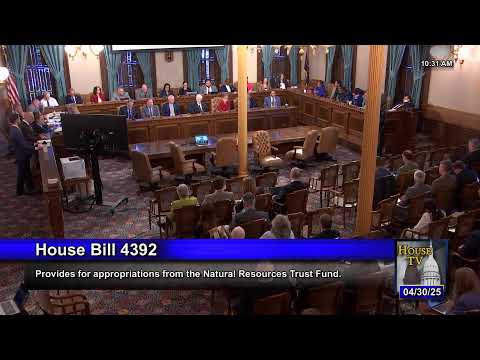
Lansing — The Michigan House Appropriations Committee on Feb. 20, 2025, voted to report House Bill 43 92 as amended, sending a $41,800,000 supplemental appropriation from the Michigan Natural Resources Trust Fund (MNRTF) to the full House.
The bill would fund 85 projects approved for 2025 from revenues constitutionally dedicated to the MNRTF, including 17 land-acquisition projects and 68 development projects that expand public recreation, protect habitat and improve outdoor infrastructure.
Representative Bill Borton, sponsor of HB 43 92, told the committee that the Trust Fund is financed through “revenues generated from oil and gas leases and severance taxes on state owned lands” and urged swift approval so “construction can begin during this year's building season.” Austin Scott, a House Fiscal Agency analyst, said the bill’s gross appropriation is $41,800,000 from the MNRTF. Scott provided a breakdown: the 17 acquisition projects total $19,300,000 and the 68 development projects total approximately $22,500,000; matching funds from local and state recipients add about $52,300,000, producing a combined project cost of roughly $94,100,000.
Committee members asked for details about specific line items. John Mays, Recreation Grants Unit Manager for the Michigan Department of Natural Resources, explained that the item listed as the Michigan Highlands conservation easement covers 73,000 acres of private corporate timberland and that the appropriation would secure a conservation easement to provide public recreational access — not state purchase of the entire acreage. Mays said the corporate owner would retain timber-management and harvest rights while the easement grants motorized and nonmotorized public access.
Lawmakers considered multiple floor amendments that would have added separate funding streams or reallocated dollars. Representative Price moved an amendment to appropriate $129,000,000 in federal grant funds; the motion failed on the recorded vote, 12 yeas to 16 nays. Representative Glanville proposed adding $55,000,000 to address Medicaid/health-plan shortfalls; that amendment failed, 12 yeas to 17 nays. Representative Rogers offered two amendments — one for $100,000,000 for PIHPs statewide and a separate $10,000,000 for a maternal-health network; both failed (each recorded as 12 yeas, 17 nays). Representative Beeson’s amendment, which the committee adopted, added language intended to restrict certain nonrecreational uses (members framed it as a land‑use clarification to discourage large-scale solar or off‑road vehicle conversion on funded parcels); that amendment passed by recorded voice and roll calls reported as 17 yeas, 3 nays, 9 pass.
After amendments, Representative Beeson moved to report HB 43 92 as an H‑1 substitute. The clerk recorded the committee vote as 29 yeas, 0 nays; the committee recommended the bill as amended to the House.
Witness statements and letters of support were entered into the record from the Department of Natural Resources, MParks, SEMCOG, Chesterfield Township and the Huron River Watershed Council; those statements did not require testimony but were noted by the clerk.
Why it matters: MNRTF disbursements fund local parks, trails and habitat projects across Michigan and include matching requirements that leverage local investment. Committee debate focused on preserving recreational access while members weighed competing proposals to redirect or expand funding for unrelated health and infrastructure priorities.
What’s next: The committee reported the H‑1 substitute to the House with a favorable recommendation; the bill will proceed for further action in the House chamber and committee calendar.