Get Full Government Meeting Transcripts, Videos, & Alerts Forever!
Get email alerts on the Maternal Child Health topic
No spam. Unsubscribe anytime.
Michigan Council of Maternal and Child Health urges continued focus on Medicaid, behavioral health and immunizations
Summary
The Michigan Council of Maternal and Child Health highlighted infant mortality gains, concerns about adolescent behavioral health, declining childhood immunization rates amid a multi‑state measles outbreak, and the central role of Medicaid for maternal and child services.
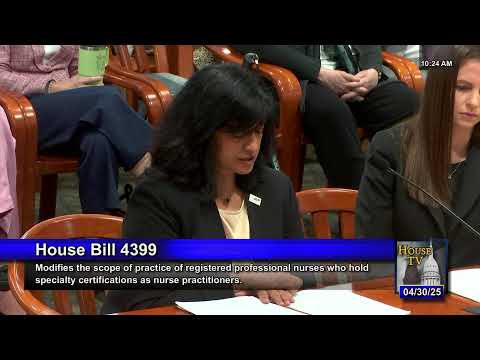
Amy Zegman, policy director for the Michigan Council of Maternal and Child Health, told the House Health Policy Committee that sustained investments and statewide coordination are needed to continue recent progress in maternal and infant outcomes.
Zegman said Michigan’s infant mortality rate is “at the lowest on record, 6.1,” and urged the committee to sustain programs that have contributed to that decline. She described Michigan’s Perinatal Quality Collaborative structure — nine regional collaboratives — as a tool local officials and health systems use to review regional data and coordinate improvements in maternal and infant care.
Zegman highlighted behavioral health for adolescents as an urgent concern, citing access to school‑based services and a need for a “full continuum” of care. She also raised immunization worries amid an active measles outbreak affecting multiple states and said Michigan’s vaccination coverage for the youngest children has dropped below herd‑immunity thresholds for some vaccine‑preventable conditions.
On children with complex conditions, Zegman summarized the Children’s Special Health Care Services program as covering “about 55,000 enrollees,” 2,700 diagnosis codes, and noted roughly 70 percent of those children are dually enrolled in Medicaid. She said the council supports additions to Medicaid — such as doulas and centering pregnancy programs — that have been added in recent years and warned that federal changes that force eligibility reductions would jeopardize those gains.
Why it matters: Maternal and child health indicators depend heavily on Medicaid coverage and coordinated public‑health efforts; Zegman framed the council’s priorities around sustaining investments, expanding behavioral‑health access in schools, and maintaining immunization levels to protect vulnerable children.
Committee questions: Representative Thompson asked about cesarean rates, breast‑feeding supports and the role of WIC; Zegman said the council is a “long standing proponent of breastfeeding” and that WIC provides peer counselors and hospital‑grade pumps for eligible families, while acknowledging more could be done to support breastfeeding initiation and continuation.
Next steps: Zegman said the council is completing phase two of a birth equity education project and expects to share findings in the fall; she left contact information and offered to work with the committee on policy and appropriations.
Quote: “We still have a lot of work to do, but we should take a moment to celebrate in Michigan,” Zegman said of recent improvements in infant mortality.