Get Full Government Meeting Transcripts, Videos, & Alerts Forever!
Get email alerts on the Earned Sick And Safe Time topic
No spam. Unsubscribe anytime.
Rules committee advances changes to earned sick-and-safe law, carving out microbusiness exemption
Summary
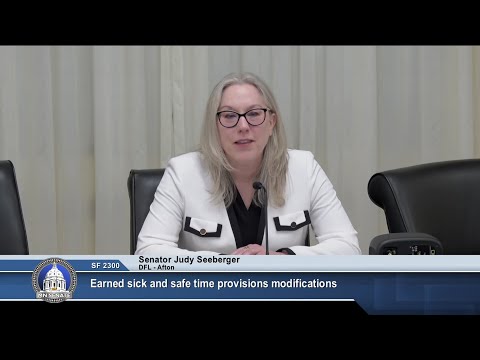
Senate File 2300, revising aspects of Minnesota's Earned Sick and Safe Time law, was advanced out of the Rules Committee on April 30, 2025, after adoption of the A3 amendment and a subsequent amendment to that amendment.
Senate File 2300, a bill revising elements of Minnesota's Earned Sick and Safe Time law, was advanced out of the Senate Committee on Rules and Administration on April 30, 2025, after adoption of the sponsor's A3 amendment and a subsequent manager's amendment vote.
Senator Seaburger, author of the bill and sponsor of the A3 amendment, said the amendment reflects stakeholder conversations and clarifies administration and compliance details. The A3 reduces the small-business exemption threshold to exempt microbusinesses with three or fewer employees (i.e., employers with fewer than four employees would be exempt under the amendment), clarifies how prorating of earned hours applies to employees hired after Jan. 1 and specifies that employers cannot require employees to use protected hours for sick and safe time if those hours are not being used for that purpose. The A3 also states that certain provisions take effect Jan. 1, 2026 to align with paid medical family leave protections for longer-term leave.
Committee members discussed impacts on small businesses. Senator Seaburger said the change to exempt microbusinesses (three or fewer employees) reflected balancing worker protections and the administrative burden on very small employers. Senator Pappas and other members noted the state's prevalence of small businesses and concerns that removing earned sick-and-safe protections would reduce benefits for an estimated 50,000 workers. Senator Marty moved an A4 amendment to restore the 1-employee threshold (i.e., remove the microbusiness exemption) which would have retained the prior, broader coverage.
A roll-call vote on the A4 amendment produced six yays and four noes; the yes votes recorded in the transcript include Senators Champion, France, Marty, Murphy, Pappas and one additional yea such that the amendment to the amendment was adopted by the committee. After further procedural motions, the committee adopted the amended A3 and moved the bill, as amended, to the Senate floor.
Senator Seaburger said scheduling on the floor would be handled by leadership; she said she had assurances the bill would be scheduled as a standalone measure. Senator Pappas moved that Senate File 2300 as amended be recommended to pass and sent to the floor; that motion was adopted by voice vote.
The committee record reflects significant discussion about the trade-off between administrability for very small employers and maintaining employee protections. Committee members and staff noted the Department of Labor and Industry has implementation materials and FAQs online and has provided trainings for businesses.