Get Full Government Meeting Transcripts, Videos, & Alerts Forever!
Get email alerts on the Veterans Affairs Budget topic
No spam. Unsubscribe anytime.
Minnesota House debates veterans, military affairs budget; lawmakers split over protections for veterans against 'claim sharks'
Summary
On Thursday, May 1, 2025, the Minnesota House took up Senate File 1959, the veterans and military affairs omnibus budget bill, hearing extended debate on funding for the Department of Military Affairs and the Minnesota Department of Veterans Affairs and on consumer‑protection language meant to stop companies that charge veterans for help filing federal benefits claims.
On Thursday, May 1, 2025, the Minnesota House took up Senate File 1959, the veterans and military affairs omnibus budget bill, hearing extended debate on funding for the Department of Military Affairs and the Minnesota Department of Veterans Affairs and on consumer‑protection language meant to stop companies that charge veterans for help filing federal benefits claims.
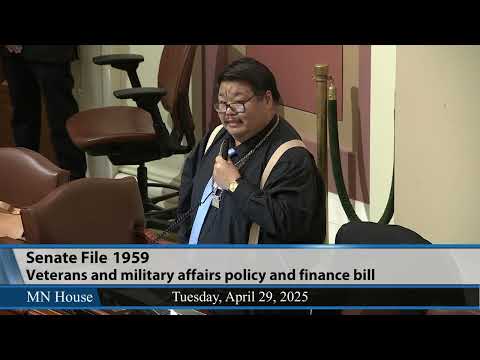
The bill funds services for veterans and military families and includes new and increased appropriations for veteran suicide prevention, food assistance, support for veteran service officers and operational funding for recently certified veterans homes. The measure also contains a provision recognizing Hmong and Lao special guerrilla unit (SGU) veterans who fought alongside U.S. forces in the Secret War in Laos; several SGU veterans and family members attended the House gallery.
House authors and committee members framed the bill as bipartisan and focused on direct services. Representative Bliss (member from Beltrami), who explained the bill on the floor, said the package was “$5,000,000 over base” — about one‑tenth of what the agencies initially requested — and highlighted funding for suicide prevention and food insecurity programs. He said the House secured roughly $11,000,000 toward staffing and operations at three new veterans homes that had requested about $40,000,000 to reach full operating capacity.
A major focus of floor debate was an effort to curb predatory private firms that advertise to veterans and charge fees for help preparing or pursuing federal benefits claims — described repeatedly as “claim sharks.” Representative Olson described the problem as one in which veterans are charged upfront fees or slices of retroactive benefits and proposed language intended to close the exploitative practices without removing lawful choices for veterans. Olson withdrew one amendment she had introduced (A5) to rework the consumer‑protection language, saying she would continue to negotiate with stakeholders and bring revised text in conference committee.
Opponents and some veterans in the House objected to proposed accreditation requirements that would limit who may charge fees or otherwise provide paid assistance for initial federal benefit claims. Representative Duran offered an amendment to remove the accreditation requirement and preserve a path for non‑accredited paid helpers; Duran said removing accreditation would keep veterans from being denied timely help. That amendment to the amendment failed on a tie roll call (67‑67), and the underlying accreditation language remained in the bill as the House advanced it.
Supporters of accreditation — including the American Legion, Veterans of Foreign Wars and other veterans service organizations cited in committee testimony — said accreditation is necessary to ensure paid advisers are trained, to provide access to the federal VA claims system and to make paid representatives accountable if they collect fees. Representative Greenman and several others said the accreditation requirement was the one non‑negotiable item from the MDVA and veterans service organizations that would guard against fraud.
The bill also includes: split funding for veteran meal programs (one advocate said funds will be divided between Lutheran Social Services for Greater Minnesota and Meals on Wheels for the metro area), funding targeted at mentorship and mental‑health programs, recognition plaques for Blue Star and Gold Star families on the State Capitol grounds, and language intended to support longtime concerns about homelessness and veteran suicide prevention. Multiple lawmakers urged further work in conference to refine consumer‑protection language so it aligns with federal law and avoids shutting out legitimate helpers.
Lawmakers from both parties praised the SGU recognition provisions and several members spoke about Hmong and Lao veterans’ service during the Secret War. Representative Cha, who identified himself as a refugee from a Thai refugee camp and son of a SGU veteran, urged passage of the measure to restore honor and recognition. Several veterans, family members and advocates took the floor to describe local programming and gaps the bill aims to address.
Members left the floor expecting continued negotiation in conference committee on the claim‑shark language and other technical details. Representative Olson and other sponsors said they would press to “close the window” on predatory practices without “slamming the door” on veterans who want to pay for accredited help.
The record shows several formal floor actions tied to SF 1959: the A3 amendment was adopted on the floor; Representative Olson withdrew A5; Representative Durand offered an amendment to the amendment that failed on a 67‑67 tie; Representative Sexton withdrew an unrelated amendment; and the bill advanced to a third reading with remaining details to be resolved in conference. Members repeatedly said additional consumer‑protection and accreditation language would be negotiated in conference committee rather than finalized on the House floor.
Looking ahead, organizers and lawmakers said they expect further changes when the House and Senate meet in conference committee and that the state’s veterans service organizations and the Minnesota Department of Veterans Affairs will continue to be consulted on final consumer‑protection language.