Get Full Government Meeting Transcripts, Videos, & Alerts Forever!
Get email alerts on the Education Charter Schools topic
No spam. Unsubscribe anytime.
Guam charter schools tell Legislature they will keep $7,800 per‑pupil funding and seek higher enrollment caps in FY2026 hearing
Summary
Guam charter school leaders asked the Legislature on April 28, 2025, to keep the per‑pupil appropriation at $7,800 for FY2026 and to raise enrollment caps so more students on waiting lists can enroll.
Guam charter school leaders asked the Legislature on April 28, 2025, to leave the per‑pupil appropriation at $7,800 while raising enrollment caps for fiscal year 2026, saying demand and waiting lists at several schools justify larger authorized rolls.
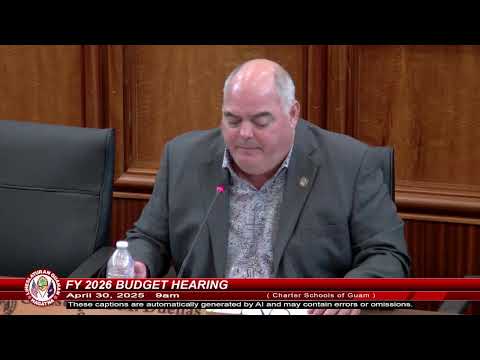
The request came during a budget hearing on Bill 44‑38 before the Committee on Finance and Government Operations. Evangeline Marie Cepeda, chair of the Guam Academy Charter School Council, told senators the council supports keeping the $7,800 per‑pupil figure but is asking for increases only in enrollment caps so more students can be served. "We will remain at $7,800 per pupil," Cepeda said, asking lawmakers to fund an FY2026 charter schools appropriation of $28,970,435 to cover a full year for two charters that opened midway through the current year.
Why it matters: the funding level and caps determine how many students charter schools can enroll and how schools plan facilities, staffing and student services. Several charter leaders said long waiting lists, demand from military families and the timing of federal grants have driven the request for expanded enrollment capacity.
Testimony and accountability
Cepeda opened the panel by recounting the charter sector’s growth since the first charter was authorized under Public Law 29‑140 (the Guam Academy Charter Schools Act of 2009) and said all seven charter schools currently meet accreditation and statutory requirements. She defended the sector on audit findings and compliance, saying the longest‑running charter has had "zero audit findings" in the last five years.
Helen Nishihara, representing iLearn Academy Charter School, described the school's recent fiscal experience and federal grant work. Nishihara said iLearn completed a FY2024 audit and has had clean audits in prior years, but a required single‑audit was triggered after exceeding the $750,000 federal threshold and delayed completion while the school awaited a GDOE statement. "We have had a clean audit every single year," she said, and described using ARP/ESSER funds to buy classroom technology, device management systems and professional development.
Dr. Anthony Jay Seunga, CEO of SIFA Learning Academy, read letters from students about academic and social supports and said SIFA recently completed an accreditation visit that recommended a six‑year accreditation term.
Anne Santiago, representing Guahan Academy Charter School, told the committee the school has served about 3,000 students since opening and that roughly 82–85% of its current student population qualifies as Title I. She said Guahan participates in the USDA child nutrition program and provides free breakfast and lunch to students who qualify.
Operational issues raised
School leaders and senators discussed several recurring operational constraints:
- Busing and transportation: multiple witnesses said charter students often spend up to two hours on buses because of routing that first serves Department of Education runs; charter representatives said DPW bus driver shortages and scheduling limit options. Sen. Will Castro and others urged exploring alternative transport arrangements and grants to reduce travel time.
- Facilities and leases: Guahan Academy said it currently occupies a government facility and does not pay lease, and that the school has carried forward unexpended balances in recent years; the school indicated it is pursuing options to acquire or lease its own campus, with a tentative two‑year timeframe if supported.
- Federal grants and audits: witnesses said charter schools used federal block and ARP grants for devices, curriculum and security; iLearn described onsite inventory checks and cooperation with GDOE federal programs. Panelists emphasized that schools that received federal funds were using them rather than returning them.
- Food service: participation in USDA child nutrition varied by school. Guahan participates in the national program; other charters described administrative or financial reasons for not participating, with one school reporting it charges parents a $2 reimbursement while the school covers remaining cost.
- Staffing and pay: charter leaders said teacher turnover exists but that many teachers accept lower pay for smaller classes and a different environment. Senators asked about increases in certain administrative salaries and larger proposed pay lines for some charter administrators; school representatives said boards set those salaries and that some larger administrator amounts reflect consolidated responsibilities.
- Procurement, contracts and legal review: senators raised concerns about contract oversight and potential liability for boards when schools enter into construction or long‑term contracts. Cepeda said the council prefers not to route every contract through the Office of the Attorney General because that could create procurement bottlenecks; she proposed a middle approach such as requiring certified sign‑off above a monetary threshold.
No vote recorded; next steps
The hearing on Bill 44‑38 was a testimony session; the committee chair said senators would continue to work with charter leaders before preparing any appropriation bill for the floor. Committee leadership said it would try to accommodate enrollment increases where possible and signaled follow‑up work on transportation, facility planning and legal/contract guidance. The chair also suggested post‑budget discussions about the long‑term relationship among charter schools, the Guam Department of Education and federal opportunities as DoDEA schools are downsized in some areas.
Credits and context
Speakers at the hearing included representatives from Guahan Academy Charter School, iLearn Academy Charter School, SIFA Learning Academy, Career/Technical (CareerTech/BTACS), Mount Carmel Academy Charter School and other charter leaders, along with members of the Guam Legislature. The panel repeatedly cited Public Law 29‑140 (the charter law) and federal grant programs, including ARP/ESSER, as the statutory and funding framework guiding the discussion.
What the record does not show
The committee did not take a formal vote during the hearing. Several numerical items mentioned at the hearing — such as facility timelines, detailed enrollment caps by school, and exact federal grant balances — were discussed in general terms or as estimates; where precise figures were not presented at the hearing, this article reports the numbers as provided (for example, the FY2026 total request stated by Cepeda, $28,970,435) or notes that details were not specified by witnesses.
The committee recessed following closing remarks; senators said they would return to the matter while they draft any bill language for the full Legislature.