Get Full Government Meeting Transcripts, Videos, & Alerts Forever!
Get email alerts on the Middle East topic
No spam. Unsubscribe anytime.
UN secretary-general urges urgent action to preserve two-state solution, demands cease-fire and humanitarian access to Gaza
Summary
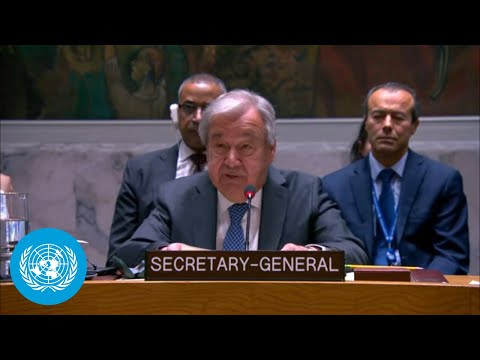
United Nations Secretary-General António Guterres told a ministerial-level meeting convened by the French presidency that the Middle East is at a “hinge point in history” and called on member states to take “irreversible action” to preserve a two-state solution.
United Nations Secretary-General António Guterres told a ministerial-level meeting convened by the French presidency that the Middle East is at a “hinge point in history” and called on member states to take “irreversible action” to preserve a two-state solution for Israel and Palestine.
Guterres said the promise of a two-state solution “is at risk of dwindling to the point of disappearance” and warned that political commitment is farther from realization than at any time in recent decades. “The political commitment to this long standing goal is farther than it has ever been,” he said.
The secretary-general framed the current crisis around three linked realities: the humanitarian catastrophe in Gaza, escalating military operations and settlement activity in the occupied West Bank (including East Jerusalem), and high levels of settler violence. He said the cease-fire in Gaza “had brought a glimmer of hope” but that those hopes were “cruelly extinguished with the shattering of the ceasefire on 18 March.”
Guterres provided casualty and access figures drawn from his address: since the breakdown of the cease-fire, “almost 2,000 Palestinians have been killed in Gaza by Israeli strikes and military operations,” and more than “2,000,000 people” in Gaza have been deprived of food, fuel, medicine and commercial supplies, he said.
Describing the humanitarian situation as “beyond imagination,” Guterres urged immediate restoration of aid and protection for humanitarian staff. “Aid is non negotiable. Israel must protect civilians and must agree to relieve shims and facilitate them,” he said, praising United Nations and other humanitarian workers for continuing to operate “under fire and then in comprehensively difficult conditions.” He also mourned “the women and men of the United Nations who were killed, including some with their families.”
Guterres warned against forced displacement and demographic or territorial change, citing Security Council positions and referencing the 1974 disengagement-of-forces agreement in the occupied Syrian Golan as an example of a commitment that must be respected. He also raised concerns about “Israeli military operations and the use of heavy weaponry in residential areas, forcible displacement, demolishments, movement restrictions, and settlement expansion” in the West Bank and East Jerusalem.
On the protection of UN personnel and the organization’s immunities, Guterres said advisory proceedings at the International Court of Justice are ongoing regarding Israel’s obligations as an occupying power and its responsibilities toward United Nations personnel and operations in the occupied Palestinian territory. He noted that United Nations legal counsel submitted a written statement in February and made an oral statement “yesterday.” He said the submissions include the points that “all parties to conflict must comply with all their obligations and international law,” and that “Israel as an occupying power is under the obligation to ensure food and medical supplies of the population.”
The secretary-general called specifically for: the immediate and unconditional release of all hostages; a permanent cease-fire; restoration of humanitarian access; protection of UN personnel and premises; and accountability for attacks on civilians, humanitarian workers and UN facilities. He cited Israeli acknowledgments of responsibility for incidents that struck a UN guest house on 19 March, killing one UN colleague and injuring others, and referenced the killing of paramedics and rescuers in Rafah on 23 March as among cases requiring accountability.
Guterres urged member states to move beyond “ticking a box” of verbal support for the two-state solution and to spell out concrete, irreversible steps they will take. He pointed to an upcoming “eye-level conference” in June, co-chaired by France and the Kingdom of Saudi Arabia, as an opportunity to “revitalize international support” and urged increased political and financial support for the Palestinian Authority so it can resume responsibilities in Gaza.
The address combined legal, humanitarian and diplomatic appeals and emphasized that the international community must act to prevent “perpetual occupation and violence.” He concluded by urging leaders to “show the political courage and exercise the political will to make good on the central question for peace for Palestinians, Israelis, the region, and humanity.”