Get Full Government Meeting Transcripts, Videos, & Alerts Forever!
Get email alerts on the Affordability Impact Statement topic
No spam. Unsubscribe anytime.
Housing staff and advocates urge reforms to Austin’s affordability-impact statement process
Summary
Housing Department staff described the city’s affordability impact statement (AIS) process—created under the Smart Housing ordinance in 2007—and proposed improvements. Community groups proposed a broader AIS scorecard covering transit, displacement risk, equity and other non-construction impacts.
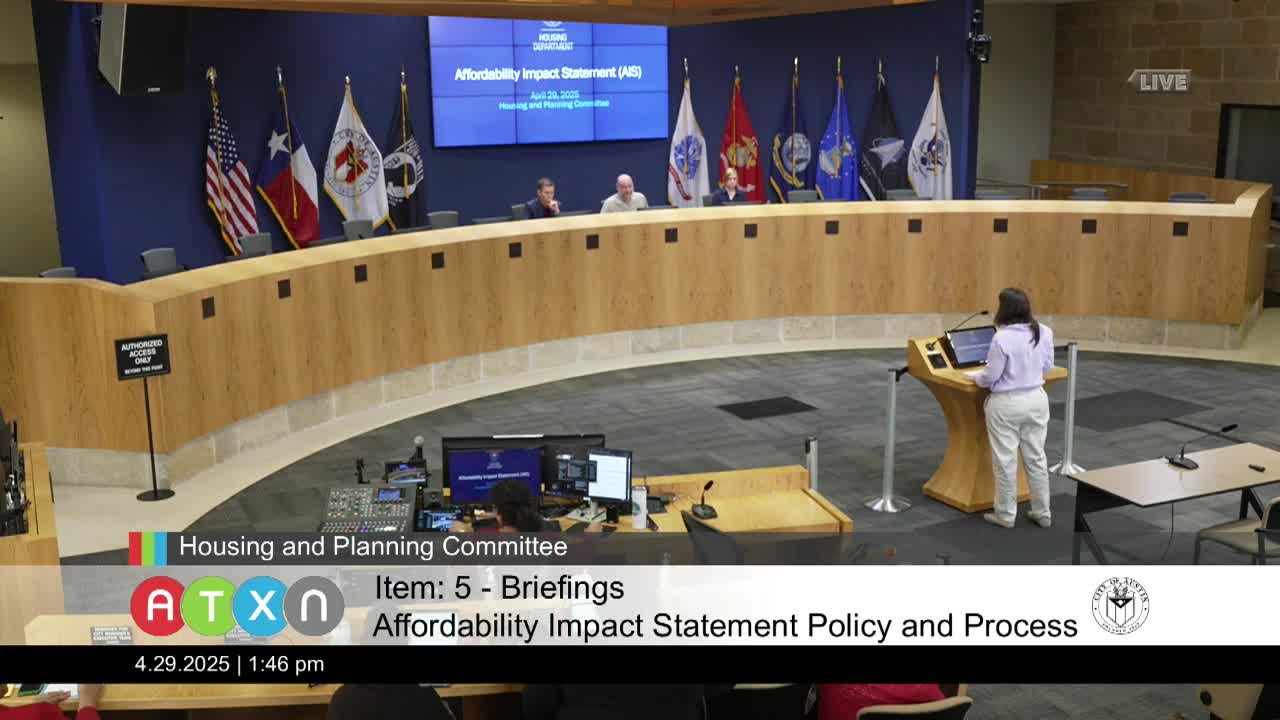
City of Austin housing staff and a representative of the Austin Housing Coalition briefed the Housing and Planning Committee on the city’s Affordability Impact Statement (AIS) process and proposed changes meant to improve public transparency and better capture nonconstruction affordability impacts.
Rachel Tepper, principal planner in the Housing Department, outlined the current AIS process and its origins in the 2007 Smart Housing ordinance. “The AIS is not intended to be about proposing outcomes or proposing solutions. It’s really just to review to see if there is an affordability impact,” Tepper said.
What the AIS does today - Intake and scope: sponsoring departments submit an intake form describing proposed rule or code changes, stakeholder engagement and schedule. - Focus areas: Housing staff review three categories: land use and zoning impacts (supply), development costs and direct effects on affordable housing (including impacts to naturally occurring affordable housing and income‑restricted housing). - Timing and posting: staff aim to complete AIS drafts within two weeks but acknowledged that items with multiple iterations (for example the Wildland-Urban Interface map) can lengthen the process. Historically AISs for rule changes and criteria manuals were available upon request rather than posted publicly.
Recent examples and staff concerns - Tepper described positive AIS outcomes (the equitable TOD amendments), neutral outcomes (2024 International Building Code adoption) and negative AIS findings (International Energy Conservation Code changes and some Wildland-Urban Interface requirements) where costs increased construction expense. - The Housing Department said it has worked with other departments to secure carve-outs in some cases—for example, exemptions for income‑restricted affordable housing on some utility or infrastructure requirements.
Advocate proposal: an AIS scorecard - David Carroll of the Austin Housing Coalition proposed a broader “Affordability Impact Scorecard” that scores policy changes across multiple categories beyond development costs: transit access, anti-displacement measures, policy alignment, equity, housing and community impacts. Carroll said the existing one‑page AIS can miss indirect impacts such as mobility and access to services.
Process improvements discussed - Better enforcement of the AIS requirement for rule changes and criteria-manual updates; tighter coordination with the Technical Advisory Review Panel (TARP) for stakeholder review of criteria manuals; clearer public posting and earlier stakeholder engagement so stakeholders have time to analyze AIS results before hearings. - Staff and advocates both recommended clearer definitions of “affordability” in the ordinance and consideration of whether budget and fee schedule changes should receive AIS review (staff said adding budget review would require significant interdepartmental coordination).
Committee follow-up: council members asked staff to provide the list of seven negative AIS findings from the past five years; Housing Department staff said they would provide that list to the committee.
What’s next: staff and advocates will continue to refine AIS procedures; committee members asked staff for recommendations on whether the ordinance should be updated to reflect current processes and to make AISs more accessible and timely.