Get Full Government Meeting Transcripts, Videos, & Alerts Forever!
Get email alerts on the Resilience topic
No spam. Unsubscribe anytime.
Edmond adopts 2025 Resiliency Action Plan and launches public dashboard
Summary
The city council unanimously adopted the Edmond Resiliency Action Plan 2025 and authorized publication of a public dashboard to track progress across six sectors, from building efficiency to water quality.
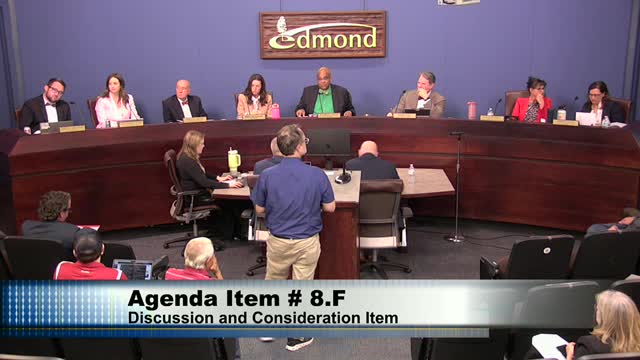
The Edmond City Council voted April 28 to adopt the Edmond Resiliency Action Plan 2025, a five‑year framework of strategies and measurable indicators aimed at improving energy efficiency, air quality, water stewardship, waste reduction, transportation and community resilience.
The plan, prepared by consultants Lotus Engineering and Sustainability with city staff and multiple boards and commissions, groups strategies into three categories — adopt (policy), act (projects) and advocate (regional partnerships). The city also approved a public dashboard designed to present progress metrics, maps and links to partner resources.
Phil Jones, the city’s sustainability planner and ADA coordinator, told the council the plan builds on existing programs, grants and infrastructure work. “We feel the resiliency plan will provide a more operational and coordinated approach in how we plan and track resiliency,” he said during the presentation.
Hillary Dobos, president of Lotus Engineering and Sustainability, said the city brought in roughly $56 million in resiliency‑related grants and that the dashboard is designed for regular updates. “It’s not going to be a normal report,” Dobos said. “It’s going to be a living dashboard that can be updated as often as you want.”
The plan sets a 2030 goal for each sector and attaches metrics to measure progress, including energy‑use intensity for city buildings, tree‑canopy coverage in neighborhoods, number of public EV charging ports, and municipal water conservation indicators. The dashboard will be maintained by city information technology staff and can be updated as data becomes available.
Council members asked how projects would be funded. Jones and Lotus staff said funding options include existing capital improvement funds, federal and state grants, tax increment financing where appropriate, and energy performance contracting for large building retrofits. The city’s planning and sustainability staff will convene focused departmental groups to prioritize near‑term actions.
The council voted to adopt the plan and publish the dashboard. Staff will return with implementation steps and proposed priorities tied to departmental work plans and expected grant opportunities.