Get Full Government Meeting Transcripts, Videos, & Alerts Forever!
Get email alerts on the Housing Land Use topic
No spam. Unsubscribe anytime.
Lake Oswego planning commission reviews 2025 housing and land‑use bills, flags timing and implementation questions
Summary
City planning staff briefed the Lake Oswego Planning Commission on six state bills — including the governor's middle‑housing package (HB 2138) and shot‑clock proposals for building and engineering reviews (SB 6 and SB 974) — highlighting uncertain deadlines, potential code changes and implementation concerns for the city.
The Lake Oswego Planning Commission on May 7 heard a staff briefing on six state housing and land‑use bills that could require changes to city code, affect permitting timelines and alter what types of housing the city must allow.
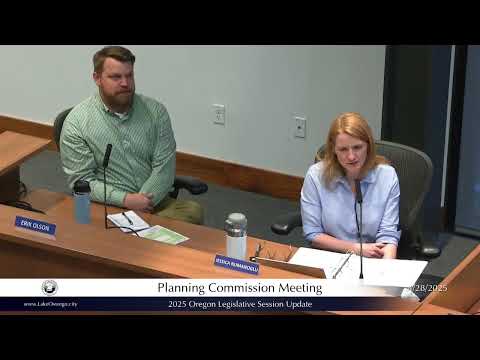
Jessica, staff coordinator for the City of Lake Oswego, told commissioners the presentation was intended to flag potential impacts on the city's upcoming workload and code amendments as the Oregon Legislature moves through its 2025 session. "We're about half a little over halfway through the current legislative session," she said, and noted the long session runs through June 29, 2025.
The presentation focused most heavily on House Bill 2138, the governor's middle‑housing bill. Jessica summarized key provisions that would: change middle‑housing definitions to allow attached or detached units (duplexes, triplexes, quadplexes and cottage clusters); permit middle housing on lots that retain an existing single‑family dwelling (including lots that also have an ADU or existing duplex); limit when cities may require traffic impact analyses for middle housing (with exceptions for townhouse or cottage clusters of more than 12 units); and create bonus units tied to accessibility or affordability that would require cities to allow "commensurate increases" in developable area, floor area, height or density to accommodate the bonus units.
Jessica said the bill directs the Land Conservation and Development Commission (LCDC) to adopt rules to implement several provisions by Jan. 1, 2028, but several implementation dates in the statute appear to require city compliance earlier (the staff team described the timing as unclear). "I cannot tell you when the city has to apply for most of the provisions in this bill," she said. Commissioners raised questions about how "commensurate increases" would be measured and whether the city could limit lot coverage or height to avoid unintended bulk increases.
Other provisions in HB 2138 discussed by staff would: - Invalidate recorded covenants (CC&Rs) or similar instruments that prohibit middle housing on lots that allow single‑family dwellings, with an effective date staff cited of Jan. 1, 2027; - Require cities to allow single‑room occupancies (SROs) in multifamily zones (SROs are defined in the bill as four attached or detached units with private lockable living/sleeping spaces and shared sanitary or food‑prep facilities) and set an allowance of up to three times the zone's maximum density where multifamily zoning allows five or more units; - Require tree removal codes related to housing developments to be clear and objective (staff noted Lake Oswego is beginning a tree code amendment process this summer); and - Allow expedited land division processes for middle housing and require a final decision within 100 days for middle‑housing land divisions that include affordable housing (staff noted the city currently targets expedited review for affordable housing and that the 100‑day requirement reduces an existing 120‑day practice).
Jessica identified other bills the city is tracking: House Bill 3031 (governor's infrastructure financing program for housing infrastructure administered through Business Oregon, staff cited an appropriation figure of approximately $100,000,000 and a minimum density threshold of 17 dwelling units per acre to qualify for certain grants/forgivable loans); HB 2950 (requires LCDC to amend statewide planning Goal 1 — citizen involvement — and requires local updates within one year of LCDC action); HB 3560 and HB 3496 (expand allowable sites for child care facilities and direct LCDC guidance on siting and incentives, with LCDC guidance due by Dec. 31, 2026); Senate Bill 6 (establishes a 45‑business‑day permit review "shot clock" for building permits on middle housing and large subdivisions and requires cities to publish completeness criteria); and Senate Bill 974 (sets a 90‑day final engineering plan review timeline and creates an "urban housing application" deadline regime with potential fee and attorney's‑fee consequences if timelines are missed).
On the permit timing bills, staff described practical concerns: both building and engineering review processes are typically iterative (staff send comments and applicants revise), and defining a single completeness threshold will determine when a statutory clock starts. For SB 6 (building review) Jessica warned that missed deadlines could expose the city to court actions seeking injunctions and to fee awards. For SB 974 (engineering review), staff noted the bill allows applicants to extend timelines with the city (lessening the risk of immediate sanctions) but also establishes monetary consequences if the city fails to meet certain deadlines.
Commissioners pressed staff on practical implementation and community expectations. One commissioner observed that several provisions could produce outcomes different from the middle‑housing expectations previously presented to the public; another asked whether the city could raise fees to fund more staffing to meet new timelines (staff said HB 2138 authorizes reasonable fees tied to actual costs for some items, but most bills are silent on fee authority).
The commission discussed next steps and scheduling: staff said the city's intergovernmental team (led by the city manager's office with participation from engineering, sustainability and other departments) is monitoring bills and coordinating with the League of Oregon Cities, the National League of Cities and regional partners, and that items requiring code amendments will come back to the commission and city council for formal action. Jessica warned the city wants to avoid adopting interim code changes only to rework them later after LCDC rulemaking clarifies state requirements.
Separately, commissioners approved the minutes from the April 14, 2025 meeting by voice vote. The motion to approve the minutes passed with all present voting yes. Chair Mitchell, Vice Chair Norschach, Commissioners Rigby, Fly, Swink and Bruce were recorded as voting in favor; Commissioner Diana Modena was absent.
The meeting adjourned after a brief schedule review; staff noted the May 28 work session will be substantive and include multiple housing production strategy topics, and the May 12 meeting was canceled.
Ending: Staff said they will continue to track bill amendments and LCDC rulemaking and will bring more detailed code‑amendment proposals to the commission and city council as the legislative picture clarifies.