Get Full Government Meeting Transcripts, Videos, & Alerts Forever!
Get email alerts on the Education Finance topic
No spam. Unsubscribe anytime.
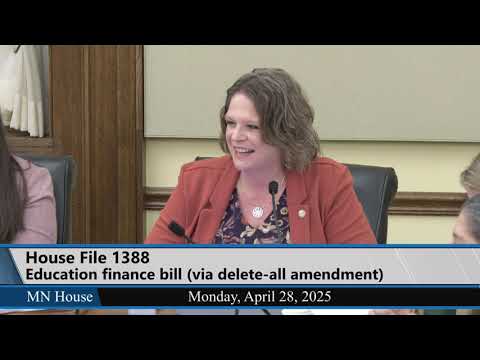
House education finance panel adopts budget compromise; amendment to restore summer UI for hourly school workers fails on 12-12 tie
Summary
The Minnesota House Education Finance Committee advanced a bipartisan education omnibus budget package April 28, adopting a delete‑all (DE) amendment. A roll‑call amendment to preserve unemployment insurance for hourly school workers failed in a 12‑12 tie after extensive public testimony from school support staff, educators and advocates.
ST. PAUL, Minn. — The Minnesota House Education Finance Committee on April 28 reviewed a bipartisan education omnibus budget agreement and adopted a DE (delete‑all) amendment to place the compromise bill before the committee. The panel then considered, but did not approve, a roll‑call amendment to restore summer unemployment insurance (UI) eligibility for hourly school workers; the amendment failed on a 12‑12 tie.
The agreement, discussed at length by committee chairs and nonpartisan staff, would use House File 02/433 as the primary vehicle and House File 13‑88 (delete‑all) to present the committee's compromise. Nonpartisan fiscal staff summarized the package as meeting the committee's budget targets: $40,000,000 in net new general fund commitments in the 2026‑27 biennium and nets to zero in the 2028‑29 tails.
Why it matters: the bill makes a mix of ongoing and one‑time adjustments to K‑12 funding and policy that school districts, charter schools and state education agencies have said will affect staffing, literacy efforts and district operating budgets. Supporters argued the package protects several priorities from prior sessions while creating flexible local dollars; opponents and many public witnesses focused on the decision to sunset UI eligibility for hourly school workers after the summer of 2028.
Key provisions and numbers
- A $40,000,000 package in REED Act funding to be distributed to districts on a per‑pupil basis in the first biennium (the bill text references REED Act implementation and includes $40,000,000 in appropriations).
- Conversion and re‑naming of local optional revenue (LOR) to Basic Supplemental Revenue (BSA), a state aid tier funded at roughly $40 per pupil for fiscal years 2026‑27 and about $42 per pupil thereafter; the bill makes this aid available to charter schools as well as districts.
- Creation of a compensatory revenue task force with interim and final reports due by Sept. 15, 2026; a temporary change letting districts allocate up to 40% of building‑level compensatory revenue away from individual buildings (requiring at least 60% remain at the building site) for fiscal years 2026‑27 only.
- One‑time funding of $30,000,000 to the unemployment account in a special revenue fund to cover UI costs for hourly school workers for summer 2025; the committee's compromise funds summer UI through the 2025 summer term but sunsets the statutory entitlement after the summer of 2028.
- Student support personnel aid (SSPA) is slowed: the per‑pupil allowance is set at $40 for fiscal years 2026‑27 and $42 thereafter (down from a previously higher schedule), and the aid's allowable uses are expanded to include up to $5,000 per year for employee training, job coaching and qualifying travel expenses.
- Special education transportation reimbursement is reduced from 100% of eligible costs to 95% beginning in fiscal year 2026, except for homeless and highly mobile students (those reimbursements remain at 100%).
- Repeal of school library aid beginning in fiscal year 2026, producing multi‑million dollar savings in both biennia; transcript figures cited roughly $45 million in the first biennium and $47 million in the second biennium as state savings.
- Funding of $4,000,000 for Minnesota Department of Education (MDE) litigation costs (MDE had requested $6,000,000).
- Changes to REED/Read Act implementation and timelines: the bill contains multiple sections adjusting definitions, delaying certain deadlines by one year, changing rubrics and requiring the department to assume activities previously performed under an external partnership referenced in the bill (transcript references the end of a partnership and funding reconfiguration for implementation).
What happened in committee
Committee co‑chairs outlined finance and policy tradeoffs before nonpartisan staff walked members through article‑by‑article summaries and spreadsheets that showed line‑by‑line budget effects. After staff presentation, Commissioner Willie Jett of the Minnesota Department of Education testified that the bill preserved many prior investments (including the general education inflation link and Universal Meals) but raised concerns about the decision to sunset unemployment insurance and about operating adjustments for MDE. “While we are appreciative of the inclusion of the compensatory revenue task force … we want to strongly urge the committee to reconsider the decision to remove this essential benefit in the future,” Jett said.
More than two dozen members of the public testified in two‑minute statements. School support staff, bus drivers and paraprofessionals described the practical effect of summer UI on retention and student continuity; a SEIU organizer, parents, and school administrators also spoke. Testimony commonly cited student continuity and staff retention as direct benefits of UI eligibility for hourly school workers. Representative Sensormira offered an A1 amendment to repeal the portion of the compromise that would end UI eligibility after summer 2028; she requested a roll call. Sensormira described the jobs at issue as “mission critical” and urged members to support retention of the benefit.
The committee adopted the DE amendment by voice vote to place the omnibus package before the committee. The subsequent roll‑call to restore summer UI (Representative Sensormira's A1 amendment) failed on a 12‑12 tie; because the vote was tied, the amendment did not prevail.
Votes at a glance
- DE amendment (to present the committee's omnibus): adopted, voice vote (chair moved to adopt and the DE was adopted by voice).
- A1 amendment (Representative Sensormira) — repeal of the provision that sunsets UI eligibility for hourly school workers after summer 2028: roll call requested; result 12 yes, 12 no; amendment failed on a tied vote.
Positions expressed
Supporters of the compromise (committee chairs and several education organizations) said the agreement balances fiscal limits with protections for programs enacted in prior sessions and provides more flexible local aid. Speakers representing nonpublic schools and school associations thanked the committee for preserving nonpublic pupil services funding and other targeted appropriations. Testimony from school support professionals, bus drivers and SEIU/union representatives urged retaining UI to maintain employee continuity, describing examples in which consistent paraprofessionals and bus drivers led to measurable classroom or student well‑being outcomes.
Opponents of removing the UI entitlement described the sunset as an equity concern for largely female, racially diverse hourly workers and said the planned expiration would worsen staffing shortages. Committee chairs and member statements indicated continued disagreement as the package moves to conference; chairs said they expect further negotiation with the Senate and the governor.
What’s next
The chair laid the delete‑all amendment over and indicated the committee will send the bill as the House position into conference. Committee members said they expect additional negotiations with the Senate and the governor on unresolved items including the UI sunset, compensatory revenue treatment and other out‑year funding choices.
Ending note: the committee transcript records detailed line items and multiple witnesses; the roll call on Representative Sensormira's A1 amendment ended in a 12‑12 tie, leaving the omnibus package's UI sunset intact in the committee version.