Get Full Government Meeting Transcripts, Videos, & Alerts Forever!
Get email alerts on the Municipal Budget And Services topic
No spam. Unsubscribe anytime.
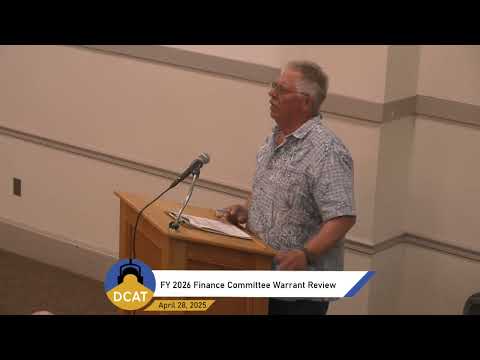
Danvers Finance Committee endorses warrant recommendations on budgets, technology, and transportation; approves several transfers
Summary
The Town of Danvers Finance Committee recommended approval of a range of warrant items at its warrant-review meeting, including budget transfers, IT modernization projects, a second-year appropriation for an on-demand transit pilot and several stabilization fund deposits.
The Town of Danvers Finance Committee reviewed and recommended action on a broad slate of warrant items ranging from budget transfers and state grant acceptance to technology investments and a second-year appropriation for the Salem Skipper on-demand transit pilot.
Budget and special-warrant actions: The committee voted to recommend the transfer of funds to cover a snow-and-ice deficit in DPW operations (a total of $350,000 drawn from free cash and DPW personnel lines) and approved a $30,000 transfer from IT personnel to IT operating to pay for contracted services incurred while a position was vacant. The committee also recommended accepting a pending Chapter 90 (state public works) allocation of approximately $1.2 million, subject to final legislative approval, and instructed staff that if MassDOT funding is reduced the town will revise its paving schedule accordingly.
Technology and IT infrastructure: Colby Cousins, information technology, presented the town’s annual technology plan and several capital items. The committee recommended funding for the municipal technology plan including continued participation in the seven-community regional IT consortium (Middleton, Topsfield, Hamilton, Wenham, Essex, Manchester, Marblehead), which staff said provides bulk purchasing and cybersecurity services at lower cost. On disaster recovery, IT staff proposed moving from an on-premises recovery site (a capital refresh every five years) to a cloud-based subscription model; staff said this will avoid roughly $100,000 of capital expense across a five-year cycle and expected recurring annual costs around $80,000, subject to usage and legacy application transitions. The committee recommended moving forward with the cloud migration and noted that staff will continue to monitor annual pricing.
Phone system consolidation: The committee recommended consolidating seven separate telephone systems — including the schools’ telephone infrastructure — into a single cloud-hosted enterprise phone system. IT told the committee the consolidation will require device replacements for some handsets and will include user training and roll-out during the summer; staff estimated recurring annual phone-bill savings around $50,000 and increased security and vendor support in the cloud model.
Transportation: The committee reviewed a request to appropriate funds for year two of a two-year pilot participation in the Salem Skipper on-demand rideshare program. Aaron Henry summarized usage: Danvers averages roughly 270 rides per week originating or ending in town, the busiest pickup area is the Liberty Tree Mall, and fares are $2 per ride ($1 for seniors). The committee recommended funding the town’s portion of year two while staff and regional partners continue to discuss longer-term funding options, including possible MBTA service restoration. Committee members and staff noted the pilot has shown higher per-week ridership than the MBTA’s discontinued fixed route 465 (which averaged 16 riders per day when last in service).
Veterans’ exemptions and tax articles: The Finance Committee recommended voter approval of warrant articles implementing two exemptions added or expanded under the state-level HERO Act. One article allows routine CPI-based increases to certain veteran exemptions; the other permits the town to grant an additional local match (up to 100% of the state exemption) to qualifying veterans, with the town covering the additional amount from local overlay funds.
Stabilization, OPEB and special-education reserves: The committee recommended appropriations to several stabilization and reserve funds. Recommendations included a $500,000 deposit to the special education stabilization fund (bringing the fund closer to a target that provides a cushion for unpredictable tuition costs), $1,000,000 to the town general stabilization (rainy-day) fund, and a $5,000,000 transfer to the debt stabilization fund that includes excess proceeds from the town landfill project. The committee also recommended a $300,000 free-cash appropriation to the OPEB (retiree health) trust; staff reported the trust’s projected balance would be roughly $18.5 million after the recommended appropriation and expected investment returns based on current assumptions.
What the committee emphasized: Committee members repeatedly encouraged continued, broad-based community engagement and suggested a dedicated study or steering committee (a “balanced growth” group) as a constructive forum to weigh housing, parking and downtown vitality goals alongside resident concerns. Multiple members said citizen petitions are an important tool but that detailed planning changes and targeted bylaw language are preferable to blanket repeals.
Votes at a glance (major warrant recommendations): - Special town meeting: unpaid bills — no action recommended (no unpaid bills at present). - Special town meeting: budget transfers (DPW snow & ice, IT operating, HR personnel) — recommended approval. - Special town meeting: Chapter 90 state public works grant (~$1.2M) — recommended acceptance, subject to final state appropriation. - Annual town meeting: Town electric division self-support authorization — recommended approval (one abstention recorded by a committee member who serves on the municipal light board). - Article 7 (Technology plan) — recommended approval; Article 8 (disaster recovery, cloud migration) — recommended approval. - Article 9 (phone system consolidation) — recommended approval. - Article 25 (Salem Skipper year-two appropriation) — recommended approval. - Articles 29–30 (HERO Act veterans exemptions) — recommended approval (Article 30 with a recommended local match up to 100%). - Articles on stabilization funds (special education, general stabilization, debt stabilization) and OPEB trust — recommended approval as presented.
Why it matters: The committee’s recommendations bundle several operational and capital priorities that affect town services, resiliency and budgets. Approvals will allow IT to modernize and reduce future capital refresh costs, insure continuity of transit options while regional funding is clarified, and strengthen town financial cushions for special education, debt service and retiree obligations.