Get Full Government Meeting Transcripts, Videos, & Alerts Forever!
Get email alerts on the Zoning Mbta topic
No spam. Unsubscribe anytime.
Danvers Finance Committee recommends no action on three citizen petitions targeting MBTA zoning
Summary
After lengthy public comment and debate, the Finance Committee voted to recommend no action on three citizen petitions that sought to rescind or prompt changes to MBTA-related zoning adopted by the town in recent years.
The Town of Danvers Finance Committee voted to recommend no action on three citizen petitions that sought to rescind or prompt changes to zoning adopted to comply with the MBTA Communities Act.
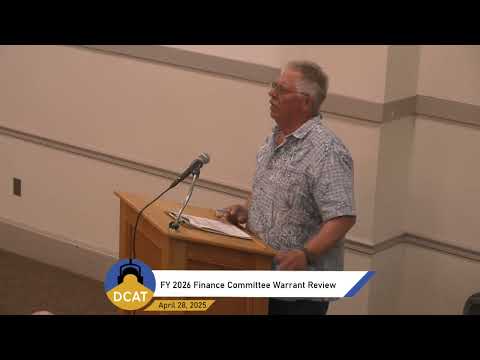
The petitions — filed as warrant articles 36, 37 and 38 — were presented to the committee by petitioner Jim Moroz and others. Moroz asked the committee to direct the town to prepare articles to repeal zoning changes tied to the MBTA mandate, saying the measures “seek to return our community to the traditional zoning and character of our town” and arguing the state-driven rules produced “increased density with decreased parking.” He told the committee the petitions represent residents’ concerns that the changes do not “fit the character” of Danvers and warned that higher density and lower parking could be “a recipe for disaster.”
Planning and legal constraints were central to the committee’s discussion. Aaron Blake, the town’s land use and community services director, described the town’s history with the MBTA Communities Act and state regulations: the town’s downtown mixed-use zoning was developed as the legislature worked on the MBTA Communities Act, and after state regulations were issued the town made “minor adjustments” at a prior town meeting to meet the regulations’ minimum density and parking criteria. Blake also noted the state Department of Housing and Community Development (now the Executive Office of Housing and Livable Communities) issued regulations that were the subject of judicial review before they were procedurally corrected.
Committee members and longtime residents questioned the petitions’ legal effect and potential unintended consequences. Several committee speakers argued the town lacks authority to unilaterally overturn zoning required by state law and warned that repealing the MBTA-related zoning could leave the town with no zoning for affected parcels. One member said simply repealing zoning “could potentially have no zoning in place,” and the planning director cautioned that rescinding adopted zoning could create “an unzoned” situation where “anything goes.”
Other speakers urged local action. Supporters of the petitions said they reflect widespread resident concern about density, parking, and preserving what they described as Danvers’ suburban character. Town meeting members and residents who spoke at the public comment portion were split: some said the MBTA zoning helps create housing supply and walkable downtown activity and described the change as positive, while others urged more local control or state-level challenges.
After public comment and discussion with staff and counsel, the committee considered motions on the petitions. For each petition the committee moved and voted to recommend no action; the committee chair called the voice votes and recorded “Aye” from the committee each time.
Why it matters: The MBTA Communities Act and related state regulations have prompted many Massachusetts communities to amend local zoning to allow higher residential density near transit. Danvers town officials, planners and residents debated whether the local zoning adjustments struck a correct balance between housing supply and preserving neighborhood character, but town staff and committee members stressed that options to fully rescind compliant zoning are constrained by state regulation and by opinion of state officials and courts.
The Finance Committee’s no-action recommendation will be forwarded to town meeting along with the committee’s meeting record and staff comments. Town meeting members and residents remain divided and several speakers urged more study or state-level advocacy rather than local repeal.