Get Full Government Meeting Transcripts, Videos, & Alerts Forever!
Get email alerts on the Open Meetings And Conflict Rules topic
No spam. Unsubscribe anytime.
Santa Rosa training reviews Brown Act, conflict rules and meeting procedures
Summary
City attorneys led a boards-and-commissions orientation in Santa Rosa covering the Brown Act, teleconferencing rules under AB 2449, Rosenberg's Rules of Order, conflict-of-interest laws including the Political Reform Act and Government Code 1090, and Form 700 filing requirements.
At a boards-and-commissions orientation hosted by the City of Santa Rosa, city attorneys and staff reviewed state open-meeting law, conflict-of-interest rules, meeting procedures and practical guidance for board members and commissioners.
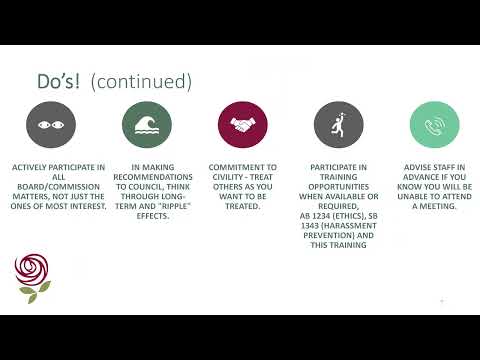
The training foregrounded the Brown Act’s notice and open-meeting requirements and explained teleconferencing options, the newer AB 2449 “just cause” and emergency provisions for remote participation, and the city’s expectations for civility and conduct. Teresa Stricker, Santa Rosa city attorney, and a city presenter identified as Dina reviewed procedural rules (Rosenberg’s Rules of Order), thresholds for recusal, and the city’s Form 700 filing obligations.
Why this matters: Boards and commissions make recommendations and decisions that affect city policy and permitting. Presenters said compliance errors can lead to undone decisions, legal fees and, in rare cases of willful violations, criminal penalties.
The Brown Act and meeting notices Dina, a city presenter, summarized the Brown Act as “transparency,” saying it requires that most meetings of a legislative body be open and that agendas be posted in advance. Presenters reiterated the standard notice windows: 72 hours for regular meetings and 24 hours for special meetings. Agendas must include a brief description of each item (including closed-session items), a physical location accessible to the public, and be posted in alternative formats on request. Supplemental materials distributed after the initial posting must be made public when provided to the body.
Teleconferencing and AB 2449 The presenters explained three teleconferencing paths: (1) traditional Brown Act teleconferencing, which requires a posted remote address and a public-accessible remote location; (2) AB 2449 “just cause” participation (for childcare, caregiving, disability, contagious illness or travel for official business) and (3) AB 2449 emergency provisions. Under AB 2449, a quorum must be physically present at a location within the city, members participating remotely must keep audio and video on for the entire meeting, and the member must disclose whether any adults are present in the remote room and their relationship. The presenters said AB 2449 remote participation can be used only twice a year for just cause and up to five times a year if the body meets twice per month or more, and noted that when AB 2449 is used the city must provide remote public comment for the entire meeting. They also cautioned that if the agenda states Zoom or another remote option will be available for public comment and that feed fails, the body should recess to try to restore the connection or adjourn if it cannot be restored promptly.
Rosenberg’s Rules of Order, quorum and motions The training walked through Rosenberg’s Rules as the city’s guide for day-to-day meeting procedure when no other law or bylaw applies. Presenters explained quorum basics (more than half the body unless another rule applies) and used the planning commission as an example where 4 of 7 members form a quorum. They outlined common motions (main motion, amend, substitute, continue), explained that a motion to limit debate ("call the question") is a formal motion requiring a two-thirds vote, and described Rosenberg’s procedural limit of three motions on the table at once (last in, first out). The presenters reminded members that a recusal (for a legal or arguable conflict) requires disclosure and leaving the dais/room, whereas an abstention is a voluntary choice not to vote.
Conflict of interest, Government Code 1090, Political Reform Act and Form 700 Teresa Stricker reviewed conflict rules and the role of Form 700 disclosures. She framed three overlapping legal buckets: the Political Reform Act (FPPC rules on financial interests and recusal), Government Code section 1090 (contracts), and the common-law disqualification doctrine (bias or significant nonfinancial personal interest). Key thresholds cited in the training included: an investment or real property interest of $2,000 or more, sources of income of $500 or more in the 12 months before a decision, and the gift threshold (adjusted biennially) which the presenters gave as $630 for the current reporting cycle. For real property, FPPC guidance presumes a material financial effect if a project is within 500 feet of the official’s property and presumes no material effect at 1,000 feet; the 500–1,000-foot range requires a fact-specific analysis.
On procedure when a conflict exists, speakers said an official must publicly identify the financial interest, recuse from participation and attempts to influence the decision, and typically leave the dais and the room (with a narrow consent-calendar exception). For potential contract conflicts under Government Code section 1090, presenters said the analysis differs and can in some cases prohibit a contract entirely or require additional steps; staff legal advice is needed on those items. The presenters emphasized that Form 700 disclosure is a public-record reporting requirement but does not by itself resolve whether a disqualifying conflict exists—conflict analysis is separate and fact-specific. The presenters also explained Form 700 filing cadence: assuming-office, annual (due April 1), and leaving-office statements, and noted penalties for late Form 700 filings including fines (up to $100 for late filers), referral to FPPC enforcement and potential removal from a board.
Public comment, disruptions and practical guidance Presenters reviewed public-comment rules: the body must allow public comment on agendized items (and typically sets time limits), but board members should not engage in a back-and-forth with commenters because it can create Brown Act risks and lengthen the meeting. A disruption was defined as conduct that prevents the meeting from proceeding (not merely loud or vigorous speech); chairs may warn and remove disruptive speakers after a warning. The presenters advised chairs that they may take recesses to reset a meeting, may regulate time limits (examples included 3 minutes per speaker or reducing to 2 minutes when high volume is anticipated), and may reorder agendas at their discretion subject to Rosenberg’s and applicable rules.
Where to find materials and follow-up Presenters said the slide deck and the recorded training will be posted online (srcity.org) later in the week or the following week, and staff and the city attorney’s office offered to answer follow-up questions. Teresa Stricker reiterated the recommendation to consult the staff liaison or the city attorney’s office in advance on questions about conflicts or procedural uncertainties.