Get Full Government Meeting Transcripts, Videos, & Alerts Forever!
Get email alerts on the Elections topic
No spam. Unsubscribe anytime.
Cranston elections official warns SAVE Act and presidential order could cut federal election funding and complicate voter registration
Summary
Nick Lima, Cranston’s registrar and director of elections, told the City Council the president’s recent executive order and the federal SAVE Act could jeopardize HAVA funding, require documentary proof of citizenship for many registrants and create operational and legal burdens for local election offices.
Nick Lima, Registrar and Director of Elections for the City of Cranston, told the City Council on April 28 that a recent presidential executive order and the federal SAVE Act would, if upheld, threaten federal funding for elections and could make voter registration and ballot access more difficult for many residents.
Lima said the order would require documentary proof of citizenship — for example, a passport or certified birth certificate — on federal voter registration forms and tie future federal funding to state compliance. “The passport requirement is new and that's concerning because over half of Americans don't have a passport,” Lima said, and warned the change could disenfranchise overseas and military voters who use the federal postcard application process.
The registrar summarized three separate but related threats: the executive order; the SAVE Act (pending in Congress); and reductions in federal election-security support. He emphasized the Help America Vote Act (HAVA) and the role of the U.S. Election Assistance Commission (EAC) in setting voluntary voting system guidelines and distributing federal funding. “Rhode Island has received over $22 million in HAVA funding” since 2004, Lima said; Cranston alone has received more than $115,000 since 2019, he added.
Why it matters: federal funding and voluntary standards enable municipalities to buy certified voting equipment and to maintain security and training. Lima said the executive order seeks changes to voluntary voting system guidelines on a timeline he called infeasible and that, if implemented, could render some currently used systems noncompliant before replacements are available. He described the executive order’s documentary-proof requirement as effectively a “show your papers” mandate that could require in‑person document presentation and increase the administrative burden on local offices.
Lima also described the SAVE Act — which passed the U.S. House and is pending in the Senate — as a broader statutory change that would require documentary proof of citizenship for every new registration and for many subsequent registration updates. He told the council that the Board of Canvassers voted unanimously, 3–0, on March 19 to oppose the SAVE Act as drafted, and estimated the city would need two to three additional full‑time staff to comply if the law were enacted as currently written.
On election security, Lima said federal partners that previously provided intelligence, cybersecurity coordination, training and information sharing have been defunded or reassigned, reducing federal support available to local jurisdictions. He described concrete local upgrades that used HAVA funds — improved scanners, network changes, staff training and obtaining a .gov domain — and warned that future investments could be jeopardized if federal funding were withheld.
Council President Marino and Council Vice President Wall thanked Lima for the presentation. Lima said the matter is likely to see extended litigation and could reach the U.S. Supreme Court; he urged councils and officials to track developments and to use committee processes to gather facts where public reporting raises questions.
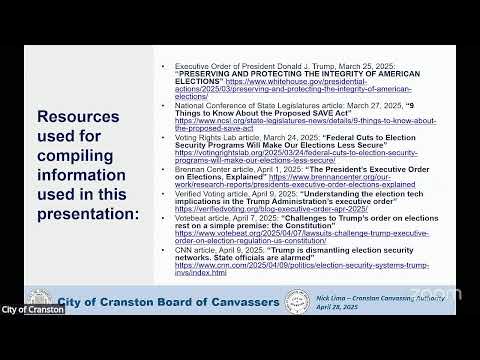
Ending: The city council heard the presentation and asked questions; no city action was taken at the April 28 meeting. Lima said Cranston will hold a tabletop exercise in June with police, fire and IT to plan for security scenarios and recommended council members review the meeting materials and federal reporting he included in the agenda packet.